


Noncoding RNA, friend or foe for nephrolithiasis?
- PMID: 39633711
- PMCID: PMC11614778
- DOI: 10.3389/fcell.2024.1457319
Noncoding RNA, friend or foe for nephrolithiasis?
Abstract
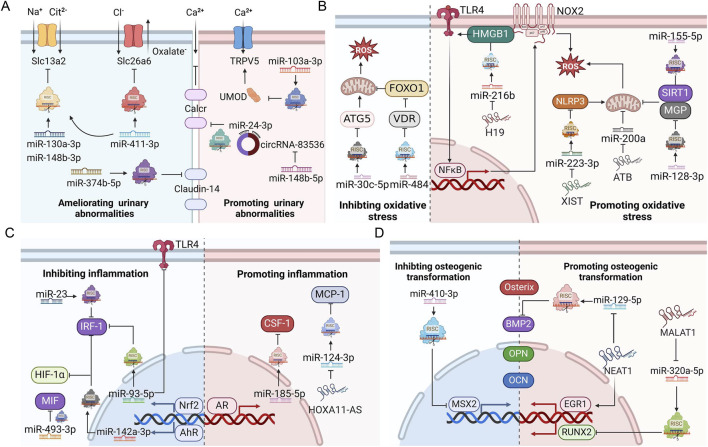
Nephrolithiasis is one of the most common diseases in urology, characterized by notable incidence and recurrence rates, leading to significant morbidity and financial burden. Despite its prevalence, the precise mechanisms underlying stone formation remain incompletely understood, thus hindering significant advancements in kidney stone management over the past three decades. Investigating the pivotal biological molecules that govern stone formation has consistently been a challenging and high-priority task. A significant portion of mammalian genomes are transcribed into noncoding RNAs (ncRNAs), which have the ability to modulate gene expression and disease progression. They are thus emerging as a novel target class for diagnostics and pharmaceutical exploration. In recent years, the role of ncRNAs in stone formation has attracted burgeoning attention. They have been found to influence stone formation by regulating ion transportation, oxidative stress injury, inflammation, osteoblastic transformation, autophagy, and pyroptosis. These findings contributes new perspectives on the pathogenesis of nephrolithiasis. To enhance our understanding of the diagnostic and therapeutic potential of nephrolithiasis-associated ncRNAs, we summarized the expression profiles, biological functions, and clinical significance of these ncRNAs in the current review.
Keywords: biomarkers; calcium oxalate; ncRNAs; nephrolithiasis; therapeutic targets.
Copyright © 2024 Wang, Yang, Chen, Yang and Jiang.
Conflict of interest statement
The authors declare that the research was conducted in the absence of any commercial or financial relationships that could be construed as a potential conflict of interest.
Figures


References
Publication types
LinkOut - more resources
Full Text Sources
Miscellaneous
