


Association between polyunsaturated fatty acid intake and estradiol levels among U.S. women
- PMID: 39634551
- PMCID: PMC11616495
- DOI: 10.3389/fnut.2024.1500705
Association between polyunsaturated fatty acid intake and estradiol levels among U.S. women
Abstract
Background: Polyunsaturated fatty acids (PUFAs) play a crucial role in maintaining homeostasis in the body. However, research on the relationship between PUFA intake and estradiol levels is limited. This study aims to investigate the association between dietary PUFA intake and estradiol levels in women in the United States.
Method: Data on PUFA intake and estradiol levels were drawn from the 2013-2016 National Health and Nutrition Examination Survey (NHANES) for women aged 20 and older. UFA intake was assessed through 24-h dietary interviews, while serum estradiol levels were measured using isotope dilution liquid chromatography-tandem mass spectrometry (ID-LC-MS/MS). Weighted logistic regression models adjusted for covariates were used to analyze the relationship between PUFA intake and estradiol levels. The inflection point of the non-linear relationship between intake of PUFAs and estradiol levels was determined by threshold effects analysis, and a two-part regression model was developed at the inflection point.
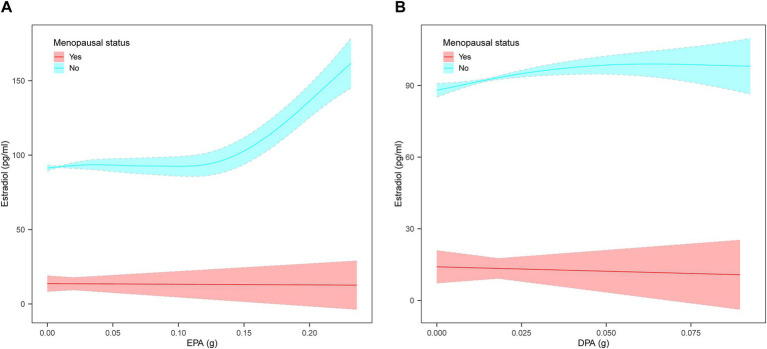
Result: Weighted multivariate linear regressions showed positive associations between eicosapentaenoic acid (EPA) and docosapentaenoic acid (DPA) intake and estradiol levels. Even in the fully adjusted model, EPA intake remained positively associated with estradiol levels in the menopausal (β = 78.08, 95% CI: 33.58, 122.58; p = 0.0006), non-menopausal (β = 287.61, 95% CI: 177.29, 397.94; p < 0.0001), and total-participant groups (β = 208.38, 95% CI: 139.81, 276.95; p < 0.0001), and DPA intake remained positively associated with estradiol levels in the non-menopausal (β = 318.87, 95% CI: 28.93, 608.82; p = 0.0313) and total-participant groups (β = 208.03, 95% CI: 22.89, 393.18; p = 0.0277). In the two-part regression model, EPA intake greater than 0.09 (p < 0.0001) and DPA intake greater than 0.05 (p = 0.0033) were positively associated with estradiol levels in non-menopausal women.
Conclusion: This study suggests that higher intake of EPA and DPA in non-menopausal women is associated with increased estradiol levels. These findings support the importance of dietary components in regulating female reproductive health and hormone levels.
Keywords: NHANES; docosapentaenoic acid; eicosapentaenoic acid; estradiol; polyunsaturated fatty acids.
Copyright © 2024 Guo, Nan, Liang, Yao and Li.
Conflict of interest statement
The authors declare that the research was conducted in the absence of any commercial or financial relationships that could be construed as a potential conflict of interest.
Figures
References
LinkOut - more resources
Full Text Sources
Research Materials
