


Comparison of volumetric brain analysis in subjects with rheumatoid arthritis and ulcerative colitis
- PMID: 39635596
- PMCID: PMC11614619
- DOI: 10.3389/fmed.2024.1468910
Comparison of volumetric brain analysis in subjects with rheumatoid arthritis and ulcerative colitis
Abstract
Background: Rheumatoid arthritis (RA) and ulcerative colitis (UC) are two autoimmune diseases where patients report high levels of fatigue, pain, and depression. The effect of systemic inflammation from these diseases is likely affecting the brain, however, it is unknown whether there are measurable neuroanatomical changes and whether these are a contributing factor to these central symptoms.
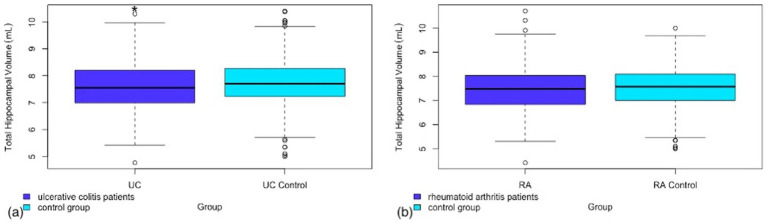
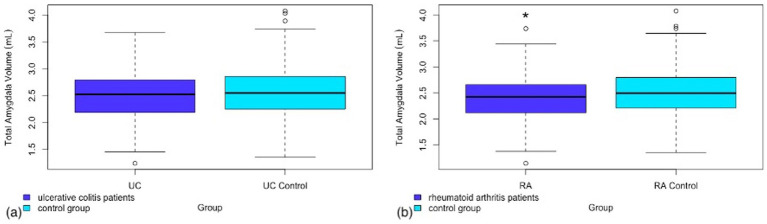
Methods: We included 258 RA patients with 774 age and sex matched controls and 249 UC patients with 747 age and sex matched controls in a case control study utilizing the UK Biobank dataset. We used imaging derived phenotypes (IDPs) to determine whether there were differences in (1) hippocampal volume and (2) additional subcortical brain volumes between patients compared to controls and if there were common regions affected between these two diseases.
Results: Patients with UC had moderately smaller hippocampi compared to age and sex matched controls (difference: 134.15 mm3, SD ± 64.76, p = 0.035). This result was not seen in RA patients. RA patients had a significantly smaller amygdala volume than age and sex matched controls (difference: 91.27 mm3, SD ± 30.85, p = 0.0021, adjusted p = 0.012). This result was not seen in UC patients. All other subcortical structures analyzed were comparable between the patients and control groups.
Conclusion: These results indicate there are subcortical brain differences between UC, RA and controls but different regions of the limbic system are preferentially affected by UC and RA. This study may provide evidence for different neurodegenerative mechanisms in distinct autoimmune diseases.
Keywords: autoimmune diseases; brain volumetry; magnetic resonance imaging; rheumatoid arthritis; systemic inflammation; ulcerative colitis.
Copyright © 2024 Cox, de Groot, Kempton, Williams and Cole.
Conflict of interest statement
Jennifer Cox is an industry funded PhD student funded by GlaxoSmithKline and an employee of Johnson & Johnson. GSK and Johnson & Johnson had no role in the design or conduct of the study. Marius de Groot is a former employee of, and holds shares in GlaxoSmithKline (GSK). GSK had no role in the design or conduct of the study. Kempton was funded by an MRC Career Development Fellowship (grant MR/J008915/1). Williams has received research funding from Bionomics, Eli Lilly, the Engineering and Physical Sciences Research Council, GlaxoSmithKline, Johnson & Johnson, Lundbeck, the National Institute of Health Research, Pfizer, Takeda, and Wellcome Trust. Marius de Groot was employed by the Groover Consulting. The remaining author declares that the research was conducted in the absence of any commercial or financial relationships that could be construed as a potential conflict of interest.
Figures
References
-
- Richardson J, Nelson L, Curry A, Ralston S. The increasing global incidence of ulcerative colitis; implications for the economic burden of ulcerative colitis. Value Health. (2018) 21:S82. doi: 10.1016/j.jval.2018.04.556 - DOI
LinkOut - more resources
Full Text Sources
