Combination of Enamel Matrix Derivatives with Bone Graft vs Bone Graft Alone in the Treatment of Periodontal Intrabony and Furcation Defects: A Systematic Review and Meta-Analysis
- PMID: 39636103
- PMCID: PMC12093055
- DOI: 10.3290/j.ohpd.b5871494
Combination of Enamel Matrix Derivatives with Bone Graft vs Bone Graft Alone in the Treatment of Periodontal Intrabony and Furcation Defects: A Systematic Review and Meta-Analysis
Abstract
Purpose: To compare the clinical performance of the combination of enamel matrix derivatives and bone substitutes (EMD+BG) with bone substitutes (BG) alone in the surgical treatment of periodontal intrabony and furcation defects.
Materials and methods: Electronic databases (Medline, Embase and Web of Science) were searched for randomised controlled trials in humans that investigated the combination of EMD+BG vs BG alone in either intrabony or furcation defects with a minimal follow-up of 6 months. A random-effect meta-analysis was conducted according to the type of defect (intrabony or furcation defects) and the follow-up time (6 or ≥ 12 months).
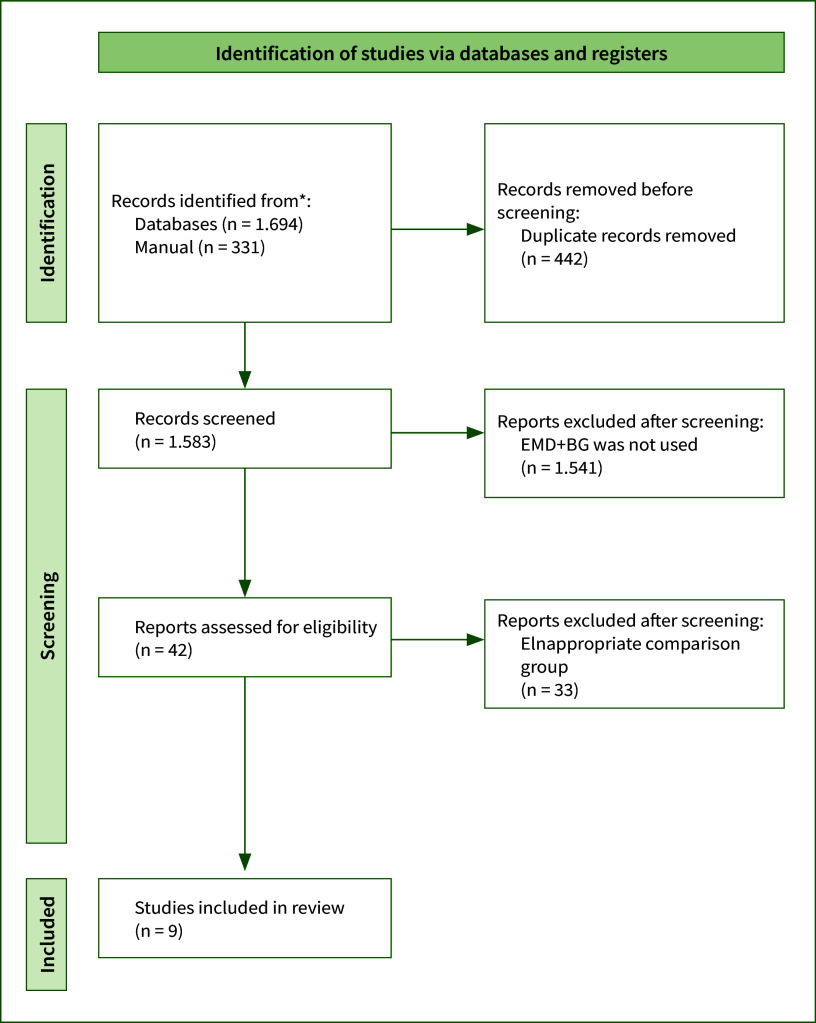
Results: From a total of 1583 entries, 9 randomised controlled clinical trials (RCTs) were retrieved and included in the qualitative and quantitative synthesis. All of them were included in the meta-analysis. The meta-analysis detected an additional clinical attachment level (CAL) gain in intrabony defects treated with EMD+BG compared to BG alone in studies with ≥ 12-month follow-up (mean difference = 0.67 mm, 95% CI [0.44 ; 0.90], p 0.00001). No additional benefit was found in furcation defects in terms of CAL gain or probing depth (PD) reduction.
Conclusion: The addition of EMD may improve the clinical outcomes of intrabony defects treated with bone substitutes. These findings may support the use of this combined therapy, particularly in large and non-contained defects.
Keywords: bone substitutes; enamel matrix derivatives; furcation defects; intrabony defects; periodontal regeneration.
Figures


References
-
- Aspriello SD, Ferrante L, Rubini C, Piemontese M. Comparative study of DFDBA in combination with enamel matrix derivative versus DFDBA alone for treatment of periodontal intrabony defects at 12 months post-surgery. Clin Oral Investig. 2011;15(2):225–232. - PubMed
-
- Barbato L, Selvaggi F, Kalemaj Z, Buti J, Bendinelli E, Marca M, et al. Clinical efficacy of minimally invasive surgical (MIS) and non-surgical (MINST) treatments of periodontal intra-bony defect. A systematic review and network meta-analysis of RCTs. Clin Oral Investig. 2020;24(3):1125–1135. - PubMed
-
- Cortellini P, Pini-Prato G, Nieri M, Tonetti MS. Minimally invasive surgical technique and enamel matrix derivative in intrabony defects: 2. Factors associated with healing outcomes. Int J Periodontics Restorative Dent. 2009;29(3):257–265. - PubMed
-
- Dias AT, de Menezes CC, Kahn S, Fischer RG, da Silva Figueredo CM, Fernandes GV de O. Gingival recession treatment with enamel matrix derivative associated with coronally advanced flap and subepithelial connective tissue graft: a split-mouth randomized controlled clinical trial with molecular evaluation. Clin Oral Investig. 2022;26(2):1453–1463. - PubMed
Publication types
MeSH terms
Substances
LinkOut - more resources
Full Text Sources
Medical