Psilocybin Therapy for Clinicians With Symptoms of Depression From Frontline Care During the COVID-19 Pandemic: A Randomized Clinical Trial
- PMID: 39636638
- PMCID: PMC11621983
- DOI: 10.1001/jamanetworkopen.2024.49026
Psilocybin Therapy for Clinicians With Symptoms of Depression From Frontline Care During the COVID-19 Pandemic: A Randomized Clinical Trial
Erratum in
-
Error in the Byline.JAMA Netw Open. 2025 Jan 2;8(1):e2459278. doi: 10.1001/jamanetworkopen.2024.59278. JAMA Netw Open. 2025. PMID: 39804652 Free PMC article. No abstract available.
-
Errors in the Author Affiliations.JAMA Netw Open. 2025 Jul 1;8(7):e2525303. doi: 10.1001/jamanetworkopen.2025.25303. JAMA Netw Open. 2025. PMID: 40638123 Free PMC article. No abstract available.
Abstract
Importance: The psychological morbidity experienced by physicians, advanced practice practitioners (APPs), and nurses from working during the COVID-19 pandemic includes burnout, depression, and posttraumatic stress disorder (PTSD).
Objective: To investigate whether psilocybin therapy could improve symptoms of depression, burnout, and PTSD in US clinicians who developed these symptoms from frontline clinical work during the pandemic.
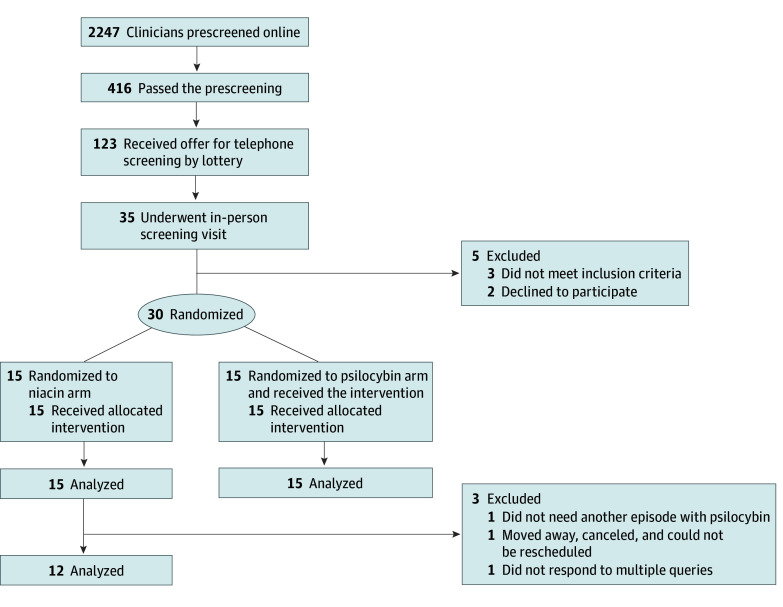
Design, setting, and participants: This double-blind randomized clinical trial enrolled participants from February to December 2022. Participants included physicians, APPs, and nurses who provided frontline care for more than 1 month during the pandemic and had no prepandemic mental health diagnoses but had moderate or severe symptoms of depression at enrollment. Participants were randomly assigned to either the psilocybin or niacin arm. Data analysis was conducted between December 2023 and May 2024 and was based on the intention-to-treat principle.
Intervention: One intervention episode consisted of 2 preparation visits, 1 medication session, and 3 integration visits. At the medication session, participants received psilocybin, 25 mg, or niacin, 100 mg, orally.
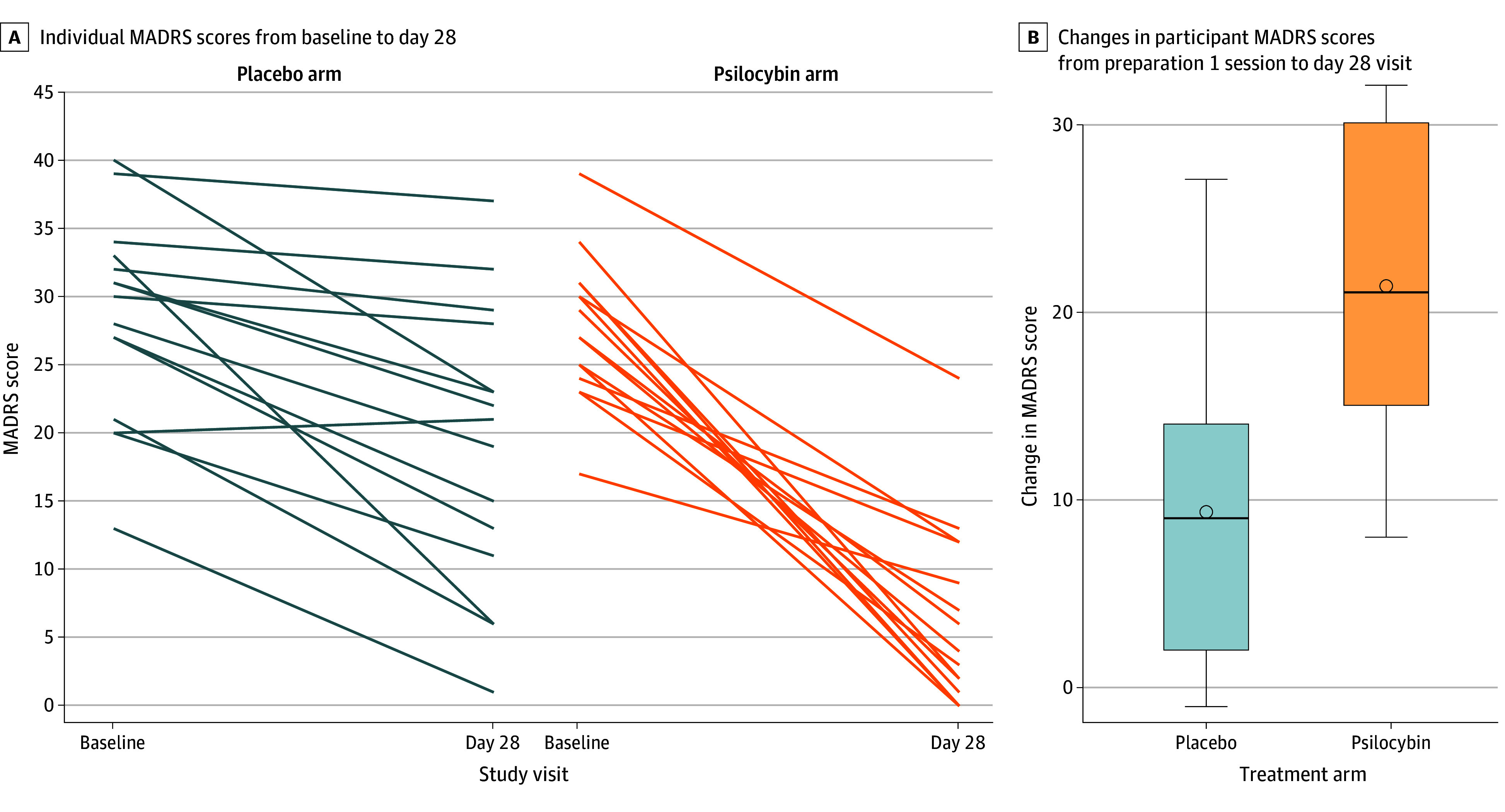
Main outcome and measures: The primary outcome was a change from baseline (preparation 1 session) to day 28 (after medication administration) in symptoms of depression as measured by the clinician-administered Montgomery-Asberg Depression Rating Scale (MADRS) used by blinded raters. The secondary outcomes were a change in symptoms of burnout (measured with the Stanford Professional Fulfillment Index [SPFI]) and symptoms of PTSD (measured with the Posttraumatic Stress Disorder Checklist for Diagnostic and Statistical Manual of Mental Disorders, Fifth Edition [PCL-5]).
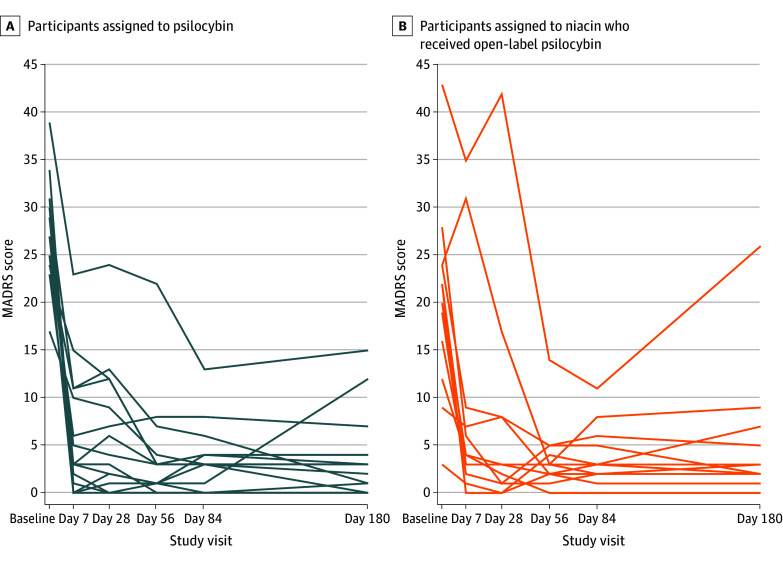
Results: A total of 30 clinicians (15 females [50%]; mean [range] age, 38 [29-60] years) participated, of whom 15 were randomly assigned to receive psilocybin and 15 to receive niacin. The mean change in symptoms of depression (MADRS scores) from preparation 1 session to day 28 was -21.33 (7.84) in the psilocybin arm compared with -9.33 (7.32) in the niacin arm, with a mean difference between arms of -12.00 (95% CI, -17.67 to -6.33; P < .001), a decrease in MADRS scores indicating improvement. The mean change in SPFI scores from preparation 1 session to day 28 showed a numerically larger improvement in symptoms of burnout in the psilocybin compared with the niacin arm (-6.40 [5.00] vs -2.33 [5.97]; P = .05) but was not statistically significant. Since the SPFI score change did not reach statistical significance, the PCL-5 score change was evaluated descriptively. The mean change in PCL-5 scores showed a numerically larger decrease in symptoms of PTSD from preparation 1 session to day 28 in the psilocybin vs the niacin arm (-16.67 [15.04] vs -6.73 [10.69]), but this difference was not statistically tested.
Conclusions and relevance: This randomized clinical trial found that psilocybin therapy resulted in a significant, sustained reduction in symptoms of depression experienced by clinicians after frontline work during the COVID-19 pandemic. The findings establish psilocybin therapy as a new paradigm of treatment for this postpandemic condition.
Trial registration: ClinicalTrials.gov Identifier: NCT05163496.
Conflict of interest statement
Figures
References
-
- Ouyang H. I’m an E.R. doctor in New York. None of us will ever be the same. The New York Times. April 14, 2020. Accessed October 24, 2024. https://www.nytimes.com/2020/04/14/magazine/coronavirus-er-doctor-diary-...
Publication types
MeSH terms
Substances
Associated data
Grants and funding
LinkOut - more resources
Full Text Sources
Medical