


Gene expression signatures between Limia perugiae (Poeciliidae) populations from freshwater and hypersaline habitats, with comparisons to other teleosts
- PMID: 39637050
- PMCID: PMC11620662
- DOI: 10.1371/journal.pone.0315014
Gene expression signatures between Limia perugiae (Poeciliidae) populations from freshwater and hypersaline habitats, with comparisons to other teleosts
Abstract
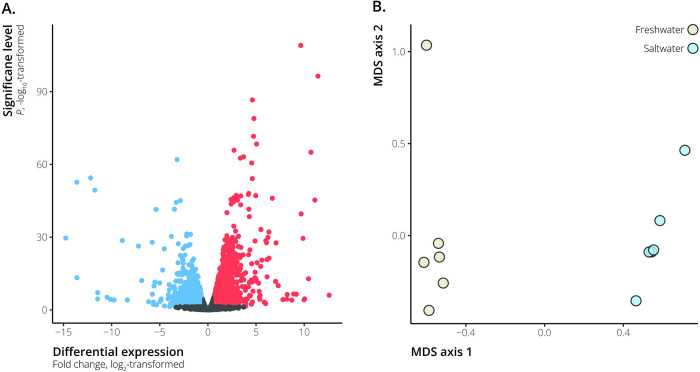
Salinity gradients act as strong environmental barriers that limit the distribution of aquatic organisms. Changes in gene expression associated with transitions between freshwater and saltwater environments can provide insights into organismal responses to variation in salinity. We used RNA-sequencing (RNA-seq) to investigate genome-wide variation in gene expression between a hypersaline population and a freshwater population of the livebearing fish species Limia perugiae (Poeciliidae). Our analyses of gill gene expression revealed potential molecular mechanisms underlying salinity tolerance in this species, including the enrichment of genes involved in ion transport, maintenance of chemical homeostasis, and cell signaling in the hypersaline population. We also found differences in gene expression patterns associated with cell-cycle and protein-folding processes between the hypersaline and freshwater L. perugiae. Bidirectional freshwater-saltwater transitions have occurred repeatedly during the diversification of fishes, allowing for broad-scale examination of repeatable patterns in evolution. Therefore, we compared transcriptomic variation in L. perugiae with other teleosts that have made freshwater-saltwater transitions to test for convergence in gene expression. Among the four distantly related population pairs from high- and low-salinity environments that we included in our analysis, we found only ten shared differentially expressed genes, indicating little evidence for convergence. However, we found that differentially expressed genes shared among three or more lineages were functionally enriched for ion transport and immune functioning. Overall, our results-in conjunction with other recent studies-suggest that different genes are involved in salinity transitions across disparate lineages of teleost fishes.
Copyright: © 2024 Wilson et al. This is an open access article distributed under the terms of the Creative Commons Attribution License, which permits unrestricted use, distribution, and reproduction in any medium, provided the original author and source are credited.
Conflict of interest statement
The authors have declared that no competing interests exist.
Figures


References
Publication types
MeSH terms
Substances
LinkOut - more resources
Full Text Sources
