. 2024 Dec:8:e2400263.
doi: 10.1200/PO.24.00263. Epub 2024 Dec 6.

KRAS Variants Are Associated With Survival Outcomes and Genomic Alterations in Biliary Tract Cancers

Affiliations

KRAS Variants Are Associated With Survival Outcomes and Genomic Alterations in Biliary Tract Cancers

Rebecca Gelfer et al. JCO Precis Oncol. 2024 Dec.

Abstract

Purpose: KRAS variants are associated with poor outcomes in biliary tract cancers (BTCs). This study assesses the prevalence of KRAS variants and their association with survival and recurrence in patients with intrahepatic cholangiocarcinoma (IHC), extrahepatic cholangiocarcinoma (EHC), and gallbladder adenocarcinoma (GB).

Methods: In this cross-sectional, single-institution study at Memorial Sloan Kettering, tumors from 985 patients treated between 2004 and 2022 with IHC, EHC, and GB who underwent either curative-intent resection or were treated with chemotherapy for unresectable disease were used for targeted sequencing.

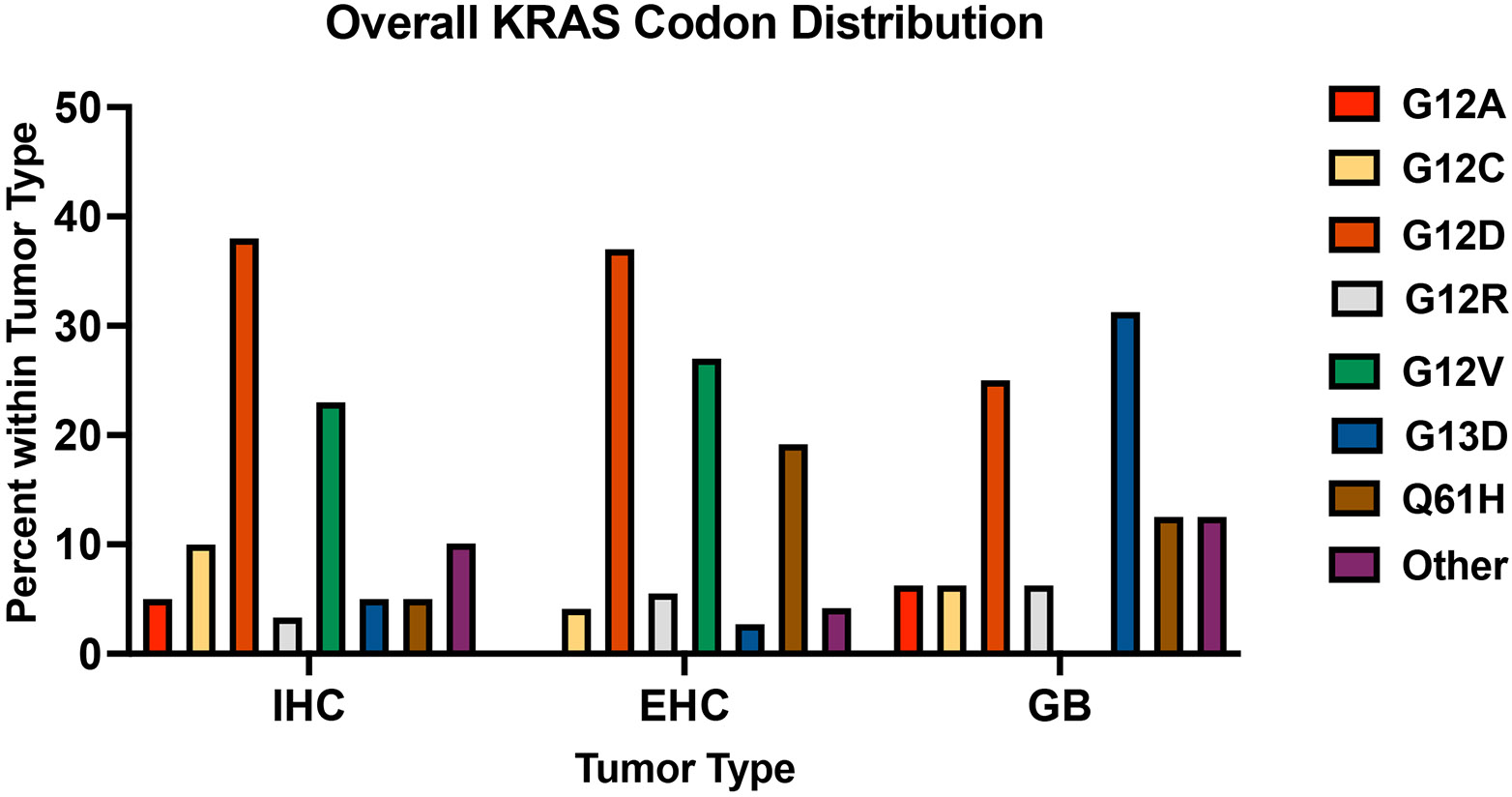
Results: Of the 985 patients sequenced, 15% had a KRAS mutation. Five hundred and seventy-two had unresectable disease (n = 395 IHC, n = 71 EHC, n = 106 GB) and 413 were treated with curative-intent resection (n = 175 IHC, n = 119 EHC, and n = 119 GB). Median follow-up time was 18 months (IQR, 11-31). KRAS G12D mutations were most common in IHC (38%) and EHC (37%) tumors. Mutations in SF3B1 co-occurred with mutant KRAS in IHC and EHC, with comutant resectable patients having worse survival after adjusting for tumor type (hazard ratio [HR], 4.04 [95% CI, 1.45 to 11.2]; P = .007). KRAS G12 mutations were associated with worse survival in patients with IHC compared with wild-type (WT) or other KRAS mutations, regardless of resection status (unresectable P < .001, resectable P = .011). After adjusting for clinical covariates, KRAS G12 mutations remained a prognostic indicator for patients with IHC compared with WT (HR, 1.99 [95% CI, 1.41 to 2.80]; P < .001).

Conclusion: The adverse impact of KRAS mutations in BTC is driven by G12 alterations in patients with IHC regardless of resection status, which was not observed in GB or EHC. There are unique comutational partners in distinct BTC subsets. These differences have important clinical implications in the era of KRAS-targeted therapeutics.


Figures
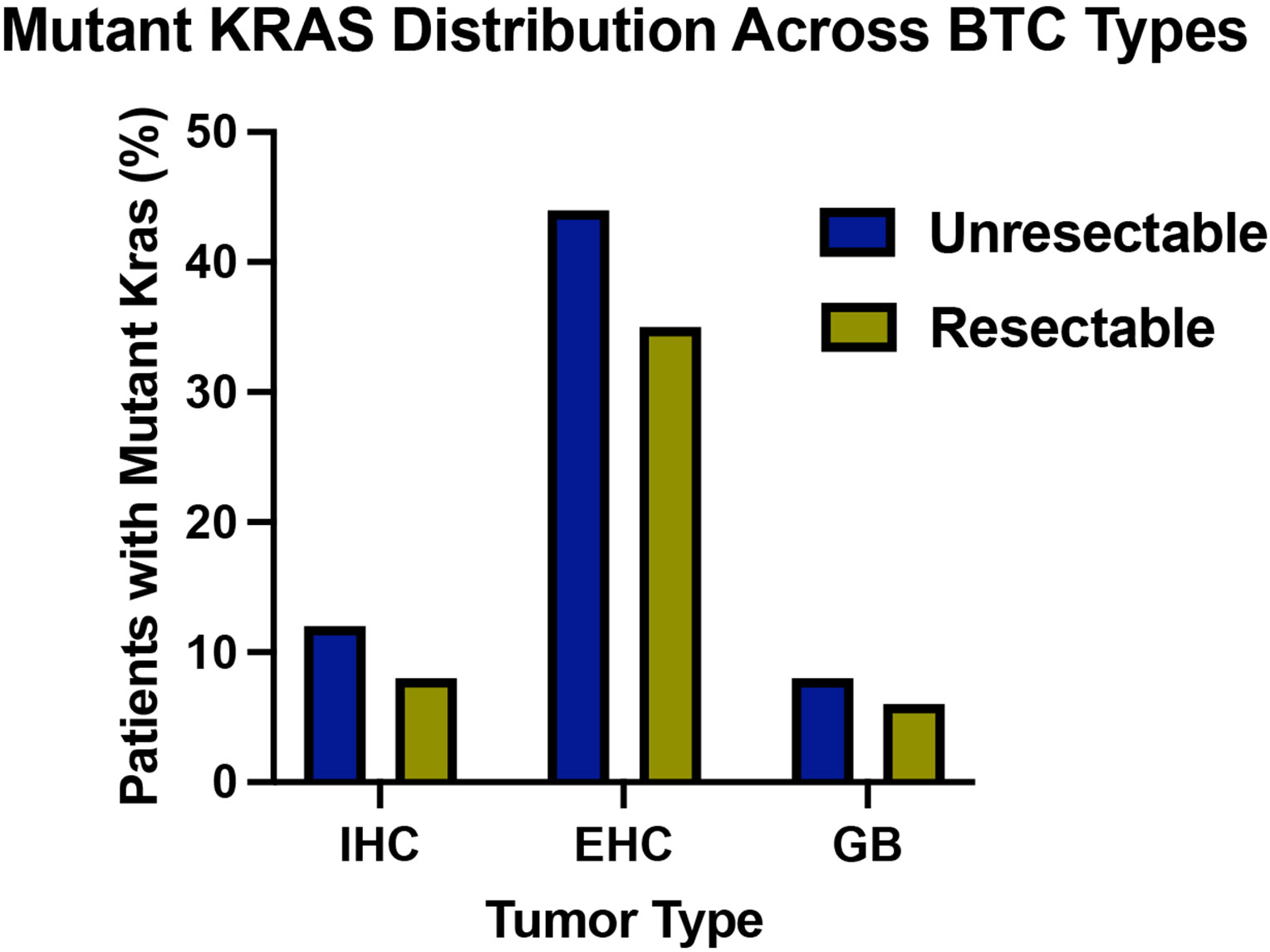
Figure 1:
Figure 1:. Frequency of KRAS alterations in biliary tract cancers.
(A) Frequency of mutant KRAS in patients with unresectable IHC (n=46/395, 12%), EHC (n=31/71, 44%), and GB (n=9/106, 8%), and resectable IHC (n=14/175, 8%), EHC (n=42/119, 35%), and GB (n=7/119, 6%). (B) Frequency of specific KRAS codon alterations in IHC (n=60), EHC (n=73), and GB (n=16) reported as percentage of patients with each KRAS alteration out of total number of KRAS mutant tumors, stratified by tumor type. Other = other KRAS variants. (C, D) Frequency of the most common KRAS codon alterations in IHC (C; n=46 unresectable, n=14 resectable,) and EHC (D, n=31 unresectable, n= 42 resectable,).
Figure 1:
Figure 1:. Frequency of KRAS alterations in biliary tract cancers.
(A) Frequency of mutant KRAS in patients with unresectable IHC (n=46/395, 12%), EHC (n=31/71, 44%), and GB (n=9/106, 8%), and resectable IHC (n=14/175, 8%), EHC (n=42/119, 35%), and GB (n=7/119, 6%). (B) Frequency of specific KRAS codon alterations in IHC (n=60), EHC (n=73), and GB (n=16) reported as percentage of patients with each KRAS alteration out of total number of KRAS mutant tumors, stratified by tumor type. Other = other KRAS variants. (C, D) Frequency of the most common KRAS codon alterations in IHC (C; n=46 unresectable, n=14 resectable,) and EHC (D, n=31 unresectable, n= 42 resectable,).
Figure 1:
Figure 1:. Frequency of KRAS alterations in biliary tract cancers.
(A) Frequency of mutant KRAS in patients with unresectable IHC (n=46/395, 12%), EHC (n=31/71, 44%), and GB (n=9/106, 8%), and resectable IHC (n=14/175, 8%), EHC (n=42/119, 35%), and GB (n=7/119, 6%). (B) Frequency of specific KRAS codon alterations in IHC (n=60), EHC (n=73), and GB (n=16) reported as percentage of patients with each KRAS alteration out of total number of KRAS mutant tumors, stratified by tumor type. Other = other KRAS variants. (C, D) Frequency of the most common KRAS codon alterations in IHC (C; n=46 unresectable, n=14 resectable,) and EHC (D, n=31 unresectable, n= 42 resectable,).
Figure 1:
Figure 1:. Frequency of KRAS alterations in biliary tract cancers.
(A) Frequency of mutant KRAS in patients with unresectable IHC (n=46/395, 12%), EHC (n=31/71, 44%), and GB (n=9/106, 8%), and resectable IHC (n=14/175, 8%), EHC (n=42/119, 35%), and GB (n=7/119, 6%). (B) Frequency of specific KRAS codon alterations in IHC (n=60), EHC (n=73), and GB (n=16) reported as percentage of patients with each KRAS alteration out of total number of KRAS mutant tumors, stratified by tumor type. Other = other KRAS variants. (C, D) Frequency of the most common KRAS codon alterations in IHC (C; n=46 unresectable, n=14 resectable,) and EHC (D, n=31 unresectable, n= 42 resectable,).
Figure 2:
Figure 2:. Association between KRAS mutations and survival.
(A, B) Kaplan-Meier curves for unresectable (A) and resectable (B) IHC patients showing overall survival stratified by tumor KRAS status, either wild-type (WT) or mutated (KRAS). (C, D) Kaplan-Meier survival analysis showing overall survival of WT KRAS (WT) versus mutant KRAS (KRAS) unresectable(C) and resectable (D) EHC tumors. (E, F) Kaplan-Meier survival analysis showing overall survival of WT KRAS (WT) versus mutant KRAS (KRAS) unresectable (E) and resectable (F) GB tumors.
Figure 2:
Figure 2:. Association between KRAS mutations and survival.
(A, B) Kaplan-Meier curves for unresectable (A) and resectable (B) IHC patients showing overall survival stratified by tumor KRAS status, either wild-type (WT) or mutated (KRAS). (C, D) Kaplan-Meier survival analysis showing overall survival of WT KRAS (WT) versus mutant KRAS (KRAS) unresectable(C) and resectable (D) EHC tumors. (E, F) Kaplan-Meier survival analysis showing overall survival of WT KRAS (WT) versus mutant KRAS (KRAS) unresectable (E) and resectable (F) GB tumors.
Figure 2:
Figure 2:. Association between KRAS mutations and survival.
(A, B) Kaplan-Meier curves for unresectable (A) and resectable (B) IHC patients showing overall survival stratified by tumor KRAS status, either wild-type (WT) or mutated (KRAS). (C, D) Kaplan-Meier survival analysis showing overall survival of WT KRAS (WT) versus mutant KRAS (KRAS) unresectable(C) and resectable (D) EHC tumors. (E, F) Kaplan-Meier survival analysis showing overall survival of WT KRAS (WT) versus mutant KRAS (KRAS) unresectable (E) and resectable (F) GB tumors.
Figure 3:
Figure 3:. Association between KRAS variants and survival.
(A, B) Kaplan-Meier curves for unresectable (A) and resectable (B) IHC patients showing overall survival stratified by tumor KRAS status, either KRAS wild-type (WT), KRAS G12 mutated (KRAS G12), and other KRAS codon variants (Other KRAS). (C, D) Kaplan-Meier survival analysis showing overall survival of WT versus KRAS G12 and Other KRAS unresectable (C) and resectable (D) EHC tumors. (E, F) Kaplan-Meier survival analysis showing overall survival of WT KRAS, KRAS G12, and Other KRAS unresectable (E) and resectable (F) GB tumors. (G) Kaplan-Meier curve for all IHC patients showing overall survival of tumors with WT KRAS versus KRAS G12C, KRAS G12D, KRAS G12V, and other KRAS mutations.
Figure 3:
Figure 3:. Association between KRAS variants and survival.
(A, B) Kaplan-Meier curves for unresectable (A) and resectable (B) IHC patients showing overall survival stratified by tumor KRAS status, either KRAS wild-type (WT), KRAS G12 mutated (KRAS G12), and other KRAS codon variants (Other KRAS). (C, D) Kaplan-Meier survival analysis showing overall survival of WT versus KRAS G12 and Other KRAS unresectable (C) and resectable (D) EHC tumors. (E, F) Kaplan-Meier survival analysis showing overall survival of WT KRAS, KRAS G12, and Other KRAS unresectable (E) and resectable (F) GB tumors. (G) Kaplan-Meier curve for all IHC patients showing overall survival of tumors with WT KRAS versus KRAS G12C, KRAS G12D, KRAS G12V, and other KRAS mutations.
Figure 3:
Figure 3:. Association between KRAS variants and survival.
(A, B) Kaplan-Meier curves for unresectable (A) and resectable (B) IHC patients showing overall survival stratified by tumor KRAS status, either KRAS wild-type (WT), KRAS G12 mutated (KRAS G12), and other KRAS codon variants (Other KRAS). (C, D) Kaplan-Meier survival analysis showing overall survival of WT versus KRAS G12 and Other KRAS unresectable (C) and resectable (D) EHC tumors. (E, F) Kaplan-Meier survival analysis showing overall survival of WT KRAS, KRAS G12, and Other KRAS unresectable (E) and resectable (F) GB tumors. (G) Kaplan-Meier curve for all IHC patients showing overall survival of tumors with WT KRAS versus KRAS G12C, KRAS G12D, KRAS G12V, and other KRAS mutations.
Figure 3:
Figure 3:. Association between KRAS variants and survival.
(A, B) Kaplan-Meier curves for unresectable (A) and resectable (B) IHC patients showing overall survival stratified by tumor KRAS status, either KRAS wild-type (WT), KRAS G12 mutated (KRAS G12), and other KRAS codon variants (Other KRAS). (C, D) Kaplan-Meier survival analysis showing overall survival of WT versus KRAS G12 and Other KRAS unresectable (C) and resectable (D) EHC tumors. (E, F) Kaplan-Meier survival analysis showing overall survival of WT KRAS, KRAS G12, and Other KRAS unresectable (E) and resectable (F) GB tumors. (G) Kaplan-Meier curve for all IHC patients showing overall survival of tumors with WT KRAS versus KRAS G12C, KRAS G12D, KRAS G12V, and other KRAS mutations.

References

    1. Beal EW, Cloyd JM & Pawlik TM Surgical treatment of intrahepatic cholangiocarcinoma: current and emerging principles. J Clin Med 10, (2020). - PMC - PubMed
    1. Abou-Alfa GK et al. Pemigatinib for previously treated, locally advanced or metastatic cholangiocarcinoma: a multicentre, open-label, phase 2 study. Lancet Oncol 21, 671–684 (2020). - PMC - PubMed
    1. Zhu AX et al. Final overall survival efficacy results of ivosidenib for patients with advanced cholangiocarcinoma with IDH1 mutation: the phase 3 randomized clinical claridhy trial. JAMA Oncol 7, 1669–1677 (2021). - PMC - PubMed
    1. Banales JM et al. Cholangiocarcinoma 2020: the next horizon in mechanisms and management. Nat Rev Gastroenterol Hepatol 17, 557–588 (2020). - PMC - PubMed
    1. Boerner T. et al. Genetic determinants of outcome in intrahepatic cholangiocarcinoma. Hepatology 74, 1429–1444 (2021). - PMC - PubMed

Substances

LinkOut - more resources