


Parotid FNAC Diagnostic Utility and Its Role in Surgical Residency Training
- PMID: 39650080
- PMCID: PMC11624852
- DOI: 10.22038/ijorl.2024.76596.3565
Parotid FNAC Diagnostic Utility and Its Role in Surgical Residency Training
Abstract
Introduction: This study aimed to investigate the relationship between preoperative fine needle aspiration cytology (FNAC) for parotid tumors and the level of surgical training among residents, as well as to further elucidate its effectiveness as a diagnostic tool in the hands of the treating physician.
Materials and methods: Surgical records from patients who underwent parotid surgery between 2014 and 2022 were retrieved. Residents reported their perceived level of training duringthese procedures. Contingency tables were used to correlate the cytological with final histopathological results.
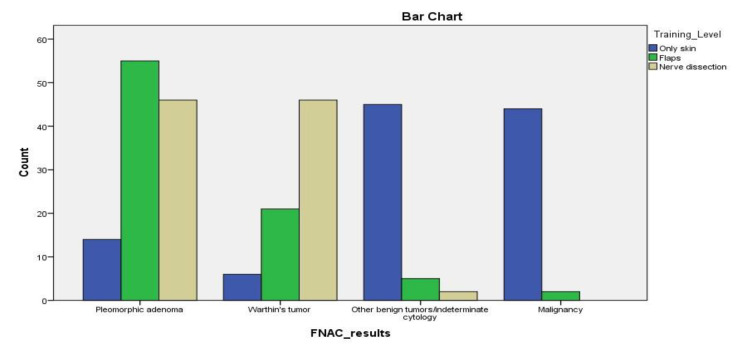
Results: A total of 286 patients who had undergone preoperative FNAC were included in the study. A preoperative diagnosis of pleomorphic adenoma or Wharthin's tumor was significantly associated with higher training scores among surgical residents. In contrast, a diagnosis of malignancy, other benign tumors, or indeterminate cytology was correlated with poor training scores (χ2 = 176.35; df = 2; p-value <0.001, Cramer's V 0.79). FNAC demonstrated a sensitivity of 88% and a specificity of 99.2% for detecting malignancy, with a positive likelihood ratio of 103.8 (95% CI: 26.02-414.34) and a negative likelihood ratio of 0.12 (95% CI: 0.06-0.26).
Conclusions: Our findingssuggest that preoperative cytological diagnoses of parotid tumors with a favorable prognosis, such as Wharthin's tumors, can enhance training and mentorship opportunities provided by senior surgeons. This is particularly significant for academic institutions with residency programs.
Keywords: Fine-needle aspiration; Parotid gland; Parotid tumor; Residency; Training.
© 2024 Mashhad University of Medical Sciences.
Figures
References
-
- Colella G, Cannavale R, Flamminio F, Foschini MP. Fine-needle aspiration cytology of salivary gland lesions: a systematic review. J Oral Maxillofac Surg. 2010;68(9):2146–2153. - PubMed
-
- Thompson L. World Health Organization classification of tumours: pathology and genetics of head and neck tumours. Ear Nose Throat J. 2006;85(2) - PubMed
-
- Guntinas-Lichius O, Klussmann JP, Wittekindt C, Stennert E. Parotidectomy for benign parotid disease at a university teaching hospital: outcome of 963 operations. Laryngoscope. 2006;116(4):534–540. - PubMed
-
- Cohen EG, Patel SG, Lin O, et al. Fine-needle aspiration biopsy of salivary gland lesions in a selected patient population. Arch Otolaryngol Head Neck Surg. 2004;130(6):773–778. - PubMed
-
- Schmidt RL, Hall BJ, Wilson AR, Layfield LJ. A systematic review and meta-analysis of the diagnostic accuracy of fine-needle aspiration cytology for parotid gland lesions. Am J Clin Pathol. 2011;136(1):45–59. - PubMed
LinkOut - more resources
Full Text Sources
Miscellaneous