


The dietary inflammatory index and asthma prevalence: a cross-sectional analysis from NHANES
- PMID: 39650711
- PMCID: PMC11622817
- DOI: 10.3389/fnut.2024.1485399
The dietary inflammatory index and asthma prevalence: a cross-sectional analysis from NHANES
Abstract
Background: Inflammation is a key factor in the development of asthma, and diet significantly influences inflammatory responses. This study examines the relationship between the Dietary Inflammatory Index (DII) and asthma prevalence.
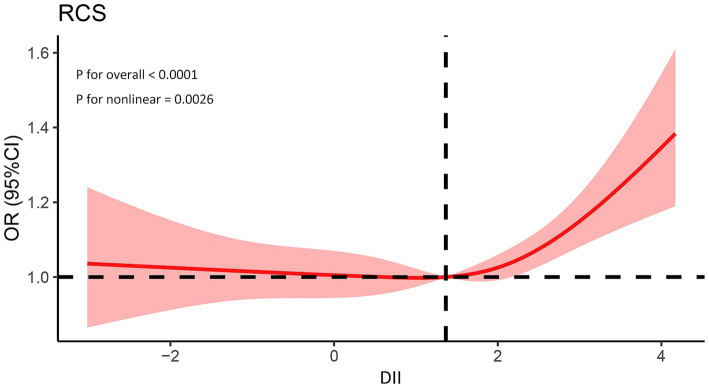
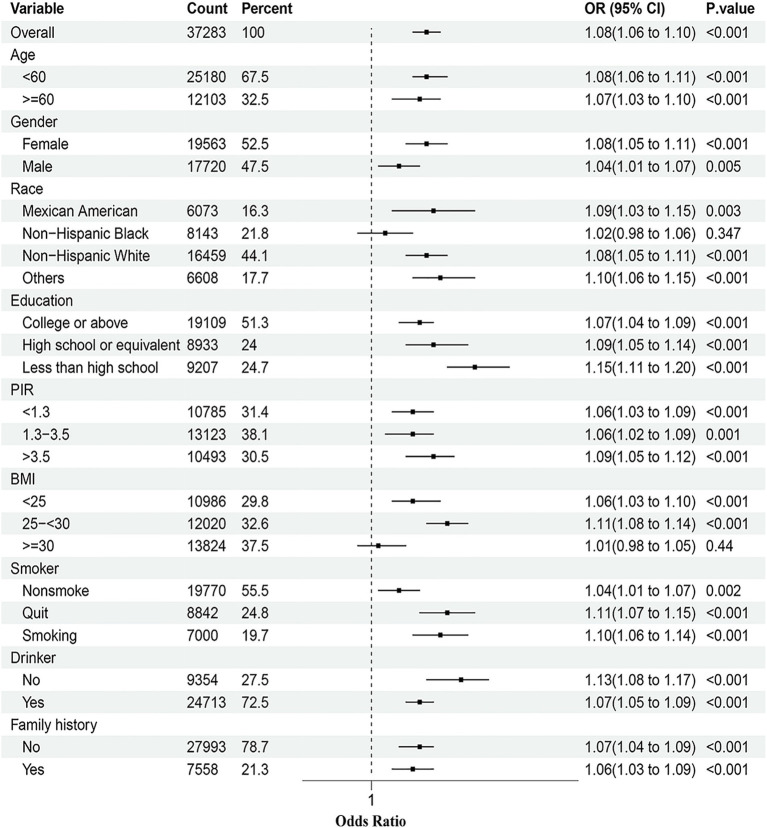
Methods: We conducted a cross-sectional analysis using data from the National Health and Nutrition Examination Survey (NHANES) from 1999 to 2018. Demographic details, anthropometric measurements, dietary habits, lifestyle factors, and asthma status were recorded for all participants. Multivariable logistic regression was utilized to assess the relationship between DII and asthma prevalence. Additionally, restricted cubic spline (RCS) analysis was employed to explore the nonlinearity and dose-response relationship between DII and asthma risk. Subgroup analyses were stratified by gender, age, race, body mass index (BMI), poverty income ratio (PIR), education, smoking status, alcohol use, and family medical history to dissect the association between DII and asthma across diverse populations.
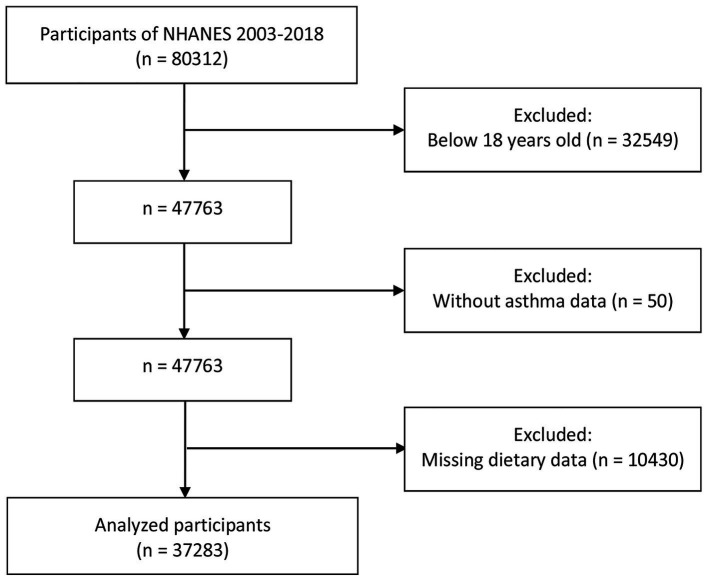
Results: The analysis included 37,283 adults from NHANES. After adjusting for potential confounders in the multivariable logistic regression model, a significant positive association was identified between DII and asthma (OR, 95% CI: 1.05, 1.02-1.09, per 1 SD increase). The RCS analysis revealed a nonlinear association (p for nonlinearity = 0.0026), with an inflection point at 1.366, beyond which an increase in DII was significantly associated with asthma risk. Furthermore, the stratified analyses indicated a positive association between DII and asthma in the majority of subgroups.
Conclusion: The findings underscore a significant and nonlinear association between DII and asthma. To enhance asthma prevention and management, greater emphasis should be placed on modulating dietary-induced inflammation.
Keywords: NHANES; asthma; cross-sectional; dietary inflammatory index; inflammation.
Copyright © 2024 Lu and Zhu.
Conflict of interest statement
The authors declare that the research was conducted in the absence of any commercial or financial relationships that could be construed as a potential conflict of interest.
Figures
References
-
- GBD 2021 Diseases and Injuries Collaborators . Global incidence, prevalence, years lived with disability (YLDs), disability-adjusted life-years (DALYs), and healthy life expectancy (HALE) for 371 diseases and injuries in 204 countries and territories and 811 subnational locations, 1990–2021: A systematic analysis for the global burden of disease study 2021. Lancet. (2024) 403:2133–61. doi: 10.1016/S0140-6736(24)00757-8, PMID: - DOI - PMC - PubMed
LinkOut - more resources
Full Text Sources
