


Biomimetic peptide self-assembly for functional materials
- PMID: 39650726
- PMCID: PMC7617017
- DOI: 10.1038/s41570-020-0215-y
Biomimetic peptide self-assembly for functional materials
Abstract
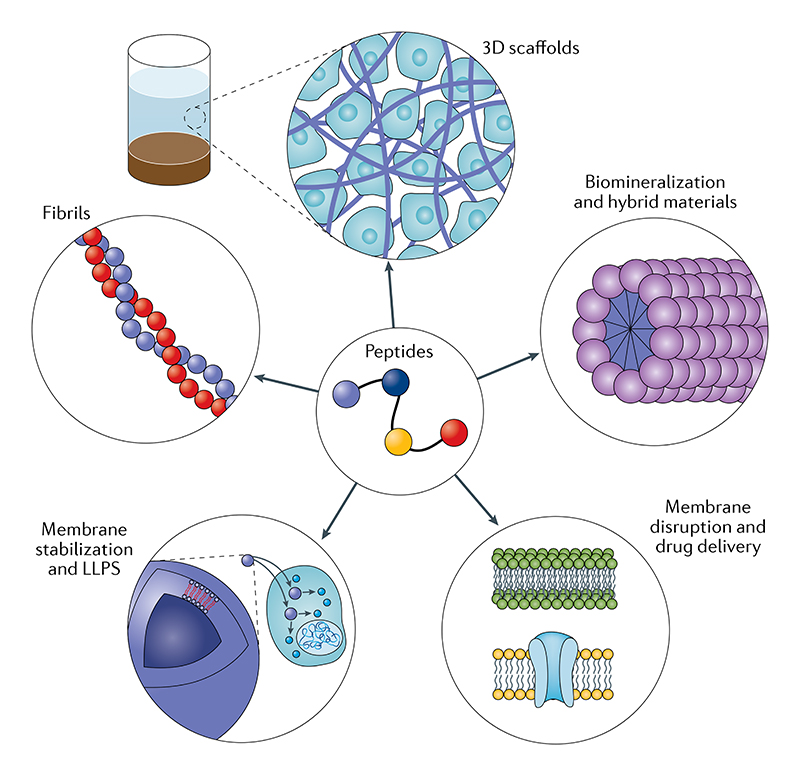
Natural biomolecular systems have evolved to form a rich variety of supramolecular materials and machinery fundamental to cellular function. The assembly of these structures commonly involves interactions between specific molecular building blocks, a strategy that can also be replicated in an artificial setting to prepare functional materials. The self-assembly of synthetic biomimetic peptides thus allows the exploration of chemical and sequence space beyond that used routinely by biology. In this Review, we discuss recent conceptual and experimental advances in self-assembling artificial peptidic materials. In particular, we explore how naturally occurring structures and phenomena have inspired the development of functional biomimetic materials that we can harness for potential interactions with biological systems. As our fundamental understanding of peptide self-assembly evolves, increasingly sophisticated materials and applications emerge and lead to the development of a new set of building blocks and assembly principles relevant to materials science, molecular biology, nanotechnology and precision medicine.
Conflict of interest statement
Competing interests The authors declare no competing interests.
Figures
References
-
- Whitesides GM, Grzybowski B. Self-assembly at all scales. Science. 2002;295:2418–2421. - PubMed
-
- Philp D, Stoddart JF. Self-assembly in natural and unnatural systems. Angew Chem Int Ed Engl. 1996;35:1154–1196.
-
- Schliwa M, Woehlke G. Molecular motors. Nature. 2003;422:759–765. - PubMed
-
- Lehn JM. Perspectives in supramolecular chemistry — from molecular recognition towards molecular information processing and self-organization. Angew Chem Int Ed Engl. 1990;29:1304–1319.
Grants and funding
LinkOut - more resources
Full Text Sources
Research Materials
