


Unveiling the hidden threats: a review of pathogen diversity and public health risks from bats, rodents, and non-human primates in Zambia (1990-2022)
- PMID: 39651468
- PMCID: PMC11621629
- DOI: 10.3389/fpubh.2024.1471452
Unveiling the hidden threats: a review of pathogen diversity and public health risks from bats, rodents, and non-human primates in Zambia (1990-2022)
Abstract
Background: Infectious disease agents of animal origin, which can cause mild to severe illnesses in humans, are increasingly spilling over into human populations. Southern Africa, particularly Zambia as a regional transport hub, has experienced notable outbreaks of zoonotic pathogens in recent years. This context underscores the importance of research, as numerous studies over the past 33 years have reported various infectious agents with differing zoonotic potential from bats, rodents, and non-human primates (NHPs) in Zambia. However, the data remained unaggregated, hampering comprehensive and organized understanding of these threats.
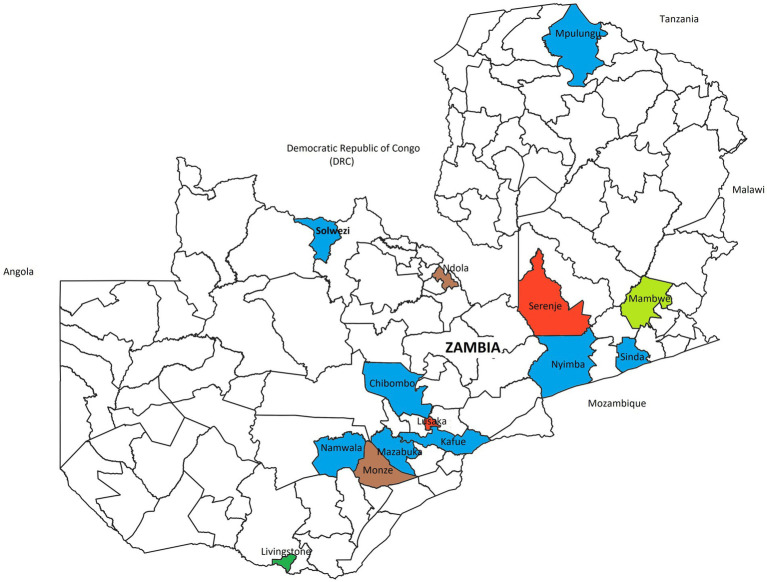
Methods: A review spanning January 1990 to December 2022 synthesised data from selected studies conducted in bats, rodents, and NHPs across 14 of Zambia's 116 districts.
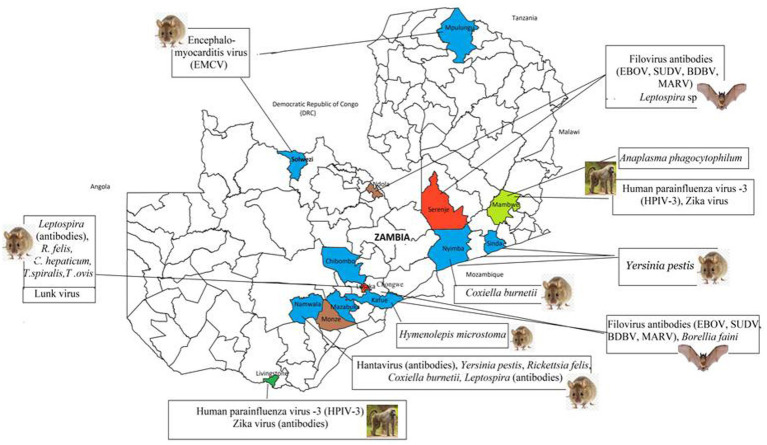
Results: Among the reported pathogens, viruses predominated (62%, 31/50), followed by parasites (20%, 10/50)), and bacteria (18%, 9/50). Notable pathogens included Ebola virus, Marburg virus, Hantavirus, Zika virus, Human parainfluenza virus-3, Anaplasma phagocytophilum, Borrelia faini, Coxiella burnetii, Trypanosoma brucei rhodesiense, Calodium hepaticum, and Trichinella spiralis. Most identified infectious agents came from short term cross-sectional investigations, thus, the temporal dynamics related to abundance and likelihood of outbreaks remain unknown.
Conclusion: The findings starkly illuminate significant zoonotic public health threats amidst glaring under-surveillance of zoonoses in humans in Zambia. This critical gap calls urgently for enhanced active, passive and syndromic surveillance activities to identify new diseases and provide evidence-based measures to safeguard public health from emerging infectious risks in Zambia and the Southern African sub-region, considering the country's position as a regional transport hub.
Keywords: Zambia; bats; non-human primates; pathogens; public health; rodents; surveillance; zoonoses.
Copyright © 2024 Munjita, Mubemba, Changula, Tembo, Hamoonga, Bates, Chitanga, Munsaka and Simulundu.
Conflict of interest statement
The authors declare that the research was conducted in the absence of any commercial or financial relationships that could be construed as a potential conflict of interest.
Figures
References
-
- Delia G, Mutua F, Ochungo P, Kruska R, Jones K, Brierley L, et al. Mapping of poverty and likely zoonoses hotspots International Livestock Research Institute – Zoonoses Project. Nairobi, Kenya. (2012).
Publication types
MeSH terms
LinkOut - more resources
Full Text Sources
Medical
Miscellaneous
