


Can wage changes solve the labour crisis in the National Health Service?
- PMID: 39652220
- PMCID: PMC12204917
- DOI: 10.1007/s10198-024-01737-4
Can wage changes solve the labour crisis in the National Health Service?
Abstract
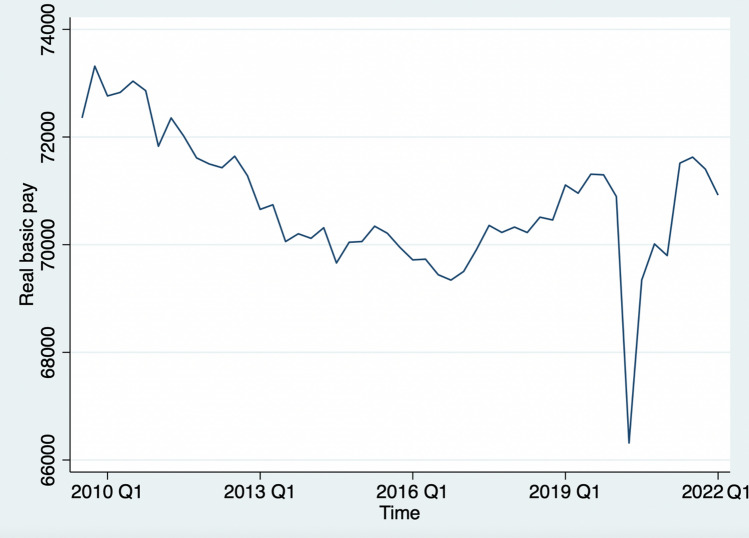
This study aimed to examine the healthcare labour demand and supply elasticity regarding wage in the National Health Service (NHS) in England amid a labour crisis. A simultaneous error-correction regression analysis was conducted using secondary data from the NHS and Office for National Statistics from 2009 Q3 to 2022 Q1. Findings indicate both labour demand and supply of HCHS doctors in the NHS are highly inelastic with respect to real wages, with only a 0.1% decrease in NHS staff hiring and a 0.8% rise in NHS staff's willingness to work as full-time equivalents per 10% wage increase. Approximately 22% of the wage disequilibrium adjusts quarterly, indicating moderate speed of wage adjustment. Our results suggest that wage setting is not a sufficient solution to the labour crisis. Innovative and sustainable solutions are needed to reduce the demand for skilled health labour and increase the supply of health labour.
Keywords: Forecasting; Labour market; Macroeconometrical modelling; National Health Service (NHS).
© 2024. The Author(s).
Conflict of interest statement
Declarations. Conflict of interest: None.
Figures
References
MeSH terms
Grants and funding
LinkOut - more resources
Full Text Sources
