


Empathy Development in Preschoolers With/Without Hearing Loss and Its Associations with Social-Emotional Functioning
- PMID: 39652274
- PMCID: PMC11845562
- DOI: 10.1007/s10802-024-01271-0
Empathy Development in Preschoolers With/Without Hearing Loss and Its Associations with Social-Emotional Functioning
Abstract
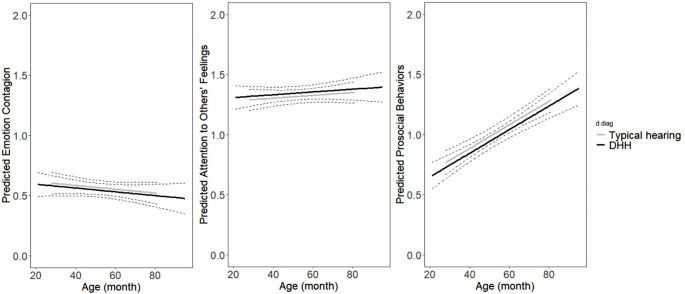
Empathy plays a crucial role in children's social-emotional development. There is an increasing trend in recent studies to recognize empathy as a multi-dimensional construct, consisting of three distinct hierarchical levels: emotion contagion, attention to others' feelings and prosocial behaviors (Hoffman, Motiv Emot, 14(2), 151-172, 1990). The present study is amongst the first to use a longitudinal approach to examine the development trajectories of the distinct empathic levels, based on a sample of Chinese preschoolers aged 2 to 6 years, half of the sample being deaf or hard-of-hearing (DHH). Our results showed that according to the parental observation, DHH preschoolers manifested similar extent of emotion contagion and attention to others' feelings as their TH (typically hearing) peers over preschool years. Yet, DHH preschoolers showed fewer prosocial behaviors, compared to their TH peers. As for the longitudinal associations over time, emotion contagion contributed to more internalizing and externalizing behaviors in both groups; whilst attention to others' feelings contributed to fewer internalizing behaviors in only DHH children. Prosocial behaviors contributed to better social competence, and fewer internalizing and externalizing behaviors in both DHH and TH children just as expected. These outcomes imply that the early intervention or special education may be useful to safeguard children's empathic development, shrinking the gaps between DHH and TH children; but meanwhile, cultural factors might cause latent effects on children's understandings of empathy and impact on how empathy "regulates" children's social-emotional functioning, in a Chinese cultural context.
Keywords: Development trajectory; Empathy; Preschoolers; Social-emotional functioning.
© 2024. The Author(s).
Conflict of interest statement
Compliance with Ethical Standards. Funding: This study was supported by the Royal Netherlands Academy of Arts and Sciences (KNAW), [grant number: 530-5CDP17]; China Scholarship Council (CSC) - Leiden Joint Scholarship for PhD Positions, [to Z. Li, scholarship ID: 201907720030]. Conflict of Interest: None. Ethics Approval: Formal approvals of this research were acquired from both the Ethical Committee of Leiden University, and the China Rehabilitation Research Center. Informed Consent: Signed paper-form consent, or online digital consent, were acquired from the caregivers of the participants (The dataset and associated information used in the current study will be shared publicly on the archiving platform “DataverseNL”, once the manuscript is accepted. According to the regulations of the Leiden University, materials and raw/processed data associated with an accepted paper will have to be archived and publicly shared along with the final manuscript within one month after publication). Pre-Registration: This research was pre-registered on OSF, titled: “The development of empathy and its association with social-emotional functioning in preschoolers with hearing loss and typical hearing”. Pre-Registration DOI: https://doi.org/10.17605/OSF.IO/V853D .
Figures
References
-
- Ashori, M., & Aghaziarati, A. (2023). The relationships among social-emotional assets and resilience, empathy and behavioral problems in deaf and hard of hearing children. Current Psychology, 42(24), 20421–20429. 10.1007/s12144-022-03152-5
-
- Bandstra, N. F., Chambers, C. T., McGrath, P. J., & Moore, C. (2011). The behavioural expression of empathy to others’ pain versus others’ sadness in young children. Pain, 152(5), 1074–1082. 10.1016/j.pain.2011.01.024 - PubMed
-
- Bates, D., Maechler, M., Bolker, B., Walker, S., Christensen, R. H. B., Singmann, H., & Bolker, M. B. (2015). Package ‘lme4’. Convergence, 12(1), 2. Retrieved from URL: http://dk.archive.ubuntu.com/pub/pub/cran/web/packages/lme4/lme4.pdf
-
- Beeler-Duden, S., Pelletz, K., & Vaish, A. (2022). Recipient identifiability increases prosocial behavior in young children. Journal of Experimental Child Psychology, 223, 105500. 10.1016/j.jecp.2022.105500 - PubMed
Publication types
MeSH terms
Grants and funding
LinkOut - more resources
Full Text Sources
Medical
Research Materials