


Time as a significant factor in the release of potassium from lithium heparin plasma and serum
- PMID: 39652602
- PMCID: PMC11627413
- DOI: 10.1371/journal.pone.0313572
Time as a significant factor in the release of potassium from lithium heparin plasma and serum
Abstract
Objectives: In most countries the majority of patients are in outpatient care. In difference to hospitalized patients, their blood samples often take hours after collection to centrifugation. The study investigates the release of potassium and the development of pseudohyperkalemia in lithium heparin (Li-Hep) and serum blood collection tubes over time.
Methods: From 201 donors 4 serum and 4 Li-Hep blood collection tubes were taken each. After 0.5, 4, 6 and 8h whole blood was centrifuged, and potassium levels were determined. To simulate the preanalytic conditions, the samples with a storage time >0.5h were shaken on a standard shaker for 1h and stored at 4-8°C for the remaining time.
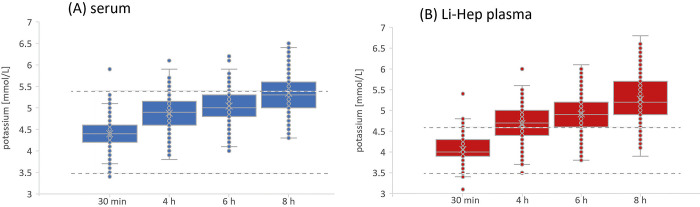
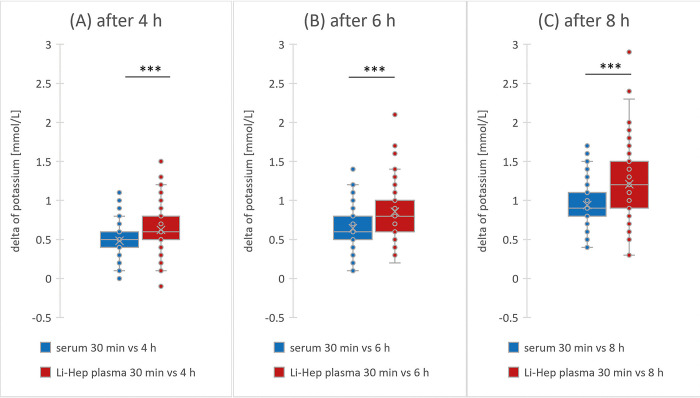
Results: Over time, significant more potassium was released before centrifugation from the Li-Hep plasma than from serum (1.21 vs 0.94 mmol/L). After 6h, the two groups were no longer highly statistically significantly different (potassium mean: 5.01 mmol/L in serum group, 4.92 mmol/L in Li-Hep group). In the Li-Hep group 164 donors developed a pseudohyperkalemia after 8h, compared to 76 in the serum group.
Significance: The decision as to which material is best suited should not only be based on which value comes closest to the physiological situation immediately after blood collection. The subsequent preanalytic circumstances must also be considered. Serum tubes appear to be at least as suitable for potassium determination as Li-Hep tubes. In terms of patient blood management, serum provides the possibility of performing a wider range of analyses in the outpatient setting.
Copyright: © 2024 Reuter et al. This is an open access article distributed under the terms of the Creative Commons Attribution License, which permits unrestricted use, distribution, and reproduction in any medium, provided the original author and source are credited.
Conflict of interest statement
The authors have declared that no competing interests exist.
Figures
References
-
- Forsman RW. Why is the laboratory an afterthought for managed care organizations? Clin Chem 1996;42:813–6. - PubMed
-
- Drogies T, Ittermann T, Lüdemann J, Klinke D, Kohlmann T, Lubenow N, et al.. Potassium–reference intervals for lithium-heparin plasma and serum from a population-based cohort / Kalium–Referenzbereiche für Lithium-Heparin-Plasma und Serum aus einer bevölkerungsbezogenen Studie. LaboratoriumsMedizin 2010;34:39–44.
-
- Schindler EI, Brown SM, Scott MG. Electrolytes and blood gases. In: Rifai N, Horvath AR, Wittwer C. Tietz Textbook of Clinical Chemistry and Molecular Diagnostics. St. Louis, MO, USA: Elsevier Saunders, 2018
-
- Oshima T, Matsuura H, Kido K, Matsumoto K, Otsuki T, Shingu T, et al.. Intracellular sodium and potassium concentrations in erythrocytes of healthy male subjects. Nihon Jinzo Gakkai Shi 1988;30:1095–101. - PubMed
MeSH terms
Substances
LinkOut - more resources
Full Text Sources
Medical
