


Investigation and management of resistant hypertension: British and Irish Hypertension Society position statement
- PMID: 39653728
- PMCID: PMC11717708
- DOI: 10.1038/s41371-024-00983-6
Investigation and management of resistant hypertension: British and Irish Hypertension Society position statement
Abstract
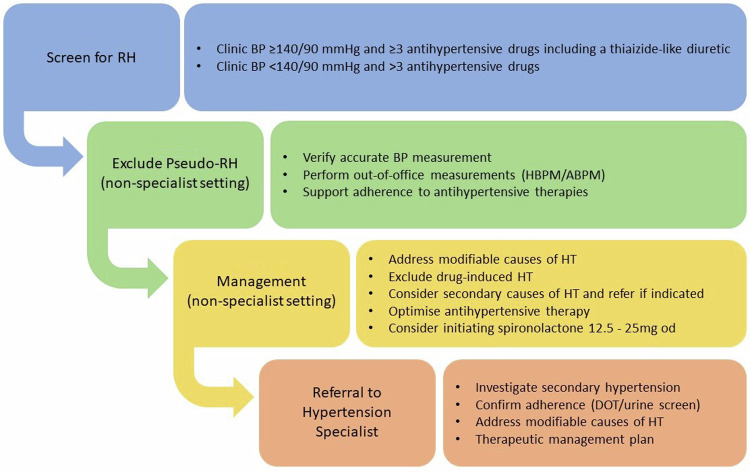
People living with resistant hypertension (RH) are at high risk of adverse cardiovascular events. The British and Irish Hypertension Society has identified suspected RH as a condition for which specialist guidance may improve rates of blood pressure control and help clinicians identify those individuals who may benefit from specialist review. In this position statement we provide a practical approach for the investigation and management of adults with RH. We highlight gaps in the current evidence and identify important future research questions. Our aim is to support the delivery of high-quality and consistent care to people living with RH across the UK and Ireland.
© 2024. The Author(s).
Conflict of interest statement
Competing interests: Professor Adrian J.B. Brady has received honoraria from Daiichi-Sankyo, Amgen, Sanofi-Aventis, Bayer, MSD, and Novartis. Professor Phil Chowienczyk has an interest in Centron Diagnostics, a company that has produced technology for blood pressure measurement. Professor Jacob George has received grants and travel funding from Astra Zeneca, Novartis and Daiichi Sankyo, is on Advisory Boards for AstraZeneca, Menarini and Novartis, consulting fees from Roche and PwC and is a Principal Investigator for studies funded by AstraZeneca, Alnylam, Novartis, Esperion. Dr Pankaj Gupta has received research grants, lecture honoraria and funding for conference attendance from Sanofi-Aventis and Amgen, and consulting fees from Ionis Pharmaceuticals. Professor Anthony Heagerty has received lecture honoraria from Servier. Dr Spoorthy Kulkarni is a PhD student at the University of Cambridge funded by AstraZeneca and has attended scientific advisory boards for Viatris. Professor Terry McCormack has received lecture honoraria and/or consultation fees from AstraZeneca, Daichi-Sankyo, and Medtronic. He is a co-investigator in the Alnylam study Kardia 3. Professor Neil R Poulter has received lecture honoraria and/or consultation fees from several pharmaceutical companies that manufacture blood pressure lowering agents including AstraZeneca, Eva Pharma, Lri Therapharma, Napi, Pfizer, Servier and Sanofi-Aventis. Professor Ian B Wilkinson has received research grants from AstraZeneca, GSK and scientific advisory board consultation fees for Viatris, Astra Zeneca and Roche. Dr Luca Faconti, Dr Carmen Maniero, Dr Vikas Kapil, Dr Philip Lewis, Ms Michaela Nuttall, Mr Sam Olden, Dr Sarah Partridge, Dr Alfredo Petrosino, Dr Abilash Sathyanarayanan, Professor Peter Sever, Dr Wayne Sunman and Dr Helen Warren have no competing interests to declare for this manuscript.
Figures


References
-
- British Heart Foundation. Cardiovascular Disease Statistics Factsheet UK 2024 2024 [Available from: https://www.bhf.org.uk/-/media/files/for-professionals/research/heart-st....
Publication types
MeSH terms
Substances
LinkOut - more resources
Full Text Sources
Medical
