


A nonlinear relationship between alcohol consumption and cognitive function in elderly people: a population-based study from NHANES 2011-2014
- PMID: 39654808
- PMCID: PMC11626387
- DOI: 10.3389/fnagi.2024.1458274
A nonlinear relationship between alcohol consumption and cognitive function in elderly people: a population-based study from NHANES 2011-2014
Abstract
Objective: This study aims to explore the association between alcohol intake and cognitive function in elderly Americans, including potential nonlinear relationships and interactions across different subgroups.
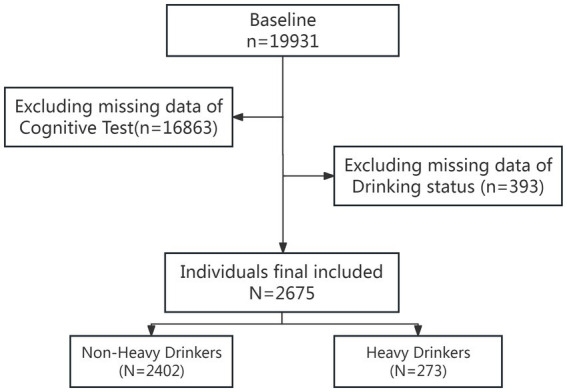
Methods: The study analyzed data from the National Health and Nutrition Examination Survey (NHANES) from 2011 to 2014. The sample included 2,675 Americans aged 60 or older. Multivariate regression analysis was used to evaluate the relationship between alcohol intake and cognitive function. Smooth curve fitting and threshold effect analysis were employed to explore potential nonlinear relationships. Subgroup analyses were conducted to examine the stability of the results across different subgroups.
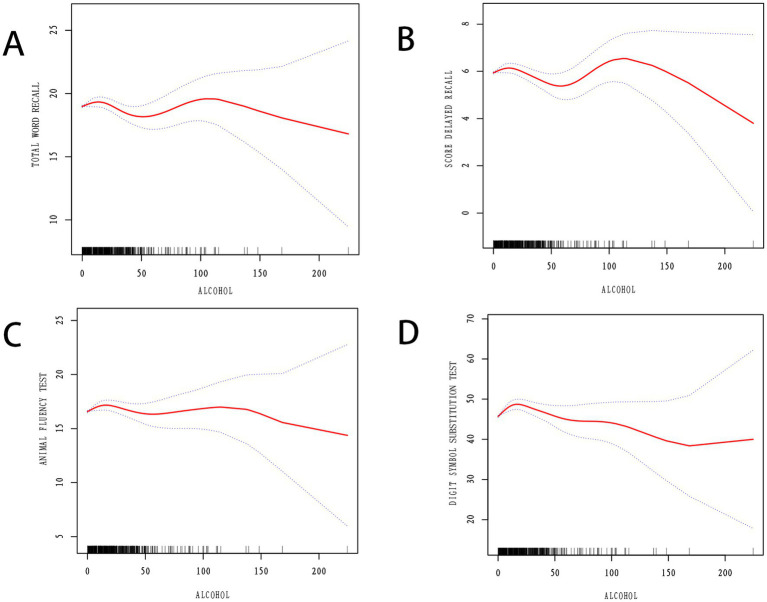
Results: The results indicate a significant negative correlation between alcohol intake and cognitive function. In the CERAD total word recall test, for every unit increase in alcohol intake, the score decreased by 0.15 points (-0.15, 95% CI: -0.25, -0.04), and in the CERAD delayed recall test, it decreased by 0.07 points (-0.07, 95% CI: -0.12, -0.01). Compared to Non-Heavy Drinkers, Heavy Drinkers showed a reduction in their CERAD total word recall scores by-0.77 points (-0.77, 95% CI: -1.23, -0.32) and in their CERAD delayed recall scores by-0.28 points (-0.28, 95% CI: -0.52, -0.04). Smooth curve fitting analysis revealed a nonlinear relationship between alcohol intake and cognitive function, with breakpoints at 10.7 for the CERAD total word recall test, 4.7 for the Animal fluency test, and 3.85 for the Digit symbol substitution test. Additionally, subgroup analysis indicated that gender, educational level, and smoking status significantly moderated the relationship between alcohol intake and cognitive function, while marital status, race, hypertension, diabetes, and cancer status showed no significant interactions.
Conclusion: The association between alcohol intake and cognitive function in the elderly is complex, influenced by both the amount of intake and individual subgroup characteristics.
Keywords: NHANES; alcohol intake; association; cognitive function; cross-sectional analysis.
Copyright © 2024 Chen, Li, Yue, Zhu, Cui, Zhang and Jin.
Conflict of interest statement
The authors declare that the research was conducted in the absence of any commercial or financial relationships that could be construed as a potential conflict of interest.
Figures
References
-
- Agardh E. E., Allebeck P., Flodin P., Wennberg P., Ramstedt M., Knudsen A. K., et al. . (2021). Alcohol-attributed disease burden in four Nordic countries between 2000 and 2017: are the gender gaps narrowing? A comparison using the global burden of disease, injury and risk factor 2017 study. Drug Alcohol Rev. 40, 431–442. doi: 10.1111/dar.13217, PMID: - DOI - PMC - PubMed
-
- Alzheimer's Association (2019). 2019 Alzheimer's disease facts and figures. Alzheimers Dement. 15, 321–387. doi: 10.1016/j.jalz.2019.01.010 - DOI
-
- Anstey K. J., Ee N., Eramudugolla R., Jagger C., Peters R. (2019). A systematic review of Meta-analyses that evaluate risk factors for dementia to evaluate the quantity, quality, and global representativeness of evidence. J. Alzheimers Dis. 70, S165–S186. doi: 10.3233/JAD-190181, PMID: - DOI - PMC - PubMed
LinkOut - more resources
Full Text Sources
