Gut dysbiosis narrative in psoriasis: matched-pair approach identifies only subtle shifts correlated with elevated fecal calprotectin
- PMID: 39656003
- PMCID: PMC11705824
- DOI: 10.1128/spectrum.01382-24
Gut dysbiosis narrative in psoriasis: matched-pair approach identifies only subtle shifts correlated with elevated fecal calprotectin
Abstract
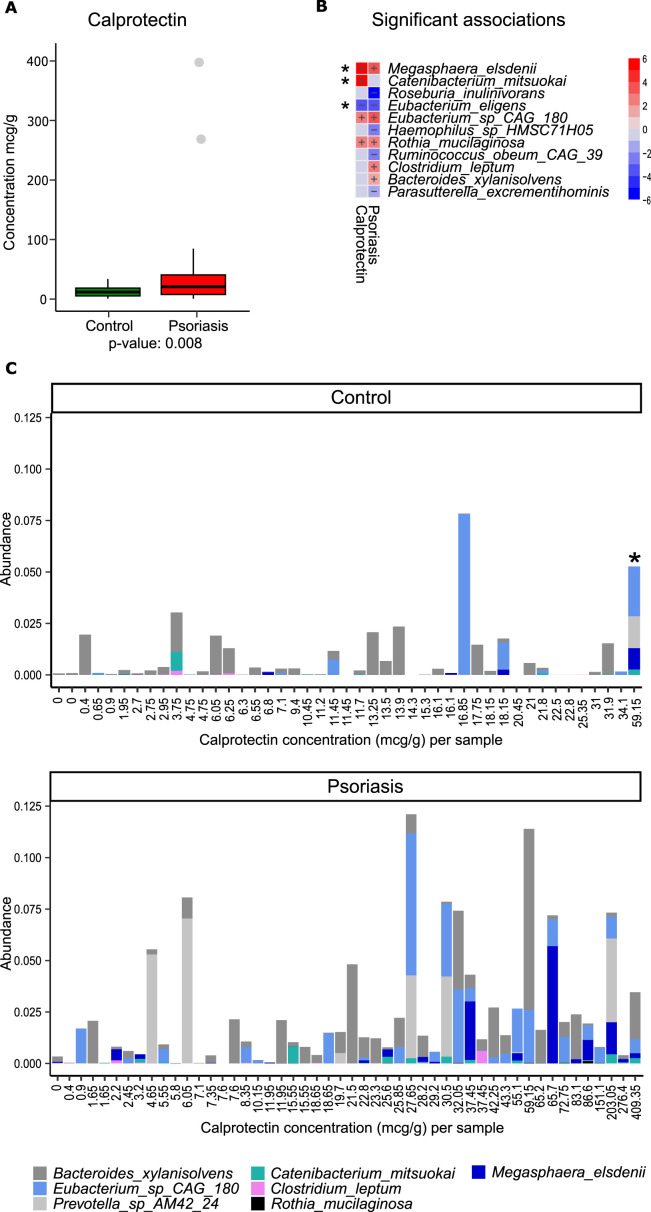
Many studies have reported gut microbiome alterations in psoriasis patients, suggesting dysbiosis. While evidence for dysbiosis and its link to pathogenesis remains inconclusive, murine models of psoriasis suggest that gut microbiome alterations develop in response to psoriasis-like inflammation. Hence, the dominant narrative about gut microbiome alterations' impact on disease should be evaluated critically with more data and a well-powered approach. In this case-control study, we used deep sequencing of fecal samples from 53 psoriasis patients and 47 healthy donors to reconstruct the strain/species-level content of the gut microbiome. Unlike previous studies, we first identified matched pairs for each patient with healthy donors to adjust for microbiome variability and increase power. We found no evidence for depleted gut community diversity and apparent divergence in structure between patients and healthy individuals. However, our matched-pair approach identified a subtle but systematic increase in select bacteria among patients, e.g., Megasphaera elsdenii and Eubacterium CAG 180. We next showed that these enriched species were correlated with elevated biomarkers of intestinal and systemic inflammation and liver function. Functionally, one of the top species, Megasphaera elsdenii, is a potent lactate utilizer in the context of intestinal lactic acidosis and inflammation. While our findings hardly support overt dysbiosis in the large intestine, the observed microbial changes correlate with moderately elevated calprotectin, albeit at levels not enough to diagnose ongoing inflammation. Hence, the sources of elevated inflammatory markers in patients' intestines remain unclear and warrant further investigation to clarify their cause-and-effect relationship with the disease.
Importance: With sufficient taxonomic resolution and sample size, this study critically evaluates new and published data on the gut microbiome in psoriasis patients. It shows that observed taxonomic changes in patients are modest and do not meet strict criteria for gut dysbiosis, at least in the large intestine. Instead, observed taxonomic changes in psoriasis patients can be explained by the microbial response to possible low-grade inflammation with unknown localization in the intestine and unclear impact on the host. The authors point out that published endoscopic data point to the small intestine as the site of gut inflammation. Therefore, further research focused on the small intestine would be informative to clarify the hypothetical gut-psoriasis link.
Keywords: dysbiosis; gut microbiota; lactate; low-grade Inflammation; psoriasis.
Conflict of interest statement
The authors declare no conflict of interest.
Figures



References
MeSH terms
Substances
Grants and funding
- 24-24-00087/Russian Science Foundation (RSF)
- project 124032000041-1/Saint Petersburg State University (SPbU)
- PURE ID 95444211/Saint Petersburg State University (SPbU)
- projects FSMG-2023-018 (agreement # 075-03-2023-106/12) and (agreement # FGFG-2024-002)/Ministry of Science and Higher Education of the Russian Federation (Minobrnauki of Russia)
LinkOut - more resources
Full Text Sources
Medical