. 2024 Dec 17;121(51):e2401024121.
doi: 10.1073/pnas.2401024121. Epub 2024 Dec 10.

Modeling the within-host dynamics of Plasmodium vivax hypnozoite activation: An analysis of the SPf66 vaccine trial

Affiliations

Modeling the within-host dynamics of Plasmodium vivax hypnozoite activation: An analysis of the SPf66 vaccine trial

Somya Mehra et al. Proc Natl Acad Sci U S A. .

Abstract

Plasmodium vivax parasites can lie dormant in the liver as hypnozoites, activating weeks to months after sporozoite inoculation to cause relapsing malarial illness. It is not known what biological processes govern hypnozoite activation. We use longitudinal data from the most detailed cohort study ever conducted in an area where both Plasmodium falciparum and P. vivax were endemic to fit a simple within-host mathematical model of P. vivax hypnozoite activation. 1,344 children living on the Thailand-Myanmar border were followed daily for 21 mo. There were 2,504 vivax and 1,164 falciparum malaria symptomatic episodes recorded over 1988 person-years. The model assumes that hypnozoites activate independently at a constant rate ("exponential clock model"). When this model was embedded in a stochastic framework for repeated infectious mosquito bites, with seasonality inferred from the incidence of clinical falciparum malaria episodes, it explained the observed temporal patterns of multiple (up to 13) recurrent vivax malaria episodes. Under this model, we estimate the mean dormancy period for a single hypnozoite to be 6 mo (i.e., a half-life of 4 mo). We use the calibrated within-host model to characterize population-level overdispersion in the risk of relapse, and assess the potential utility of a serological test for radical cure in low transmission settings. We show that mefloquine treatment of falciparum malaria eliminates early vivax relapses; and that there are substantially more P. vivax recurrences than expected under the model following artesunate monotherapy treatment for falciparum malaria. These results suggest that hypnozoites can be activated by symptomatic malarial illness.

Keywords: exponential clock; hypnozoite; mathematical model; vivax malaria; within-host.


Conflict of interest statement

Competing interests statement:The authors declare no competing interest.

Figures
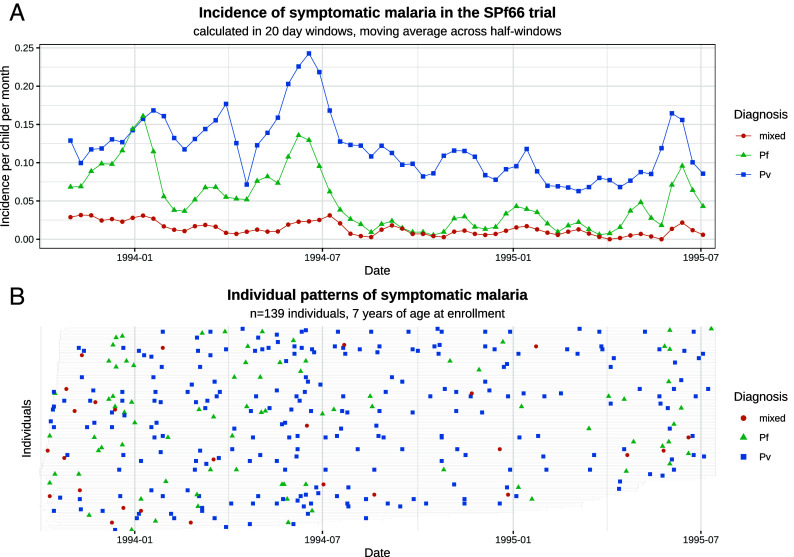
Fig. 1.
Fig. 1.
Symptomatic falciparum and vivax malaria in the SPf66 trial. Panel (A) shows the aggregate monthly incidence of symptomatic malaria (blue: P. vivax; green: P. falciparum; orange: mixed infections). Mixed infections are double-counted as vivax and falciparum episodes. Panel (B) shows individual data from all participants aged 7 y at enrollment (the gray bar shows the period of active detection; documented absences from the camp are not indicated).
Fig. 2.
Fig. 2.
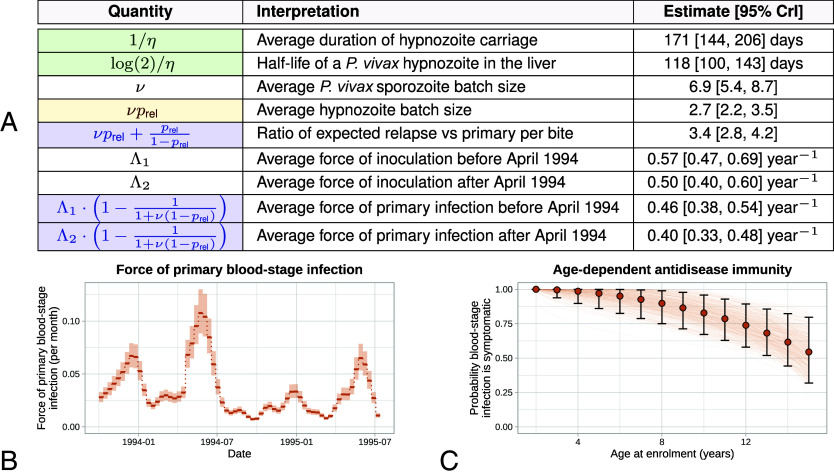
Summary of posterior model estimates. Panel (A) posterior median estimates [95% credible intervals (CrI)] for quantities of epidemiological interest. Blue: estimates robust to misspecification in the sporozoite batch distribution; yellow: estimates robust to misspecification of the hypnozoite fating probability; green: estimates robust to both forms of misspecification. Panel (B) force of primary blood-stage infection, with seasonality inferred from the incidence of symptomatic falciparum malaria over 10 d windows (shaded regions show 95% CrI). Scaling factors for the ratio of vivax to falciparum inoculation rates are estimated separately before and after April 1994 (day 200 of the study) when there was a camp-wide shift to artesunate-mefloquine treatment of falciparum malaria. Panel (C) age-dependent probability of symptomatic bloodstream vivax malaria infection, relative to a 2 y old. Error bars indicate 95% CrI for each age group; continuous curves are plotted for 200 parameter combinations (ρ,γ) sampled from the posterior distribution.
Fig. 3.
Fig. 3.
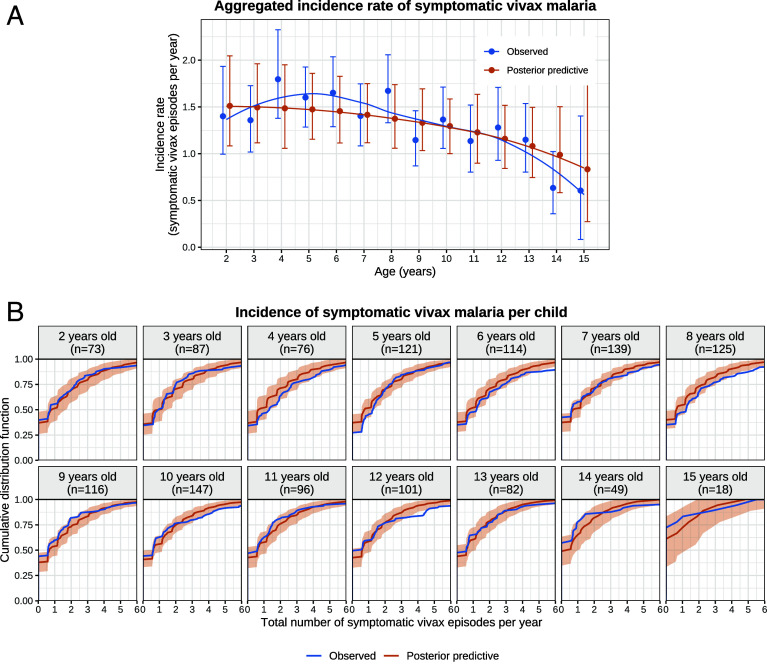
Characterizing the vivax malaria model fit by age group. Panel (A) shows the observed vs. posterior predictive incidence rate of symptomatic vivax malaria, stratified by age at enrollment; error bars show 95% bootstrap CIs for observed data, and 95% posterior predictive intervals. Panel (B) shows the cumulative distribution functions of the incidence of symptomatic vivax malaria per child. Shaded areas: 95% credible intervals. Simulation of data under the posterior predictive distribution is described in SI Appendix, Appendix C.2.1.
Fig. 4.
Fig. 4.
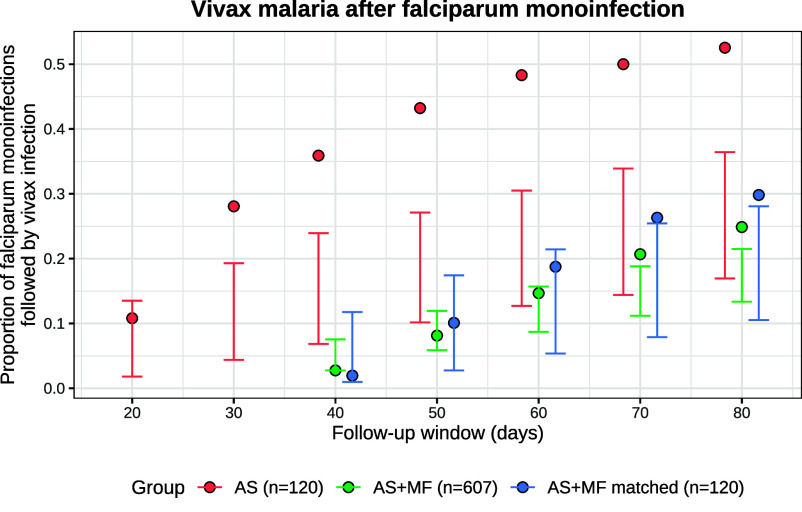
Vivax malaria following P. falciparum monoinfection in the SPf66 trial. Model-predicted conditional probabilities for each follow-up window are shown by the vertical bars (99% CrI). Observed proportions are shown by the filled circles. Red: artesunate (AS) monotherapy; green: artesunate-mefloquine combination therapy (AS+MF); blue: AS+MF episodes matched against AS episodes for the time of the baseline episode (to control for seasonality) and the history of P. vivax recurrence.
Fig. 5.
Fig. 5.
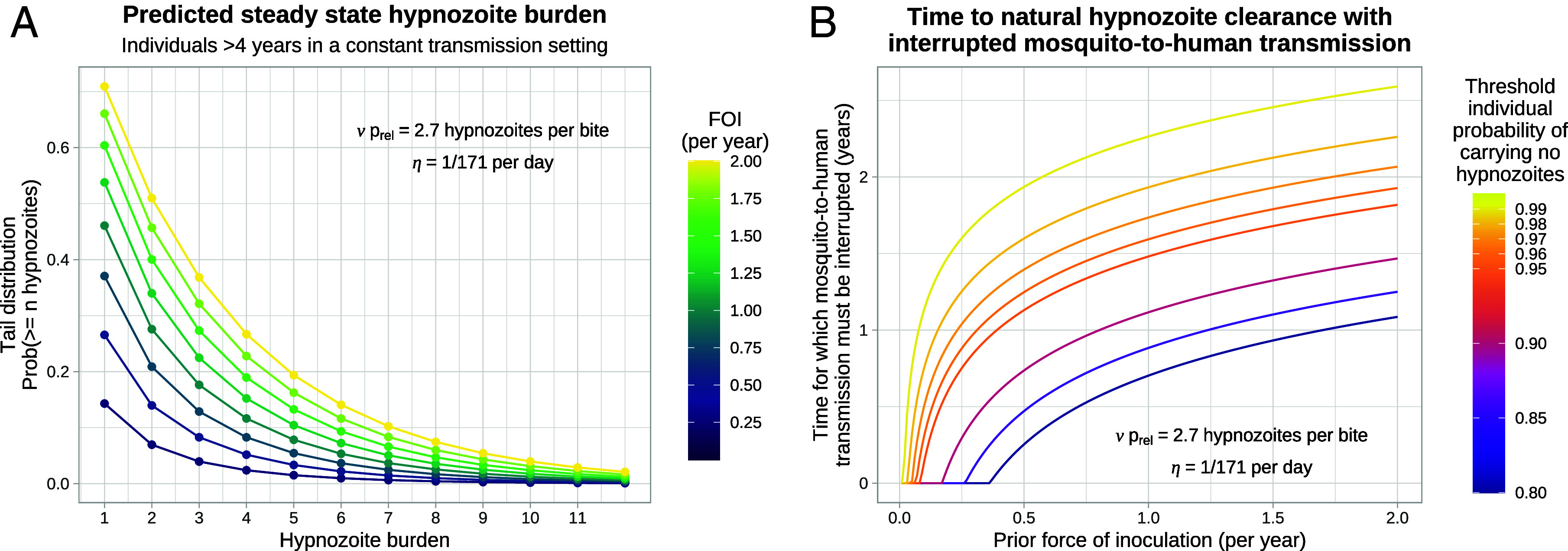
Overdispersion in the hypnozoite burdens across individuals and expected times until all hypnozoites clear naturally, as a function of the force of inoculation (FOI). Panel (A) shows the tail distribution for the size of the hypnozoite reservoir. Panel (B) shows the duration of time for which mosquito-to-human transmission must be interrupted for a individuals to clear all hypnozoites naturally with a threshold probability.
Fig. 6.
Fig. 6.
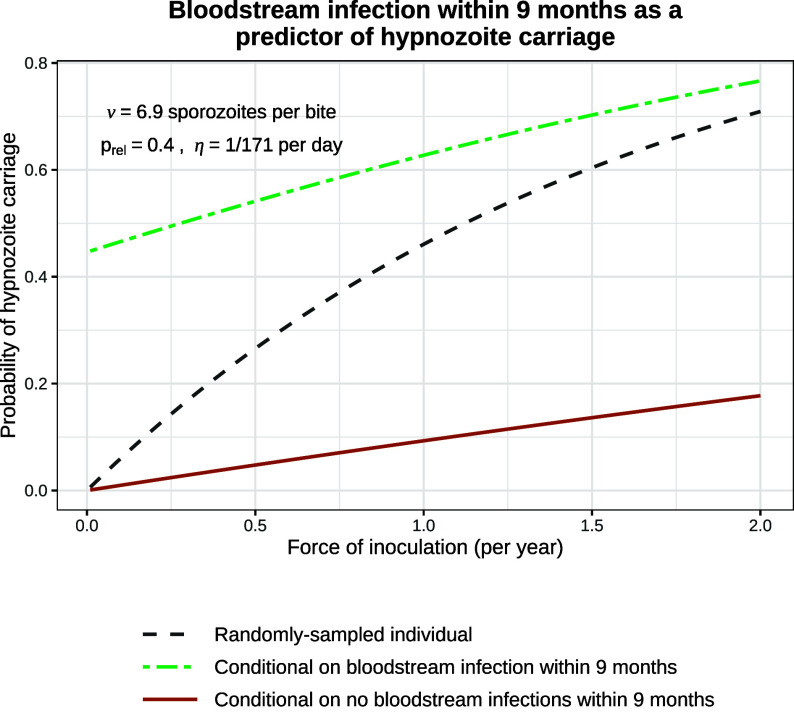
The probability of hypnozoite carriage. This compares the probability that a randomly sampled individual carries hypnozoites (dashed gray line) with the conditional probability given a bloodstream infection within the previous 9 mo (i.e. the positive predictive value, green) and the conditional probability given no bloodstream infection within the previous 9 mo (i.e. the false omission rate, maroon).
Fig. 7.
Fig. 7.
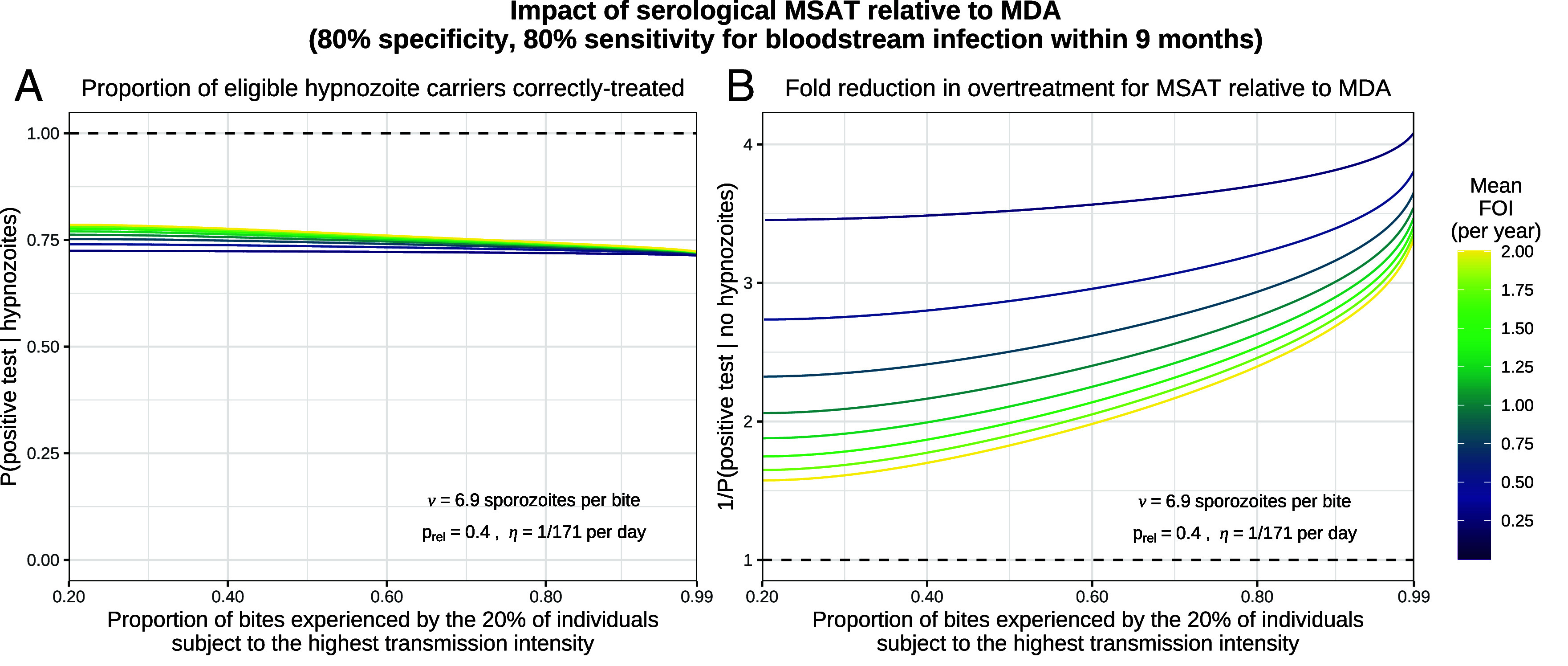
The modeled impact of serological MSAT (assuming 80% sensitivity and 80% specificity for bloodstream infection within 9 mo) relative to MDA, as a function of transmission intensity and population heterogeneity. We model each individual to be subject to a constant force of inoculation (FOI), sampled from a Gamma distribution (37) parameterized by the population mean and the proportion of bites experienced by the 20% of individuals subject to the highest transmission intensity. Panel (A) shows the proportion of eligible hypnozoite carriers who are correctly treated in the MSAT setting. Panel (B) shows the fold reduction in overtreatment for MSAT vs. MDA.
Fig. 8.
Fig. 8.
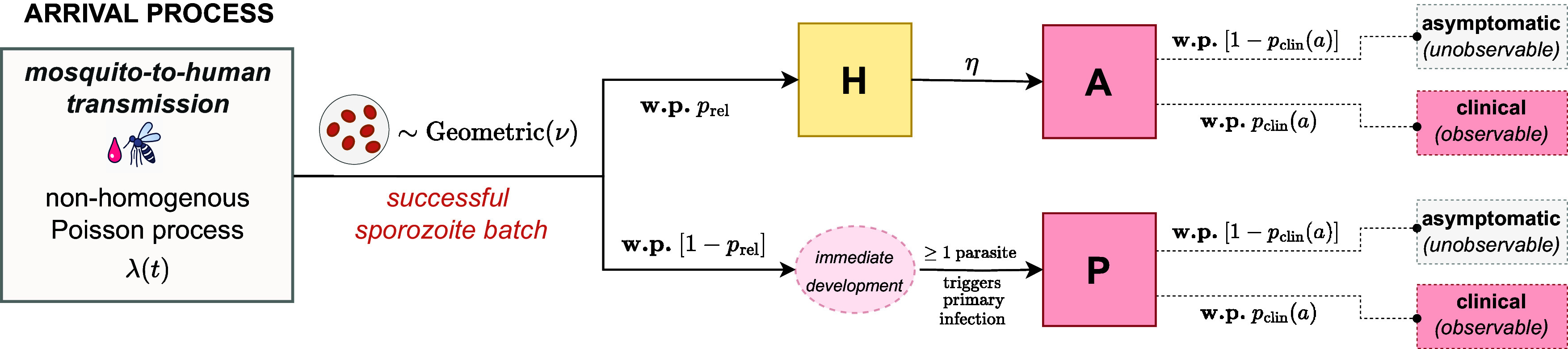
Schematic of the open network of infinite server queues used to model the burden of bloodstream infection (see SI Appendix, Appendix B.1 for a link to ref. 19). Adapted from figure 1 of ref. . w.p.: with probability.

References

    1. White N. J., Why do some primate malarias relapse? Trends Parasitol. 32, 918–920 (2016). - PMC - PubMed
    1. World Health Organization, WHO Guidelines for Malaria (World Health Organization, 2023).
    1. White N. J., Determinants of relapse periodicity in Plasmodium vivax malaria. Malar. J. 10, 297 (2011). - PMC - PubMed
    1. Schäfer C., Zanghi G., Vaughan A. M., Kappe S. H., Plasmodium vivax latent liver stage infection and relapse: Biological insights and new experimental tools. Annu. Rev. Microbiol. 75, 87–106 (2021). - PubMed
    1. Gural N., et al. , In vitro culture, drug sensitivity, and transcriptome of Plasmodium vivax hypnozoites. Cell Host Microbe 23, 395–406 (2018). - PMC - PubMed

MeSH terms

LinkOut - more resources