


Drivers of global tourism carbon emissions
- PMID: 39658580
- PMCID: PMC11631969
- DOI: 10.1038/s41467-024-54582-7
Drivers of global tourism carbon emissions
Abstract
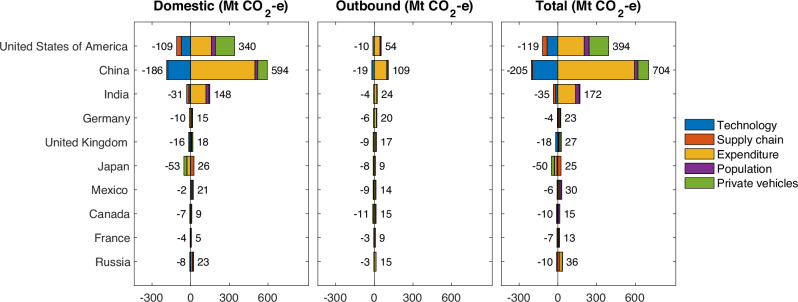
Tourism has a critical role to play in global carbon emissions pathway. This study estimates the global tourism carbon footprint and identifies the key drivers using environmentally extended input-output modelling. The results indicate that global tourism emissions grew 3.5% p.a. between 2009-2019, double that of the worldwide economy, reaching 5.2 Gt CO2-e or 8.8% of total global GHG emissions in 2019. The primary drivers of emissions growth are slow technology efficiency gains (0.3% p.a.) combined with sustained high growth in tourism demand (3.8% p.a. in constant 2009 prices). Tourism emissions are associated with alarming distributional inequalities. Under both destination- and resident-based accounting, the twenty highest-emitting countries contribute three-quarters of the global footprint. The disparity in per-capita tourism emissions between high- and low-income nations now exceeds two orders of magnitude. National tourism decarbonisation strategies will require demand volume thresholds to be defined to align global tourism with the Paris Agreement.
© 2024. The Author(s).
Conflict of interest statement
Competing interests: The authors declare no competing interests.
Figures



References
-
- UNWTO-ITF. Transport-related CO2 Emissions of the Tourism Sector – Modelling Results. (United Nations World Tourism Organization and International Transport Forum, 2019).
-
- UNWTO. Tourism Statistics, https://www.e-unwto.org/toc/unwtotfb/current (2024).
-
- World Travel & Tourism Council. Benchmarking Research Trends 2019 - How does travel & tourism compare to other sectors?, (World Travel and Tourism Council, 2019).
-
- UNWTO. Tourism Reocvery Tracker, https://www.unwto.org/news/tourism-unites-behind-the-glasgow-declaration... (2023).
-
- UNWTO. Tourism unites behind the Glasgow Declaration on climate action at COP26, https://www.unwto.org/news/tourism-unites-behind-the-glasgow-declaration... (2021).
LinkOut - more resources
Full Text Sources
Miscellaneous
