Review
. 2024 Nov 26:45:274-300.
doi: 10.1016/j.bioactmat.2024.11.027. eCollection 2025 Mar.

Microneedle technology for enhanced topical treatment of skin infections

Affiliations
Review

Microneedle technology for enhanced topical treatment of skin infections

Tingting Peng et al. Bioact Mater. .

Abstract

Skin infections caused by microbes such as bacteria, fungi, and viruses often lead to aberrant skin functions and appearance, eventually evolving into a significant risk to human health. Among different drug administration paradigms for skin infections, microneedles (MNs) have demonstrated superiority mainly because of their merits in enhancing drug delivery efficiency and reducing microbial resistance. Also, integrating biosensing functionality to MNs offers point-of-care wearable medical devices for analyzing specific pathogens, disease status, and drug pharmacokinetics, thus providing personalized therapy for skin infections. Herein, we do a timely update on the development of MN technology in skin infection management, with a special focus on how to devise MNs for personalized antimicrobial therapy. Notably, the advantages of state-of-the-art MNs for treating skin infections are pointed out, which include hijacking sequential drug transport barriers to enhance drug delivery efficiency and delivering various therapeutics (e.g., antibiotics, antimicrobial peptides, photosensitizers, metals, sonosensitizers, nanoenzyme, living bacteria, poly ionic liquid, and nanomoter). In addition, the nanoenzyme-based multimodal antimicrobial therapy is highlighted in addressing intractable infectious wounds. Furthermore, the MN-based biosensors used to identify pathogen types, track disease status, and quantify antibiotic concentrations are summarized. The limitations of antimicrobial MNs toward clinical translation are offered regarding large-scale production, quality control, and policy guidance. Finally, the future development of biosensing MNs with easy-to-use and intelligent properties and MN-based wearable drug delivery for home-based therapy are prospected. We hope this review will provide valuable guidance for future development in MN-mediated topical treatment of skin infections.

Keywords: Biosensing; Drug delivery systems; Microneedle; Skin infection; Topical treatment.


Conflict of interest statement

All authors declare that there is no conflict of interest in this paper.

Figures

Image 1
Graphical abstract
Fig. 1
Fig. 1
MNs are promising administration tools for managing skin infections: (a) Comparision of different administration routes, including transdermal preparations (e.g., cream, patch), hypodermic injections, and MNs. (b) MNs with proper design can hijack the sequential drug delivery barriers involved in skin infections. (c) MNs offer distinct advantages in managing skin infections.
Fig. 2
Fig. 2
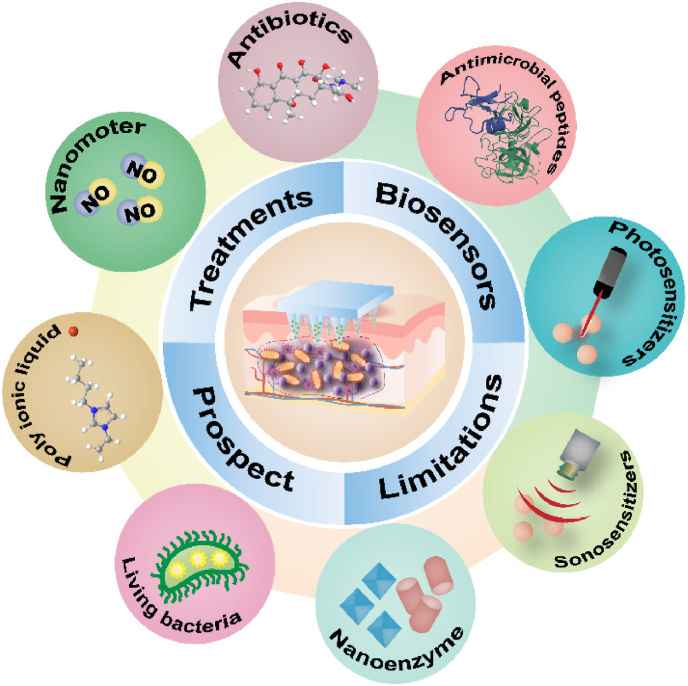
An overview of MNs used for skin infections, including treatments, biosensors, limitations, and prospect.
Fig. 3
Fig. 3
MN-mediated diverse treatments of bacterial skin infections. PDT: photodynamic therapy; PTT: photothermal therapy; MABT: metal-based antibacterial therapy; CDT: chemodynamic therapy; SDT: sonodynamic therapy; ST: starvation therapy; NABT: nanoenzyme antibacterial therapy; PIL: poly ionic liquid; NO: Nitric oxide; ROS: reactive oxygen species; H2O2: hydrogen peroxide; •O2: superoxide anion; •OH: hydroxyl radicals; O2: oxygen; POD: peroxidase; OXD: oxidase; GOx: glucose oxidase; CAT: catalase.
Fig. 4
Fig. 4
Antibiotics used for treating skin infections. (a) The antibacterial mechanism of antibiotics. PABA: p-aminobenzoic acid; THFA: tetrahydrofolate; DNA: deoxyribonucleic acid; RNA: ribonucleic acid. (b) Schematic illustrating the MN-mediated intradermal delivery of chloramphenicol-loaded gelatin NPs (CAM@GNP) to treat biofilm-induced skin infections. The CAM@GNP can be degraded explicitly by active bacteria-secreted gelatinase, thus providing responsive release of CAM at the site of infection and reducing off-target side effects. GNP: gelatin nanoparticles; CAM: chloramphenicol. (c) Schematic illustrating the utilization of dye (sulforhodamine B) solution to treat fluorescent protein (GFP)-labeled biofilms. (d) Schematics of inserting the sulforhodamine B-loaded MN patch into the skin and the release of dye into biofilms. Fluorescence microscope images displaying the spatial distribution of dye in GFP-labeled biofilms treated with (e) solution or (f) MN patch. The scale bar is 200 μm. Fig. 4b–f were reproduced from Ref. [37] with permission.
Fig. 5
Fig. 5
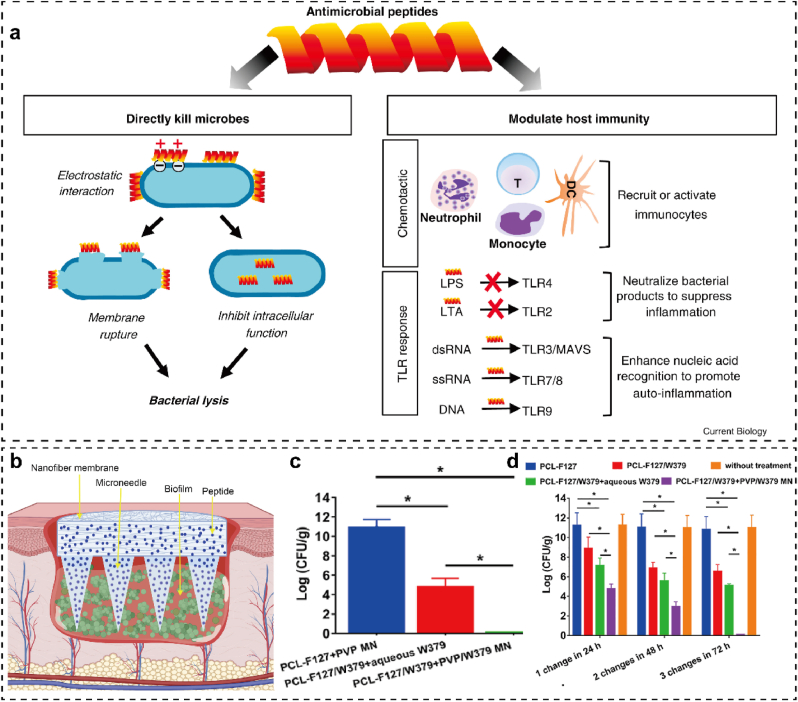
Antimicrobial peptides used for treating skin infections. (a) The antibacterial mechanism of antimicrobial peptides, including direct bacterial killing and modulating host immunity. Adapted from Ref. [48] with permission. (b) Development of W379 peptide-loaded MNs integrated with Janus-type antimicrobial dressings to treat biofilm-infected chronic wounds. In vivo anti-biofilm efficacy of W379 and Janus-type antimicrobial dressings against the biofilm-infected wounds established on the (c) type II diabetic mice and (d)ex vivo human skin. Adapted from Ref. [51] with permission.
Fig. 6
Fig. 6
PDT used for skin infections. (a) Antibacterial mechanism of PDT. S0 and Sn refer to the ground and excited singlet state of the photosensitizer molecule, respectively; ISC: intersystem crossing; T1: triplet excited state of the photosensitizer molecule; 3O2: ground state oxygen; 1O2: singlet oxygen; •O2−: superoxide anion; •HO: hydroxyl radical; H2O2: hydrogen peroxide. (b) Schematic illustration of MNs bearing ICG-loaded ZIF-8 for chemo-photodynamic therapy against acne vulgaris. (c) Representative images to show the appearance alterations in the P. acnes-infected ear before and after treatment. (d) Photographic images of the bacterial colonies harvested from the infectious ear showed the antibacterial effect of different treatments. Adapted from Ref. [61] with permission.
Fig. 7
Fig. 7
PTT used for skin infections: (a) Antibacterial mechanism of PTT. (b) The transmittance ratio of 808 and 1275 nm laser penetrating the porcine muscle with different thicknesses. Adapted from Ref. [70] with permission.
Fig. 8
Fig. 8
Photothermal MNs-based combinatory therapy for biofilm infection: (a) Construction of 4 K10@V2C-loaded MNs for membranolytic, photothermal, and photocatalytic triple therapy of skin bacterial infections. Adapted from Ref. [75] with permission; (b) Dissolving MNs loaded with α-amylase and PDA@Levo for the triple therapy of enzymolysis, chemotherapy, and PTT in biofilm-infected wounds. Adapted from Ref. [76] with permission; (c) The preparation process and antibiofilm mechanism of nanomotors-loaded MN patches used for biofilm-infected wounds. Adapted from Ref. [17] with permission.
Fig. 9
Fig. 9
Antibacterial mechanism of metal in the form of ions, oxide, and NPs.
Fig. 10
Fig. 10
Development of PFG/M MN for treating infected wound healing: (a-c) schematic illustration of preparing (a) Fe/PDA@GOx@HA, (b) (AP-MSN), and (c) PFG/M MN, (d) Therapeutic mechanism. TEOS: tetraethyl orthosilicate; CTAB: cetyltrimethylammonium bromide; APTES: 3-aminopropyltriethoxysilane. Adapted from Ref. [27] with permission.
Fig. 11
Fig. 11
SDT used for skin infections. (a) Antibacterial mechanism of SDT. (b) Schematic illustrating US-triggered and interfacial engineering-strengthened MN patch for topical acne treatment. Adapted from Ref. [26] with permission.
Fig. 12
Fig. 12
Schematic illustration of NABT used as an “all-in-one” treatment strategy for skin bacterial infection. Based on the antibacterial mechanism, the nanoenzymes can be divided into POD-like and OXD-like ones. The activity of nanoenzymes can be modulated by introducing external stimuli (e.g., light, ultrasound, metabolic regulator). Benefiting from the multiple antibacterial, anti-inflammatory, and immunomodulatory activities of nanoenzymes, NABT could provide an “all-in-one” therapy for skin infections.
Fig. 13
Fig. 13
MN-mediated codelivery of nanoenzyme and antimicrobial peptide for combined treatment of DCFI. (a) Schematic illustration of CuS/PAF-26 MNs to treat DCFI. In vitro antifungal activity: (b) Representative images and (c) quantitative analysis of C. albicans colonies treated with different agents, (d) Antifungal rate of different treatments against C. albicans, (e) Changes in drug resistance of C. albicans after treatment with CuS/PAF-26 MN and amphotericin. The therapeutic efficacy of CuS/PAF-26 MNs to treat DCFI: (f) Periodic Acid-Schiff (PAS) staining percentage of different treatment groups versus the control group to demonstrate the in vivo antifungal activity, (g) Change of the fungal infected nodule sizes (normalized to the initial size) after different treatments. Adapted from Ref. [141] with permission.
Fig. 14
Fig. 14
Schematic illustration of PILMN-NO MN for treating deep skin fungal infection through the multiple actions of fungal killing, antiinflammation, and angiogenesis. Adapted from Ref. [152] with permission.
Fig. 15
Fig. 15
MNs used for the diagnosis and treatment of skin infections. (a) Schematic illustration of IS-SERS-MNs integrated with surface-enhanced Raman scattering technique for bacterial infection diagnosis via ISF route. Adapted from Ref. [20] with permission. (b) Preparation and (c) therapeutic mechanism of FNDs-loaded MNs for MRSA-infected wounds. Adapted from Ref. [161] with permission.
Fig. 16
Fig. 16
Development of biosensing MNs for real-time monitoring of antibiotic pharmacokinetics. The procedures involved in (a) conventional TDM and (b) wearable TDM. (c) The process of μNEAB-patch used to real-time track the pharmacokinetics of antibiotics in ISF. (d) Schematic illustration of using μNEAB-patch to conduct TDM in a rat model.
Fig. 17
Fig. 17
Existing issues and the potential solutions involved in the clinical translation of antimicrobial MNs: (a) Various adverse reactions associated with the administration of MNs, (b) Inconsistent pharmacokinetics caused by varied drug delivery accuracy and efficiency, (c) Lack of quality evaluation guidelines to ensure pharmacodynamics, and (d) The issues of biosafety, reliability, and intelligence hinder the translation of MN-based sensors.

References

    1. Liu W., Gao R., Yang C., Feng Z., Ou-Yang W., Pan X., Huang P., Zhang C., Kong D., Wang W. ECM-mimetic immunomodulatory hydrogel for methicillin-resistant Staphylococcus aureus-infected chronic skin wound healing. Sci. Adv. 2022;8 - PMC - PubMed
    1. Chin J.S., Madden L., Chew S.Y., Becker D.L. Drug therapies and delivery mechanisms to treat perturbed skin wound healing. Adv. Drug Deliv. Rev. 2019;149–150:2–18. - PubMed
    1. Anjani Q.K., Sabri A.H.B., Hutton A.J., Cárcamo-Martínez Á., Wardoyo L.A.H., Mansoor A.Z., Donnelly R.F. Microarray patches for managing infections at a global scale. J. Contr. Release. 2023;359:97–115. - PubMed
    1. Phatale V., Vaiphei K.K., Jha S., Patil D., Agrawal M., Alexander A. Overcoming skin barriers through advanced transdermal drug delivery approaches. J. Contr. Release. 2022;351:361–380. - PubMed
    1. Long L., Ji D., Hu C., Yang L., Tang S., Wang Y. Microneedles for in situ tissue regeneration. Mater Today Bio. 2023;19 - PMC - PubMed

LinkOut - more resources