Clinical Trial
. 2024 Nov 26:15:1482715.
doi: 10.3389/fimmu.2024.1482715. eCollection 2024.

Warehouse-based, immunopeptidome-guided design of personalised peptide vaccines shows feasibility in clinical trial evaluation in CLL patients

Affiliations
Clinical Trial

Warehouse-based, immunopeptidome-guided design of personalised peptide vaccines shows feasibility in clinical trial evaluation in CLL patients

Jonas S Heitmann et al. Front Immunol. .

Abstract

Cancer peptide vaccination represents a promising therapeutic approach, but has been hampered by lack of suitable antigens and restricted applicability due to different HLA backgrounds of individual patients. We here introduce a novel warehouse-based concept for composition of personalized peptide vaccines and report on its successful application in a Phase II clinical trial in patients with chronic lymphocytic leukemia (CLL) after first-line therapy. 26 CLL patients in at least partial remission (PR) after 6 months of immuno-chemotherapy were vaccinated with a personalized vaccine compiled from a premanufactured peptide warehouse comprising immunopeptidome-defined CLL-associated peptides. Primary objective was evaluation of immunogenicity, secondary objectives were safety and minimal residual disease (MRD) response. Immunopeptidome-guided vaccine composition was throughout successful, proving the feasibility of warehouse-based vaccine design. Vaccination was well tolerated, with local injection site reactions being the most common adverse event. Only few patients showed vaccine-induced T cell responses, attributable to their inability to mount strong immune responses due to immune-chemotherapy and lack of potent adjuvant formulations. Both issues are addressed within a follow-up trial (NCT04688385), combining the immunopeptidome-guided warehouse-based vaccine design reported here with a potent novel adjuvant evaluating personalized multi- peptide vaccination in CLL patients under T cell supportive BTK inhibitor therapies.

Clinical trial registration: www.clinicaltrialsregister.eu, identifier NCT02802943.

Keywords: CLL; immunopeptidome; peptide; trial; vaccine; warehouse.


Conflict of interest statement

H-GR and JW are listed as inventors on a patent related to the CLL vaccine cocktail. The remaining authors declare that the research was conducted in the absence of any commercial or financial relationships that could be construed as a potential conflict of interest.

Figures
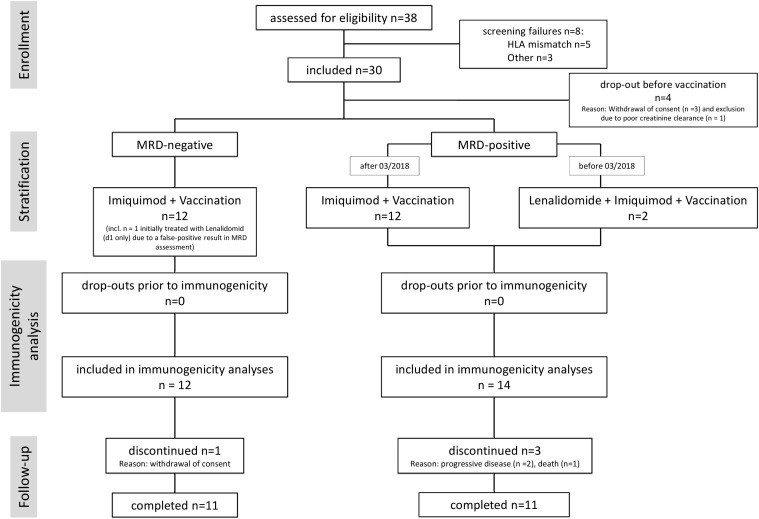
Figure 1
Figure 1
Consort flow diagram of the trial. 8 patients did not meet the inclusion criteria at screening and accordingly were not enrolled in the trial. 30 patients were enrolled in the trial, of which 4 dropped out prior to vaccination. Overall 26 patients received at least one dose of the personalized vaccine. Prior to vaccination 12 patients were minimal residual disease (MRD) negative and 14 patients MRD positive, of those latter three received lenalidomide as immune stimulator. All patients of the MRD positive arm could be included in the immunogenicity analysis, 1 patient in the MRD negative arm dropped out prior to immunogenicity analysis. All enrolled patients were assessable for safety. n, number.
Figure 2
Figure 2
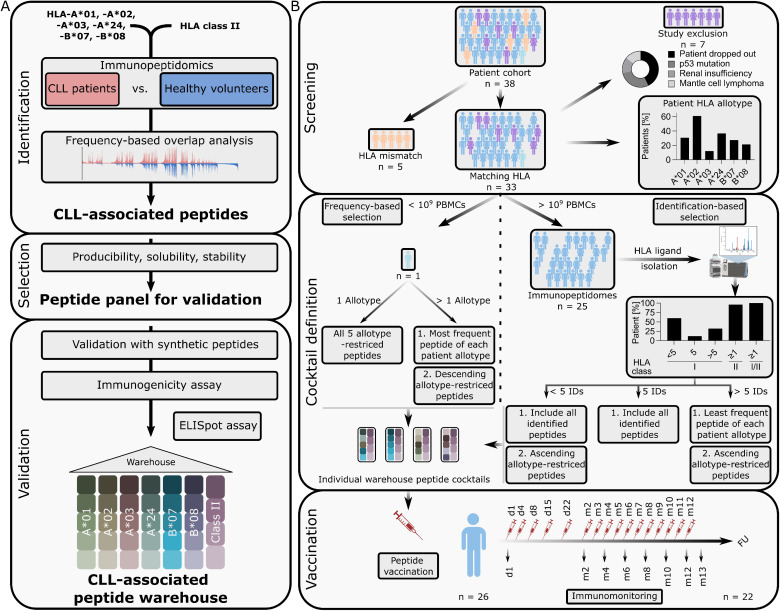
CLL-associated peptide warehouse establishment and application in clinical trial. (A) Chronic lymphocytic leukemia (CLL)-associated peptide warehouse establishment illustrated in a schematic workflow. A frequency-based overlap analysis was performed on peripheral blood mononuclear cells (PBMC)-derived immunopeptidomes of CLL-patients versus healthy volunteer samples. Peptide candidates were evaluated for producibility, solubility and stability and were validated by mass spectrometry (MS) using synthetic peptides. All warehouse peptides were further tested to be immunogenic. Five peptides were selected per human leukocyte antigen (HLA) class I allotype (HLA-A*01, HLA-A*02, HLA-A*03, HLA-A*24, HLA-B*07, HLA-B*08) and four peptides were selected for HLA class II. (B) Application of CLL-associated peptide warehouse. A CLL patient cohort (n = 38) was screened for warehouse matching HLA allotypes and other exclusion criteria as shown in the donut plot. Percentage of HLA class I allotypes of the HLA-matching patient cohort (n = 33) is shown in the upper panel (bar graph). Exclusions and corresponding exclusion criteria are shown as fraction of whole in a donut plot. Immunopeptidomes (n = 25) were analyzed and categorized in <5, 5 or >5 detected HLA class I-restricted warehouse peptides, ≥1 detected HLA class II-restricted warehouse peptides and respective length variants, or ≥1 overall warehouse peptides (HLA class I- or HLA class II-restricted including length variants (I/II)) per study patient. Vaccination took place on day (d) 1, d4, d8, d15, d22, followed by vaccinations every 4 weeks for 1 year. Immunomonitoring was performed with blood samples from d1, month (m) m2, m4, m6, m8, m10, m12, m13 and at m18 the follow-up (FU). Identifications (IDs).
Figure 3
Figure 3
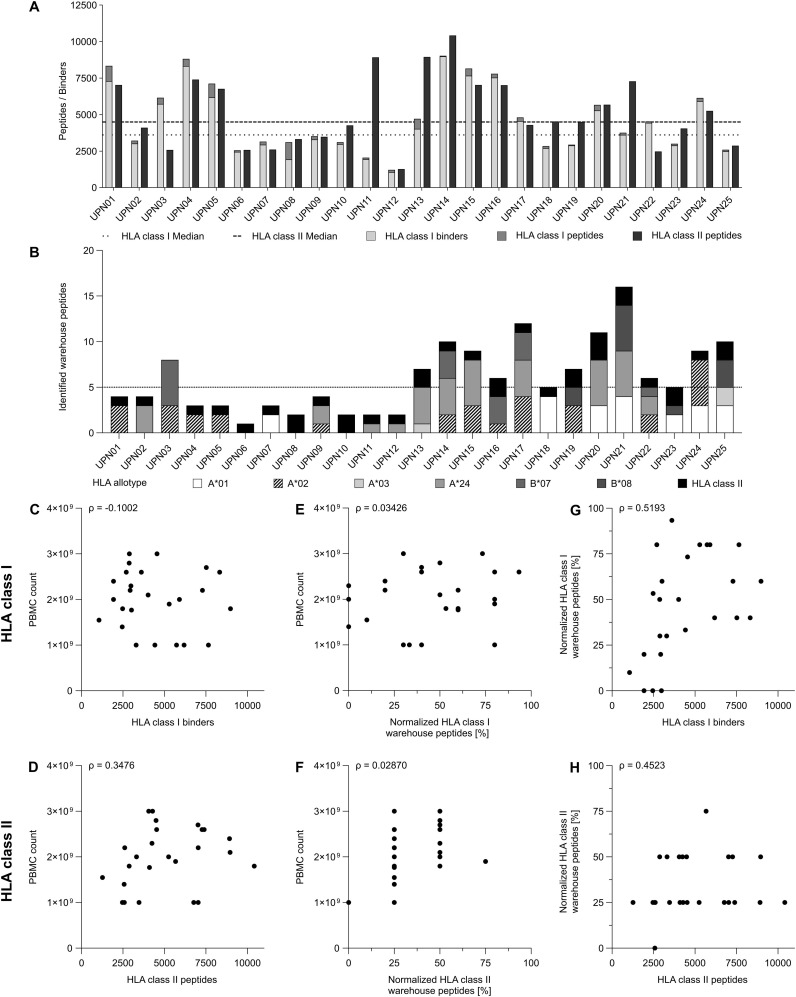
Identification and correlation analysis of study patient immunopeptidome and warehouse peptides. (A) Bar graph of human leukocyte (HLA) class I and HLA class II-presented peptide yields, as well as the corresponding predicted HLA class I binders on the patient’s HLA allotype superimposed with HLA class I-presented peptide yields. HLA class I binder yields are visualized as light grey, peptide yields as grey and HLA class II peptide yields as dark grey bars. Median yields are depicted as dotted (HLA class I binders) and dashed (HLA class II-restricted peptides) lines. (B) Bar graph of warehouse peptide identification in the respective patient’s immunopeptidome. HLA-restriction of warehouse peptides is visualized in different grey-scales and patterns. Median warehouse peptide identifications are represented as dotted line. (C-H) Scatter plot indicating (C, D) the relationship between peripheral blood mononuclear cell (PBMC) count and (C) HLA class I binder yields or (D) HLA class II-restricted peptide yields, (E, F) the relationship between PBMC count and (E) HLA allotype normalized HLA class I warehouse peptide identifications or (F) HLA class II warehouse peptide identifications (and respective length variants) and (G) HLA allotype normalized HLA class I-restricted warehouse peptide identifications and HLA class I binder yields or (H) HLA class II-restricted warehouse peptide identifications (and respective length variants) and HLA class II peptide yields. (C-H) Statistical analyses were performed using non-parametric Spearman correlation analysis. Spearman’s rho (ρ) are given in the top left of each subfigure.
Figure 4
Figure 4
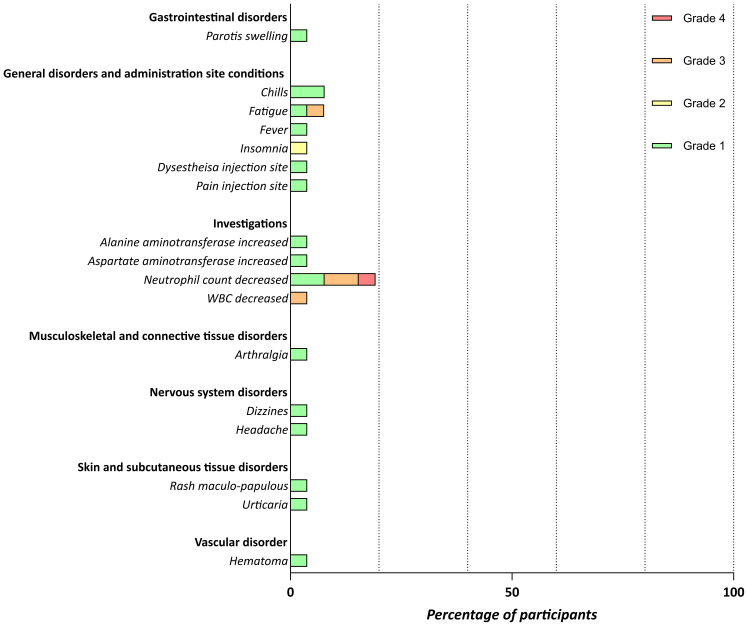
Safety of the personalized vaccination. Related adverse events (AEs) documented until last assessment. Severity was graded as mild (grade 1), moderate (grade 2), severe (grade 3), or life-threatening (grade 4) based on CTCAE V4.03.
Figure 5
Figure 5
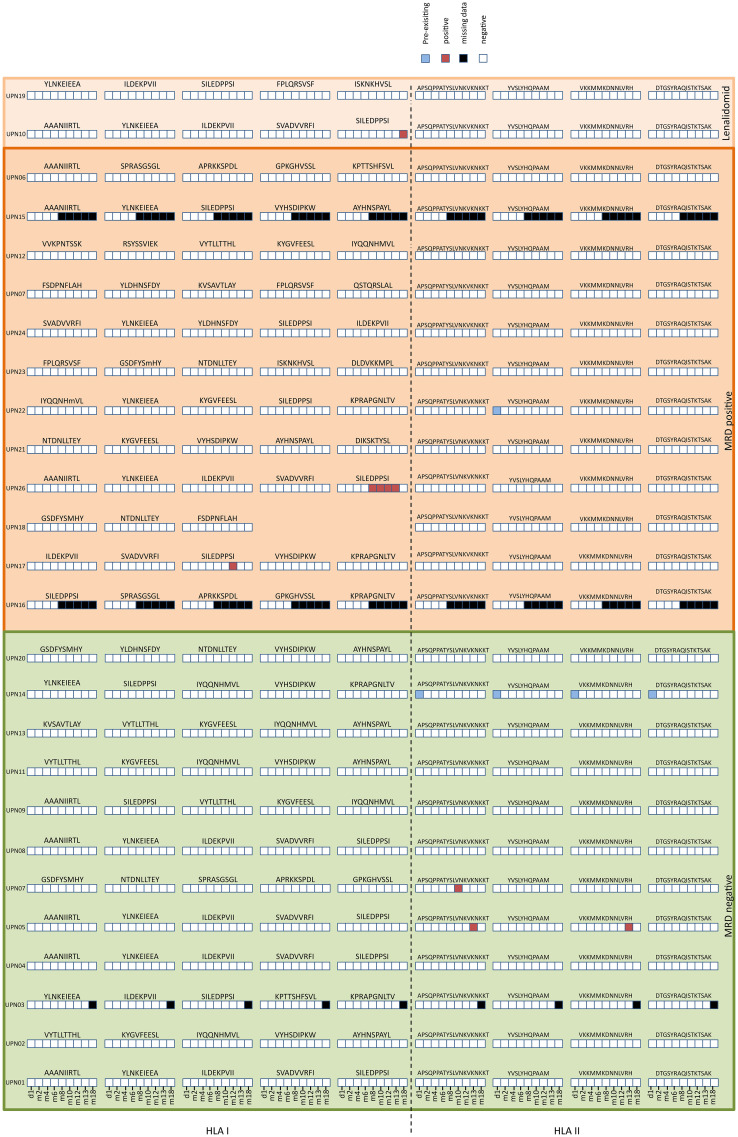
Immunogenicity of the personalized vaccination. Heatmap of personalized vaccine-induced T cell responses assessed after 12 days in vitro expansion by IFN-γ ELISpot assays using PBMCs from study patients collected before administration and at different time points after first administration (d1, m2, m4, m6, m8, m10, m12, m13, m18). T cell responses were assessed as pre-existing (positive prior to vaccination), positive, negative, missing data.

References

    1. Siegel RL, Giaquinto AN, Jemal A. Cancer statistics, 2024. CA Cancer J Clin. (2024) 74:12–49. doi: 10.3322/caac.21820 - DOI - PubMed
    1. Shadman M. Diagnosis and treatment of chronic lymphocytic leukemia: A review. JAMA. (2023) 329:918–32. doi: 10.1001/jama.2023.1946 - DOI - PubMed
    1. Coombs CC. Frontline therapy of CLL-changing treatment paradigms. Curr Hematol Malig Rep. (2024) 19(2):65–74. doi: 10.1007/s11899-024-00726-x - DOI - PubMed
    1. Cramer P, von Tresckow J, Bahlo J, Engelke A, Langerbeins P, Fink AM, et al. . CLL2-BXX Phase II trials: sequential, targeted treatment for eradication of minimal residual disease in chronic lymphocytic leukemia. Future Oncol. (2018) 14:499–513. doi: 10.2217/fon-2017-0442 - DOI - PubMed
    1. Cramer P, von Tresckow J, Bahlo J, Robrecht S, Langerbeins P, Al-Sawaf O, et al. . Bendamustine followed by obinutuzumab and venetoclax in chronic lymphocytic leukaemia (CLL2-BAG): primary endpoint analysis of a multicentre, open-label, phase 2 trial. Lancet Oncol. (2018) 19:1215–28. doi: 10.1016/S1470-2045(18)30414-5 - DOI - PubMed

Publication types

Associated data

LinkOut - more resources