. 2024 Dec 2;7(12):e2450241.
doi: 10.1001/jamanetworkopen.2024.50241.

Global Healthspan-Lifespan Gaps Among 183 World Health Organization Member States

Affiliations

Global Healthspan-Lifespan Gaps Among 183 World Health Organization Member States

Armin Garmany et al. JAMA Netw Open. .

Abstract

Importance: Health-adjusted life expectancy, a measure of healthy longevity, lags longevity gains, resulting in a healthspan-lifespan gap.

Objective: To quantify the healthspan-lifespan gap across the globe, investigate for sex disparities, and analyze morbidity and mortality associations.

Design, setting, and participants: This retrospective cross-sectional study used the World Health Organization (WHO) Global Health Observatory as the global data source and acquired national-level data covering all continents. The 183 WHO member states were investigated. Statistical analysis was conducted from January to May 2024.

Exposures: Data represent 2 decades of longitudinal follow-up.

Main outcomes and measures: Changes in life expectancy and health-adjusted life expectancy, as well as the healthspan-lifespan gap were quantified for all participating member states. Gap assessment was stratified by sex. Correlations of the gap with morbidity and mortality were examined.

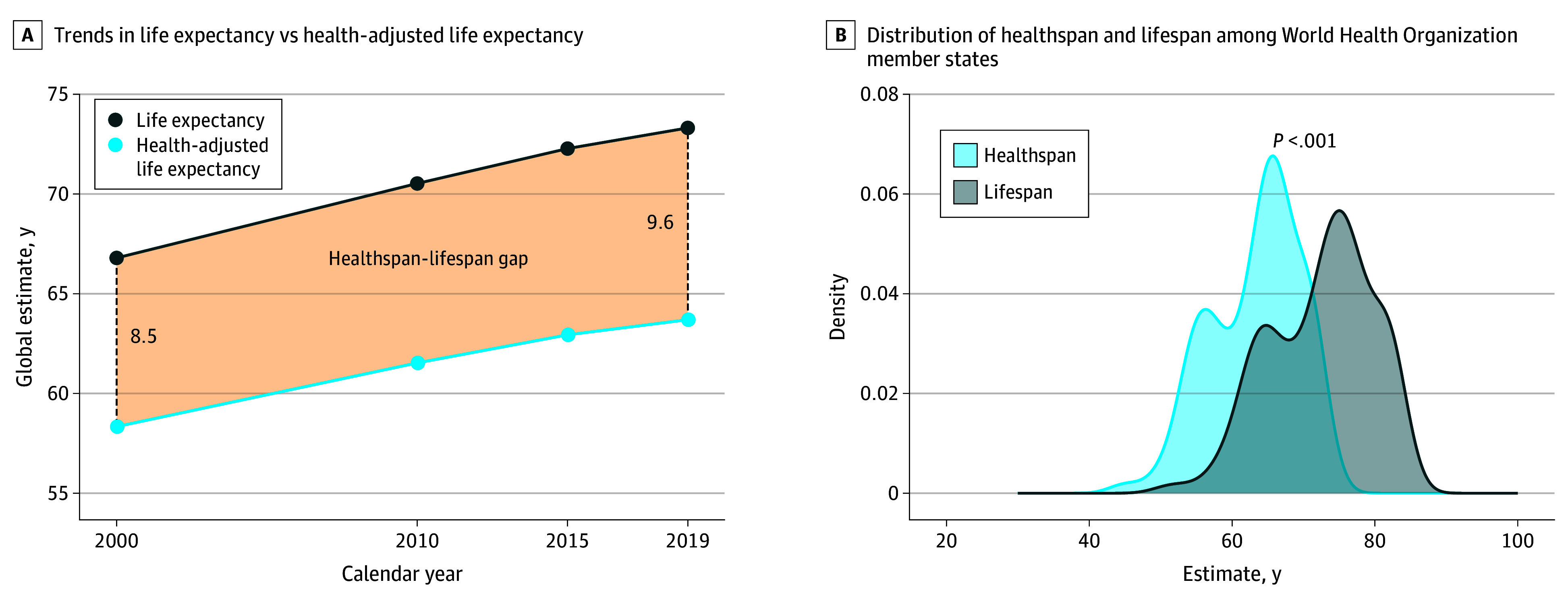
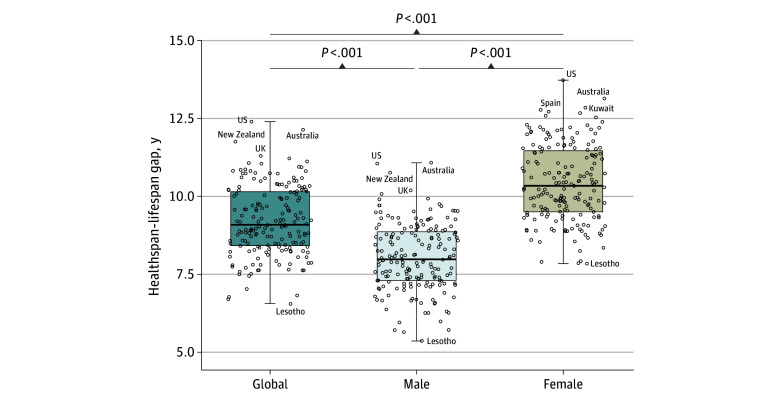
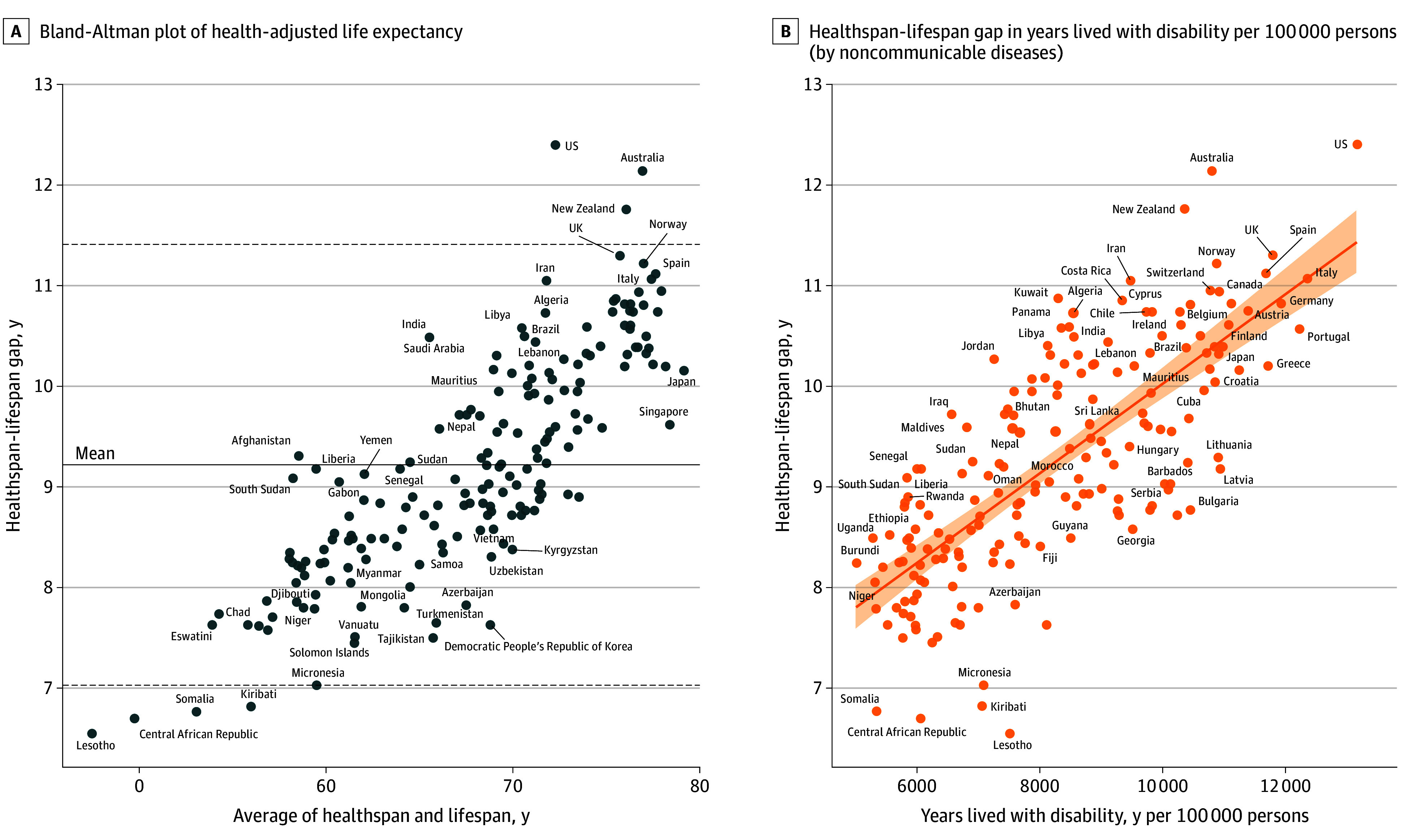
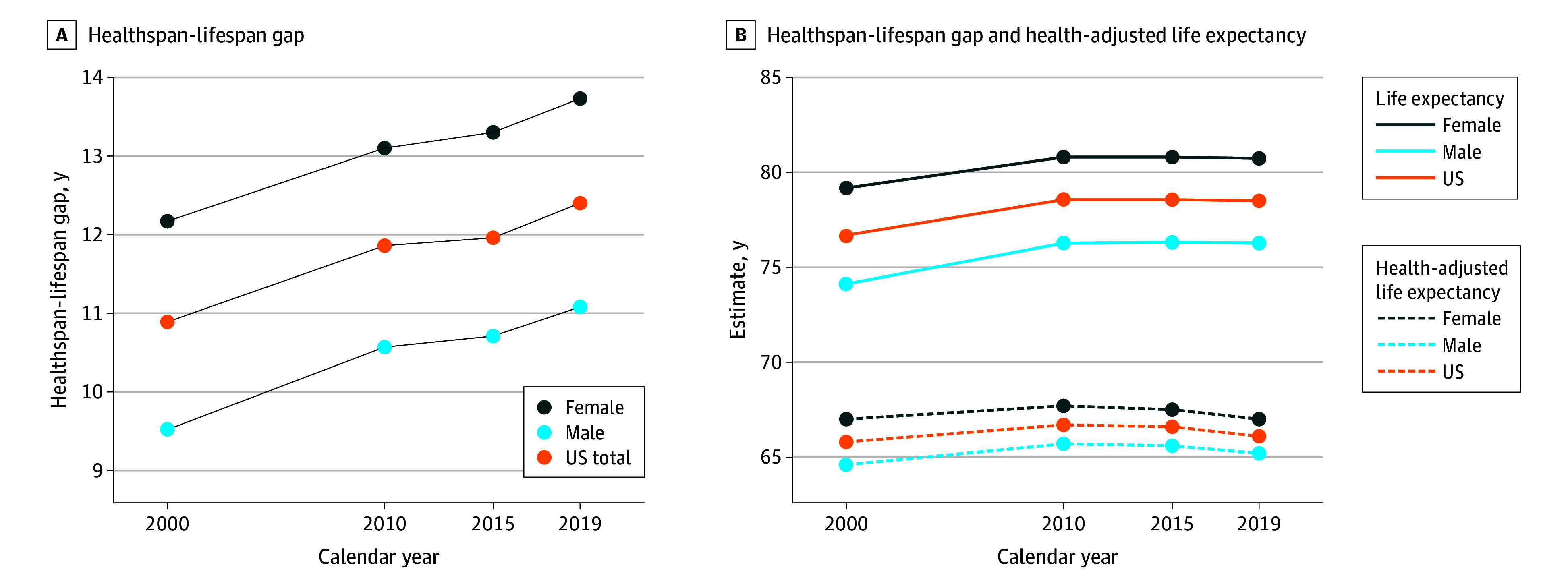
Results: The healthspan-lifespan gap has widened globally over the last 2 decades among 183 WHO member states, extending to 9.6 years. A sex difference was observed with women presenting a mean (SD) healthspan-lifespan gap of 2.4 (0.5) years wider than men (P < .001). Healthspan-lifespan gaps were positively associated with the burden of noncommunicable diseases and total morbidity, and negatively with mortality. The US presented the largest healthspan-lifespan gap, amounting to 12.4 years, underpinned by a rise in noncommunicable diseases.

Conclusions and relevance: This study identifies growing healthspan-lifespan gaps around the globe, threatening healthy longevity across worldwide populations. Women globally exhibited a larger healthspan-lifespan gap than men.


Conflict of interest statement

Conflict of Interest Disclosures: None reported.

Figures

Figure 1.
Figure 1.. Global Life Expectancy, Health-Adjusted Life Expectancy, and Healthspan-Lifespan Gap
A, Trends of life expectancy, health-adjusted life expectancy, and healthspan-lifespan gap. B, Distribution of healthspan and lifespan among 183 World Health Organization member states.
Figure 2.
Figure 2.. Healthspan-Lifespan Gaps for Individual World Health Organization Member States Stratified by Sex
Boxplot represents 75th percentile, 50th percentile, and 25th percentile. Whiskers extend to the most extreme value within 1.5 times the IQR. Dots indicate individual countries.
Figure 3.
Figure 3.. Healthspan-Lifespan Gap Associations With Life Expectancy and Disease Burden
A, Bland-Altman plot of the health-adjusted life expectancy and life expectancy. Solid line represents the mean healthspan-lifespan gap. Dotted lines represent the 95% CI for the healthspan-lifespan gap. B, The healthspan-lifespan gap as a function of years lived with disability per 100 000 persons contributed by noncommunicable diseases. Solid line represents the line of best fit and the shaded ribbon represents the 95% CI for the regression line.
Figure 4.
Figure 4.. US Trends
A, The US healthspan-lifespan gap with stratification by sex. B, US life expectancy and health-adjusted life expectancy with stratification by sex.
Figure 5.
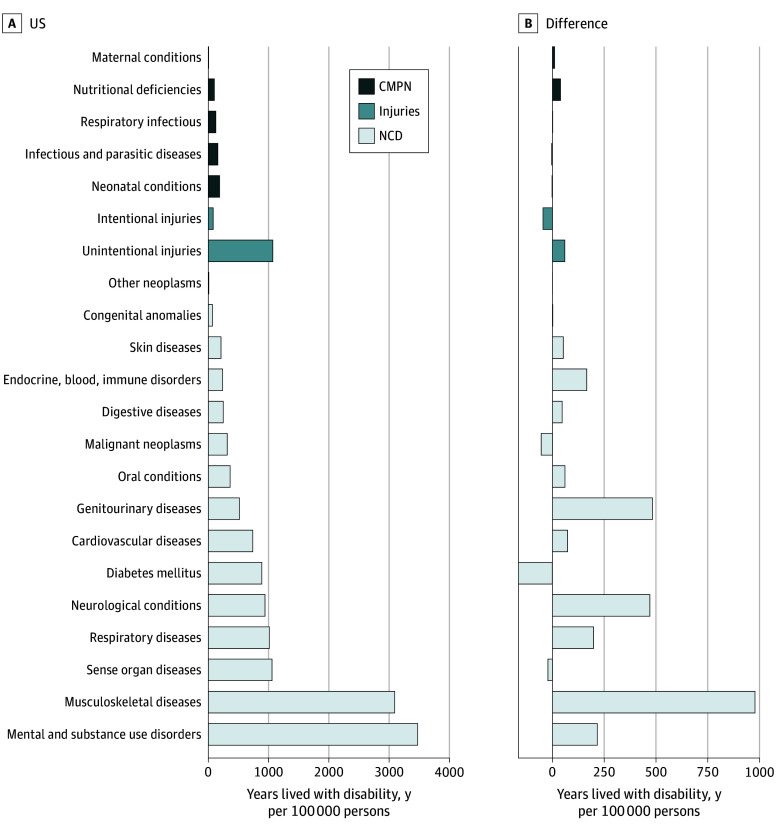
Figure 5.. Years Lived With Disability Contributed by Disease Groups With Sex Differences in the US
CMPN indicates communicable, maternal, perinatal and nutritional conditions; NCD, noncommunicable diseases.

References

    1. Garmany A, Yamada S, Terzic A. Longevity leap: mind the healthspan gap. NPJ Regen Med. 2021;6(1):57. doi: 10.1038/s41536-021-00169-5 - DOI - PMC - PubMed
    1. Olshansky SJ. From lifespan to healthspan. JAMA. 2018;320(13):1323-1324. doi: 10.1001/jama.2018.12621 - DOI - PubMed
    1. Putot A, Putot S, Hacquin A, Manckoundia P. Beyond longevity: healthy longevity. Lancet Healthy Longev. 2021;2(7):e393-e394. doi: 10.1016/S2666-7568(21)00141-0 - DOI - PubMed
    1. Molla MT, Wagener DK, Madans JH. Summary measures of population health: Methods for calculating healthy life expectancy. Healthy People 2010 Stat Notes. 2001;(21):1-11. doi: 10.1037/e583762012-001 - DOI - PubMed
    1. Islam MS, Mondal MNI, Tareque MI, et al. Correlates of healthy life expectancy in low- and lower-middle-income countries. BMC Public Health. 2018;18(1):476. doi: 10.1186/s12889-018-5377-x - DOI - PMC - PubMed

Publication types