Complement Activation Profiles Predict Clinical Outcomes in Myelin Oligodendrocyte Glycoprotein Antibody-Associated Disease
- PMID: 39661937
- PMCID: PMC11637507
- DOI: 10.1212/NXI.0000000000200340
Complement Activation Profiles Predict Clinical Outcomes in Myelin Oligodendrocyte Glycoprotein Antibody-Associated Disease
Abstract
Background and objectives: The role of the complement system in myelin oligodendrocyte glycoprotein antibody-associated disease (MOGAD) is not completely understood, and studies exploring its potential utility for diagnosis and prognosis are lacking. We aimed to investigate the value of complement factors (CFs) as diagnostic and prognostic biomarkers in patients with MOGAD.
Methods: Multicentric retrospective cohort study including patients with MOGAD, multiple sclerosis (MS) and aquaporin-4 seropositive neuromyelitis optica spectrum disorder (AQP4-NMOSD) with available paired serum and CSF samples. A panel of CFs were measured by multiplex ELISA, and the levels were compared between the 3 conditions. Univariable and multivariable analyses were performed to evaluate the association between levels of CFs and relapse and disability outcomes in MOGAD patients.
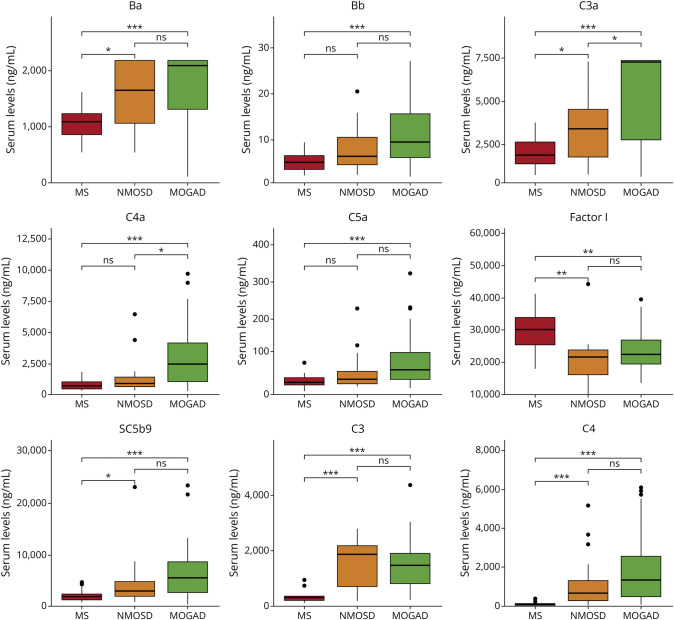
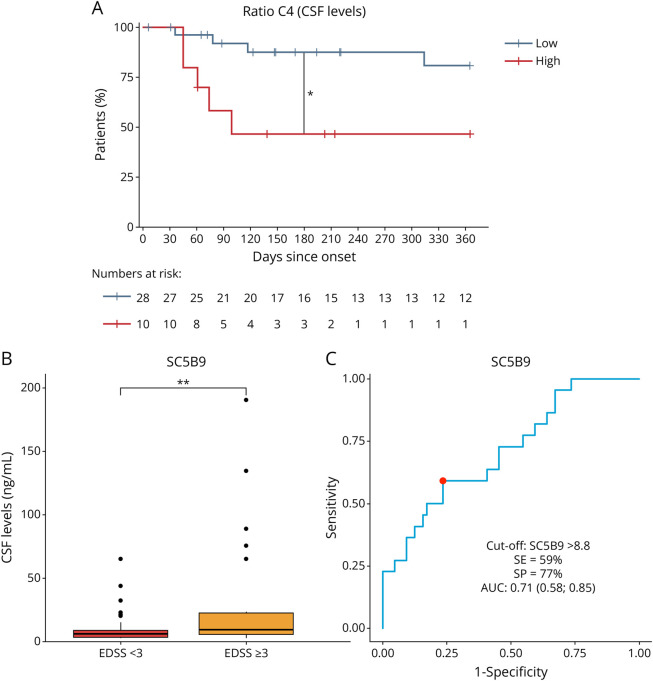
Results: Ninety-four patients (MOGAD, n = 60; MS, n = 18; AQP4-NMOSD, n = 16) were included. Mean (SD) age at sampling was 39.4 (16.7), 40.7 (7.0), and 43.3 (21.0), respectively. Female were predominant, especially in AQP4-NMOSD (88%). Combination of the serum levels of C3a, C4a, and C3a/C3 ratio showed excellent potential to discriminate MOGAD from patients with MS (area under the curve [AUC] [95% CI] 0.95 [0.90-0.99]) and from AQP4-NMOSD (AUC 0.88 [0.76-1.00]). In patients with MOGAD, CSF levels of CFs of the classical/lectin pathway influenced relapse-related outcomes, and lower C4 levels were associated with higher number of relapses during follow-up (incidence rate ratio [95% CI] 0.88 [0.78-0.99]; p = 0.04 in multivariable analysis), and a high C4a/C4 ratio was associated with increased risk of second relapse during the first year (hazard ratio [95% CI] 3.68 [1.26-10.78]; p = 0.02 in multivariable analysis). Time to second relapse was shorter in patients with MOGAD with a high CSF C4a/C4 ratio (log-rank p = 0.01). CSF levels of the membrane attack complex SC5b9 influenced disability-related outcomes, and baseline CSF SC5b9 levels were higher in patients who reached the final Expanded Disability Status Scale (EDSS) ≥ 3.0 (p = 0.002), and elevated SC5b9 levels were associated with increased risk of reaching EDSS ≥ 3.0 (odds ratio [95% CI] 1.79 [1.16-3.67]; p = 0.04 in multivariable analyses).
Discussion: Our results suggest that serum and CSF levels of CFs have diagnostic and prognostic value respectively in patients with MOGAD. These findings support the use of complement inhibitors as a therapeutic approach in these patients.
Conflict of interest statement
The authors report no relevant disclosures. Go to
Figures
References
Publication types
MeSH terms
Substances
LinkOut - more resources
Full Text Sources
Miscellaneous