


Mixed strongyle parasite infections vary across host age and space in a population of feral horses
- PMID: 39663810
- PMCID: PMC11894017
- DOI: 10.1017/S0031182024001185
Mixed strongyle parasite infections vary across host age and space in a population of feral horses
Abstract
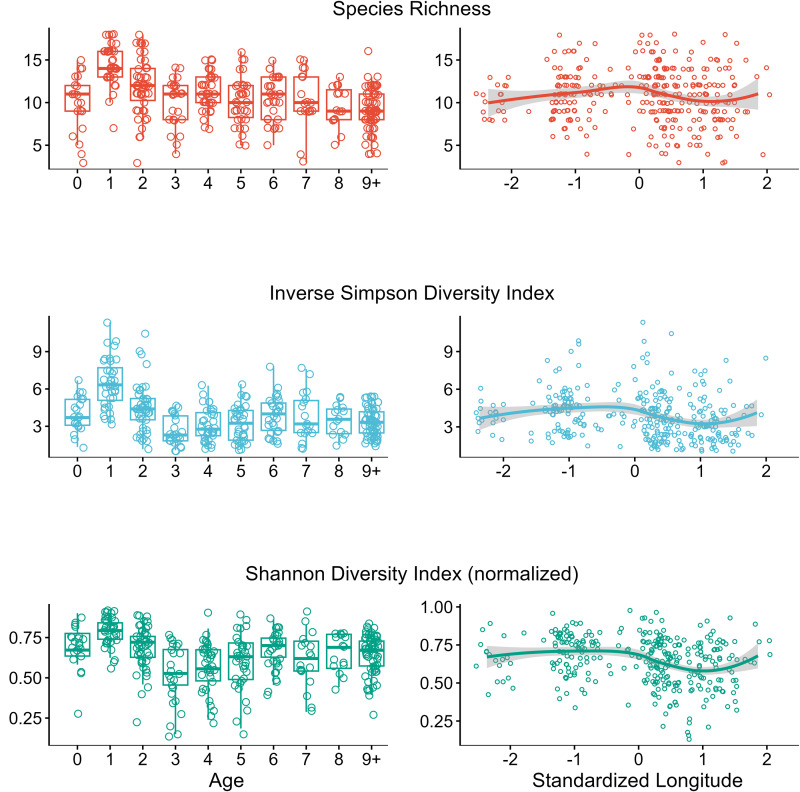
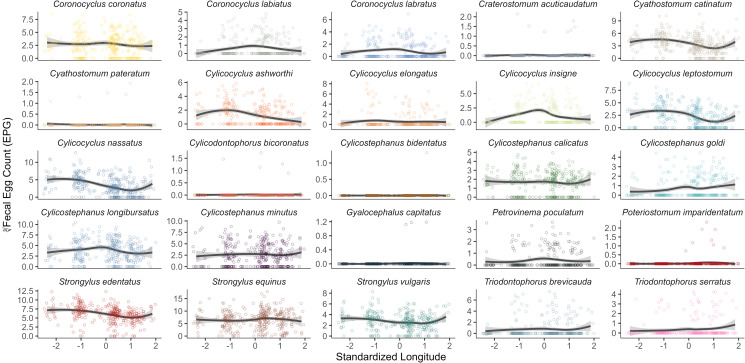
Identifying factors that drive among-individual variation in mixed parasitic infections is fundamental to understanding the ecology and evolution of host–parasite interactions. However, a lack of non-invasive diagnostic tools to quantify mixed infections has restricted their investigation for host populations in the wild. This study applied DNA metabarcoding on parasite larvae cultured from faecal samples to characterize mixed strongyle infections of 320 feral horses on Sable Island, Nova Scotia, Canada, in 2014 to test for the influence of host (age, sex and reproductive/social status) and environmental (location, local density and social group membership) factors on variation. Twenty-five strongyle species were identified, with individual infections ranging from 3 to 18 species with a mean richness (±1 s.d.) of 10.8 ± 3.1. Strongyle eggs shed in faeces were dominated by small strongyle (cyathostomins) species in young individuals, transitioning to large strongyles (Strongylus spp.) in adults. Egg counts were highest in young individuals and in the west or centre of the island for most species. Individuals in the same social group had similar parasite communities, supporting the hypothesis that shared environment may drive parasite assemblages. Other factors such as local horse density, sex, date and reproductive/social status had minimal impacts on infection patterns. This study demonstrates that mixed infections can be dynamic across host ontogeny and space and emphasizes the need to consider species-specific infection patterns when investigating mixed infections.
Keywords: DNA metabarcoding; ITS2; disease ecology; gastrointestinal parasite; mixed infection; nemabiome.
Conflict of interest statement
The authors declare none.
Figures




References
-
- Abbas G, Ghafar A, Bauquier J, Beasley A, Ling E, Gauci CG, El-Hage C, Wilkes EJA, McConnell E, Carrigan P, Cudmore L, Hurley J, Beveridge I, Nielsen MK, Stevenson MA, Jacobson C, Hughes KJ and Jabbar A (2023) Prevalence and diversity of ascarid and strongylid nematodes in Australian thoroughbred horses using next-generation sequencing and bioinformatic tools. Veterinary Parasitology 323, 110048. doi: 10.1016/j.vetpar.2023.110048 - DOI - PubMed
-
- Avramenko RW, Bras A, Redman EM, Woodbury MR, Wagner B, Shury T, Liccioli S, Windeyer MC and Gilleard JS (2018) High species diversity of trichostrongyle parasite communities within and between Western Canadian commercial and conservation bison herds revealed by nemabiome metabarcoding. Parasites & Vectors 11, 299. - PMC - PubMed
MeSH terms
Grants and funding
- Canada Graduate Doctoral Scholarship/Natural Sciences and Engineering Research Council of Canada
- Discovery Grant No. 2015-03976/Natural Sciences and Engineering Research Council of Canada
- Discovery Grant No. 2019-04388/Natural Sciences and Engineering Research Council of Canada
- Discovery Grant No. 2022-04584/Natural Sciences and Engineering Research Council of Canada
- L. David Dubé and Heather Ryan Veterinary Health/University of Saskatchewan
LinkOut - more resources
Full Text Sources
Miscellaneous
