


Social organization of necrophoresis: insights into disease risk management in ant societies
- PMID: 39665101
- PMCID: PMC11632371
- DOI: 10.1098/rsos.240764
Social organization of necrophoresis: insights into disease risk management in ant societies
Abstract
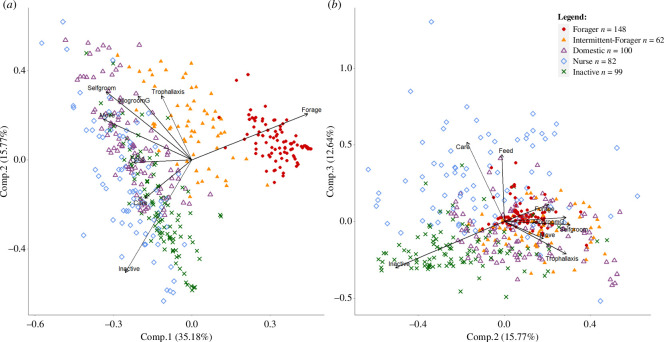
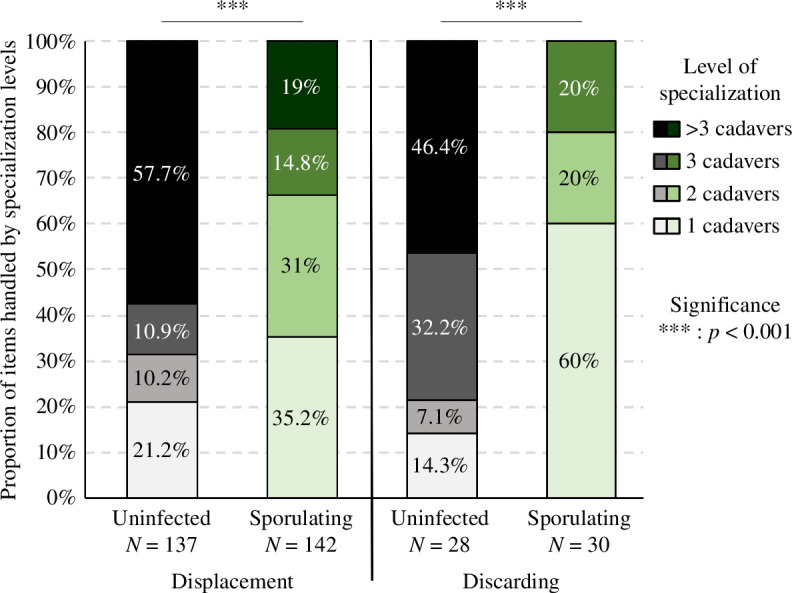
Insect societies, which are at a high risk of disease outbreaks, have evolved sanitary strategies that contribute to their social immunity. Here, we investigated in the red ant Myrmica rubra, how the discarding of nestmate cadavers is socially organized depending on the associated pathogenicity. We examined whether necrophoresis is carried out by a specific functional group of workers or by any nestmates that may become short-term specialists. By observing the behavioural profiles of tagged individuals, we assigned half of the colony members to functional groups (foragers, intermittent-foragers, domestics, nurses and inactives). Following the introduction of uninfected or sporulating corpses into the nest, intermittent-foragers were the functional group most involved in necrophoresis, as they touched, moved and discarded more cadavers. Interestingly, sporulating corpses induced a more generalized response in workers from all functional groups, thereby accelerating their rejection from the nest. The individuals contacting corpses were also prophylactically engaged in more grooming behaviour, suggesting the existence of hygienist workers within ant colonies. These findings raise questions about a trade-off existing between concentrating health risks on a few workers who are highly specialized in necrophoresis and exposing a larger population of nestmates who cooperate to speed up nest sanitization.
Keywords: Beauveria bassiana; Myrmica rubra; generalist entomopathogen; social immunity; waste management; work organization.
© 2024 The Authors.
Conflict of interest statement
We declare we have no competing interests.
Figures






References
-
- Detrain C, Pasteels JM. 1991. Caste differences in behavioral thresholds as a basis for polyethism during food recruitment in the ant, Pheidole pallidula (Nyl.) (Hymenoptera: Myrmicinae). J. Insect Behav. 4, 157–176. (10.1007/BF01054609) - DOI
-
- Sendova-Franks A, Franks NR. 1993. Task allocation in ant colonies within variable environments (a study of temporal polyethism: experimental). Bull. Math. Biol. 55, 75–96. (10.1007/BF02460295) - DOI
-
- Tripet F, Nonacs P. 2004. Foraging for work and age‐based polyethism: the roles of age and previous experience on task choice in ants. Ethology 110, 863–877. (10.1111/j.1439-0310.2004.01023.x) - DOI
Associated data
LinkOut - more resources
Full Text Sources
Other Literature Sources