. 2025 Feb 7;15(2):286-298.
doi: 10.1158/2159-8290.CD-24-0878.

Predisposition Footprints in the Somatic Genome of Wilms Tumors

Affiliations

Predisposition Footprints in the Somatic Genome of Wilms Tumors

Taryn D Treger et al. Cancer Discov. .

Abstract

Approximately 10% of children with cancer harbor a mutation in a predisposition gene. In children with the kidney cancer Wilms tumor, the prevalence is as high as 30%. Certain predispositions are associated with defined histological and clinical features, suggesting differences in tumorigenesis. To investigate this, we assembled a cohort of 137 children with Wilms tumor, of whom 71 had a pathogenic germline or mosaic variant. We examined 237 neoplasms (including two secondary leukemias), utilizing whole-genome sequencing, RNA sequencing, and genome-wide methylation, validating our findings in an independent cohort. Tumor development differed in children harboring a predisposition, depending on the variant gene and its developmental timing. Differences pervaded the repertoire of driver events, including high-risk mutations, the clonal architecture of normal kidneys, and the relatedness of neoplasms from the same individual. Our findings indicate that predisposition may preordain Wilms tumorigenesis, suggesting a variant-specific approach to managing children merits consideration. Significance: Tumors that arise in children with a cancer predisposition may develop through the same mutational pathways as sporadic tumors. We examined this question in the childhood kidney cancer, Wilms tumor. We found that certain predispositions dictate the genetic development of tumors, with clinical implications for these children. See related commentary by Brzezinski and Malkin, p. 258.


Conflict of interest statement

The authors declare no potential conflicts of interest.

Figures
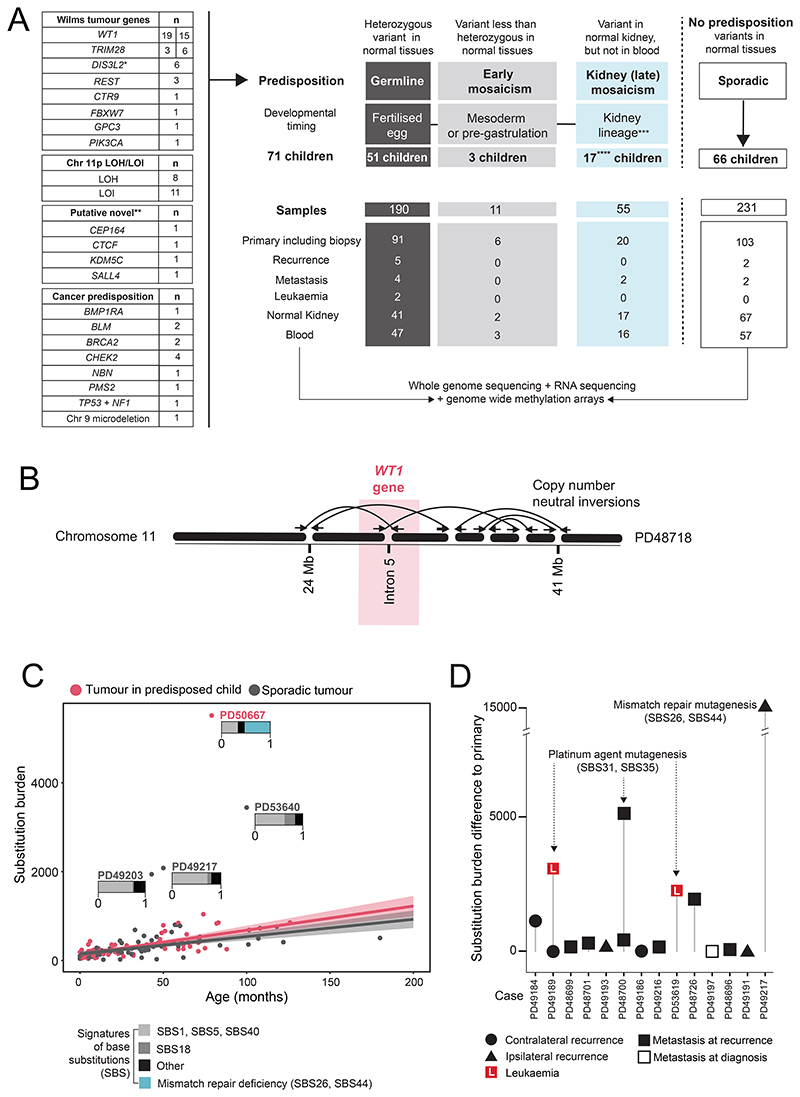
Figure 1
Figure 1. Overview of discovery cohort including substitution burden and signatures.
(A) Numbers of samples and sample type for each individual. WT1 and TRIM28 groups are split into numbers in discovery and validation cohorts. Loss of heterozygosity (LOH), loss of imprinting (LOI). *Monoallelic variant in DIS3L2, one child was only registered at recurrence. **Evidence underlying putative novel predispositions is shown in Supplementary Figure 2 and Supplementary Table 3. ***After segregation of blood and kidney lineages. ****1 child did not have blood available for methylation analysis, however, phenotypically did not have an overgrowth syndrome. Recurrences included ipsilateral (n=3), contralateral (n=3), and only registered at recurrence (n=1). (B) A cryptic complex germline rearrangement overlying WT1 in an infant (<12 months) with bilateral Wilms tumours. (C) Substitution burden in primary tumours from children with or without a predisposition, mutational signatures (stacked bar plots) are shown for outliers. Mutational signatures for the entire discovery cohort are shown in Supplementary Figure 5. (D) Difference between substitution burden for secondary events in relation to matched primary. Platinum agents were used for PD49189 and PD48700 at recurrence, during initial post-operative treatment for PD53619 due to high-risk blastemal histology and for high-risk diffuse anaplasia in PD49217.
Figure 2
Figure 2. Somatic driver events in predisposition group, sporadic tumours and validation cohort.
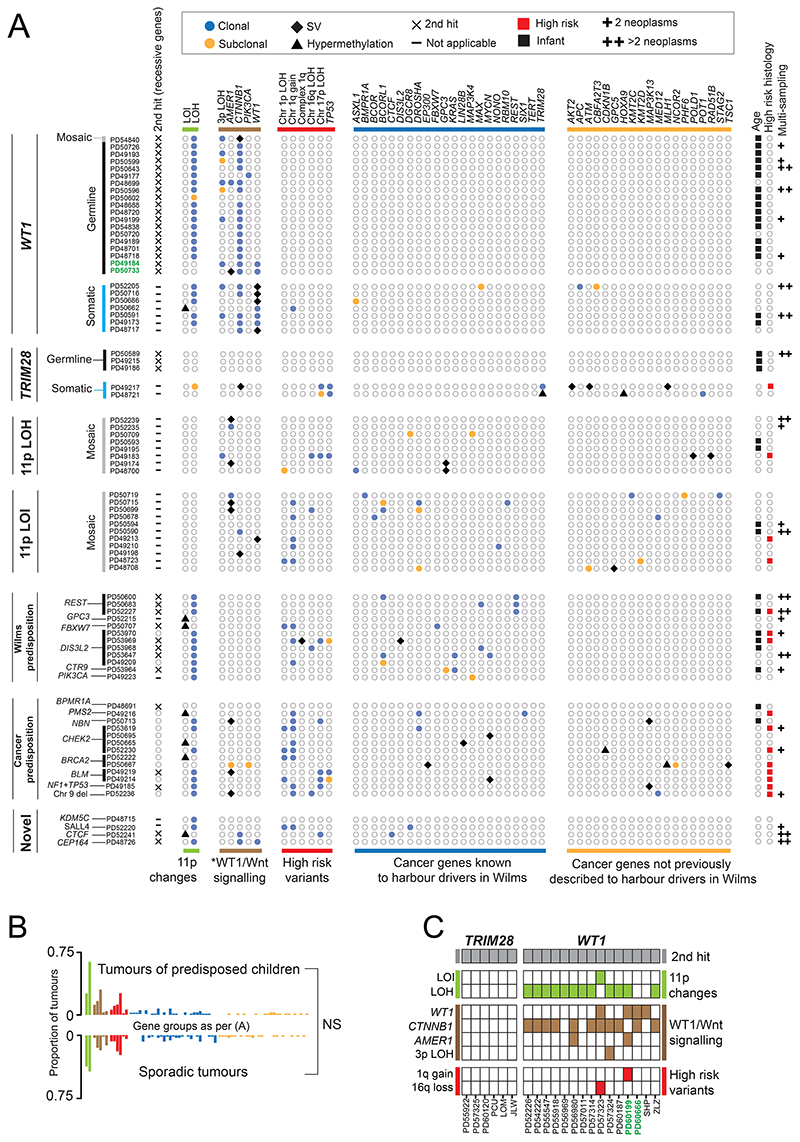
(A) Driver events in primary tumours. Note the confined repertoire of driver events in children with germline WT1 and germline TRIM28 events. Multi-sampling and high risk histology are included to highlight that these are not confounding factors. Loss of heterozygosity (LOH), loss of imprinting (LOI). Green highlights children with WAGR syndrome and deletion of chromosome 11p including the WT1 locus. The second hit (chromosome 17 LOH) in PD49185 encompasses both the TP53 and NF1 loci. The BLM mutation in PD49219 is homozygous in the germline. PD52230 has a subclonal chromosome 22 deletion of the wildtype allele of CHEK2. *PIK3CA is included in the Wnt signalling pathway, owing to the crosstalk between Wnt signalling and the PI3K/Akt pathway, converging on CTNNB1. LOH of chromosome 3p, with retention of variant CTNNB1, is included as a recurrent event in the group of WT1-predisposed tumours. (B) Driver events in tumours from children with a predisposition versus children in whom no predisposition could be identified. No significant (NS) difference was found after multiple hypothesis correction testing. (C) Driver events in a validation cohort of children with germline WT1 and germline TRIM28 recapitulates findings in the discovery cohort. Green highlights children with WAGR syndrome and deletion of chromosome 11p including the WT1 locus. Three letter pseudonyms refer to children without PD IDs.
Figure 3
Figure 3. Clonal expansions in normal kidney tissue.
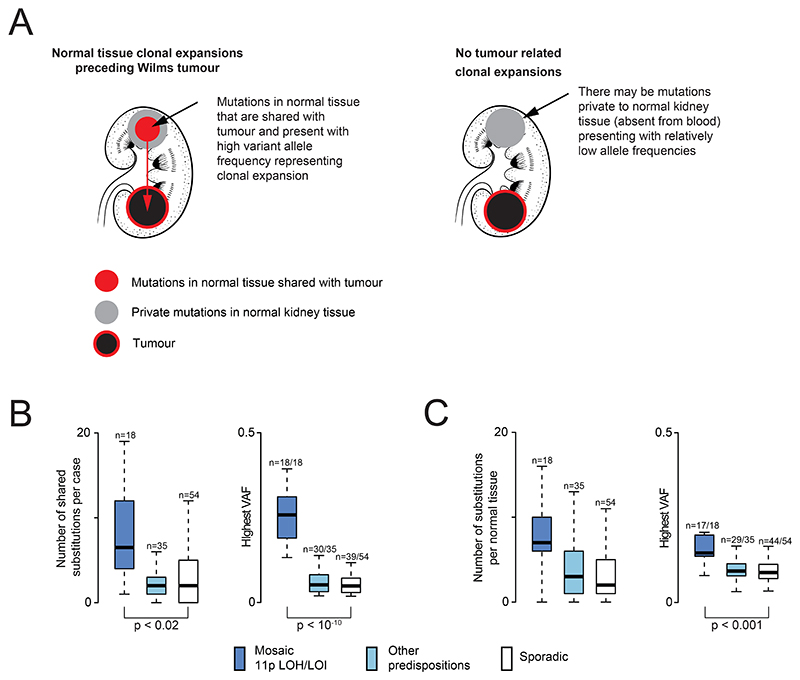
(A) Schematic to illustrate the concept of clonal expansions in normal kidneys. (B) Boxplot of number of substitutions shared between normal kidney tissue and tumour for each case and their variant allele frequencies (VAF). Loss of heterozygosity (LOH), loss of imprinting (LOI). (C) Boxplot of number of private (i.e. not shared with tumour) substitutions in normal kidney tissue sample for each case and their variant allele frequencies (VAF).
Figure 4
Figure 4. Phylogenetic relationship of blood, normal kidney and multiple tumours in predisposed children.
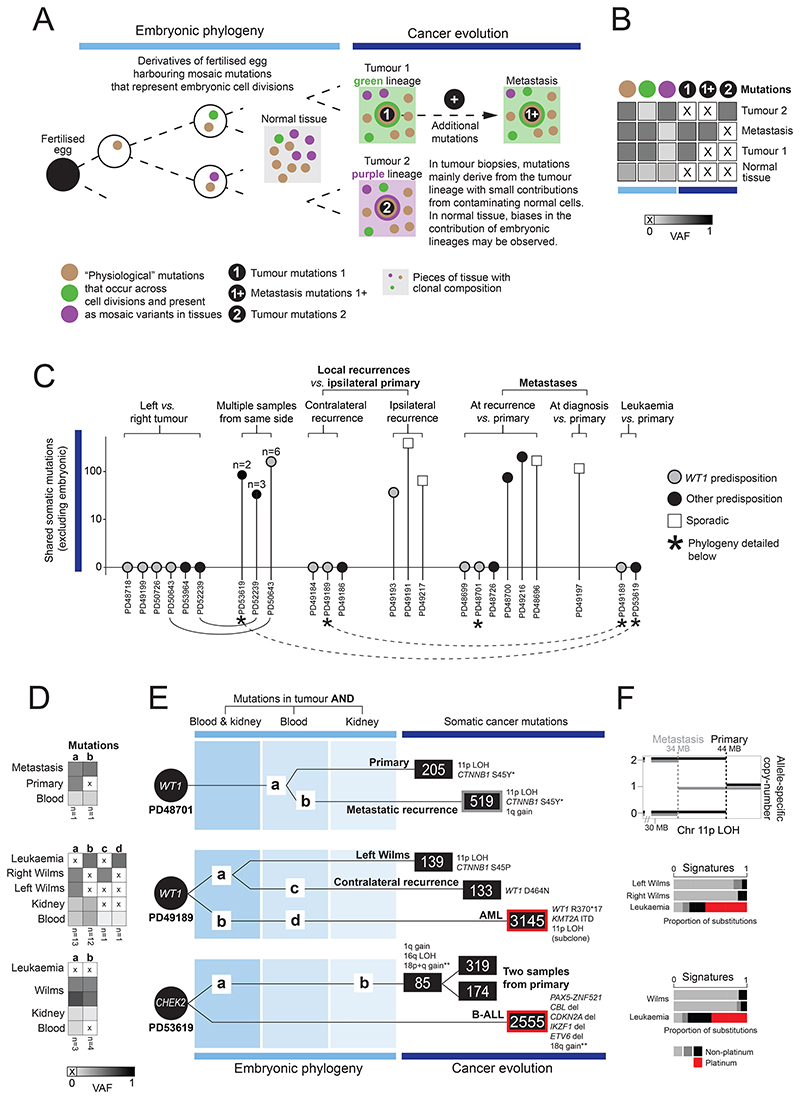
(A) Schematic to illustrate phylogenetic reconstruction. (B) Variant allele frequency (VAF) heatmap of embryonic and tumour somatic mutations, across normal and tumour biopsies, to illustrate the VAF inflation of embryonic mutations in tumours via clonal expansions. (C) The sharedness of tumour somatic mutations between primary and secondary events in children with WT1 predisposition, other predispositions and sporadic cases. (D) VAF heatmap of embryonic mutations across all samples from an individual, underlying phylogeny reconstruction shown in (E). Letters correspond to letter in (E). The number at the bottom of each column refers to the number of mutations represented by each letter. (E) Example phylogenies. Circle represents zygote with a mutation in a cancer predisposition gene. Patient ID underneath. Lines (not scaled to mutation burden) represent phylogenetic relations. Number in squares are the tumour substitution burden. Mutations in non-diploid regions were excluded from phylogenetic analyses. Variants listed are the driver events of each neoplasm. Loss of heterozygosity (LOH), loss of imprinting (LOI). *Same hotspot mutation in CTNNB1 that has evolved in parallel (explained in text). **Chromosome 18q gain is shared between the three tumour samples but with different breakpoints in each sample. It is not a common copy number change in either Wilms tumour or ALL. (F) Noteworthy genomic features. Top: Different breakpoints in 11p LOH in both tumours. Middle and bottom – signatures of substitutions highlighting mutations due to platinum chemotherapy agents (red) in secondary leukaemias.

References

    1. Kratz CP, Jongmans MC, Cavé H, Wimmer K, Behjati S, Guerrini-Rousseau L, et al. Predisposition to cancer in children and adolescents. Lancet Child Adolesc Health. 2021;5:142–54. - PubMed
    1. Mody RJ, Wu YM, Lonigro RJ, Cao X, Roychowdhury S, Vats P, et al. JAMA. Vol. 314. American Medical Association (AMA); 2015. Integrative clinical sequencing in the management of refractory or relapsed cancer in youth; pp. 913–25. - DOI - PMC - PubMed
    1. Wong M, Mayoh C, Lau LMS, Khuong-Quang DA, Pinese M, Kumar A, et al. Nat Med. Vol. 26. Springer Science and Business Media LLC; 2020. Whole genome, transcriptome and methylome profiling enhances actionable target discovery in high-risk pediatric cancer; pp. 1742–53. - PubMed
    1. Villani A, Davidson S, Kanwar N, Lo WW, Li Y, Cohen-Gogo S, et al. The clinical utility of integrative genomics in childhood cancer extends beyond targetable mutations. Nat Cancer. 2023;4:203–21. doi: 10.1038/s43018-022-00474-y. - DOI - PMC - PubMed
    1. Hol JA, Kuiper RP, van Dijk F, Waanders E, van Peer SE, Koudijs MJ, et al. Prevalence of (Epi)genetic Predisposing Factors in a 5-Year Unselected National Wilms Tumor Cohort: A Comprehensive Clinical and Genomic Characterization. J Clin Oncol. 2022;40:1892–902. doi: 10.1200/JCO.21.02510. - DOI - PMC - PubMed