


Comprehensive analysis of the bacterial spectrum for enhanced clinical insight in microbial ureteral stent colonization, uncomplicated urinary tract infections and catheter-associated urinary tract infections: a principal component analysis-based literature review
- PMID: 39668263
- PMCID: PMC11638318
- DOI: 10.1007/s00345-024-05354-x
Comprehensive analysis of the bacterial spectrum for enhanced clinical insight in microbial ureteral stent colonization, uncomplicated urinary tract infections and catheter-associated urinary tract infections: a principal component analysis-based literature review
Abstract
Purpose: Controversies exist regarding the prevailing spectrum of microorganisms in microbial ureteral stent colonization (MUSC) and their clinical significance. The aim of this comprehensive review is to determine the predominant microbial spectrum in patients with an indwelling ureteral stent in comparison to catheter-associated urinary tract infections (CAUTI) and uncomplicated urinary tract infections (UTI).
Methods: Google scholar, PubMed, Embase, Medline, and Cochrane literature databases were searched from inception to April 2022 to identify manuscripts on MUSC, uncomplicated UTI and CAUTI. A principal component analysis (PCA) was performed to identify patterns of the pathogen spectrum of the different groups.
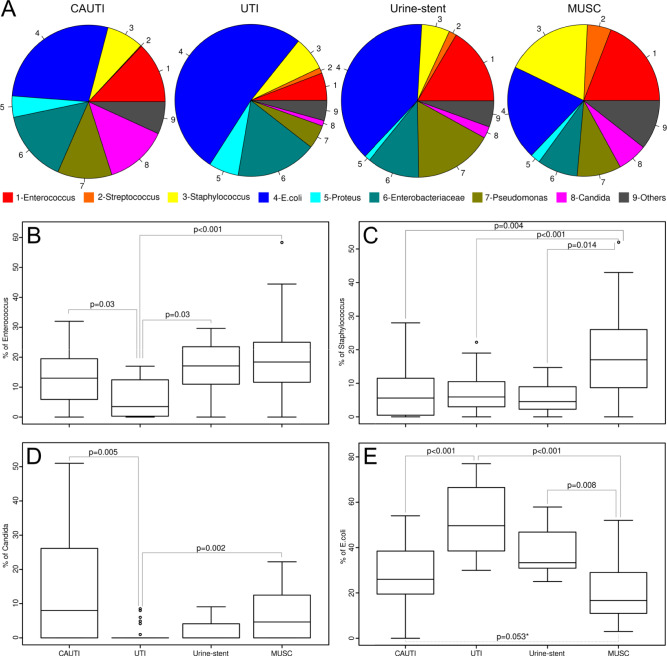
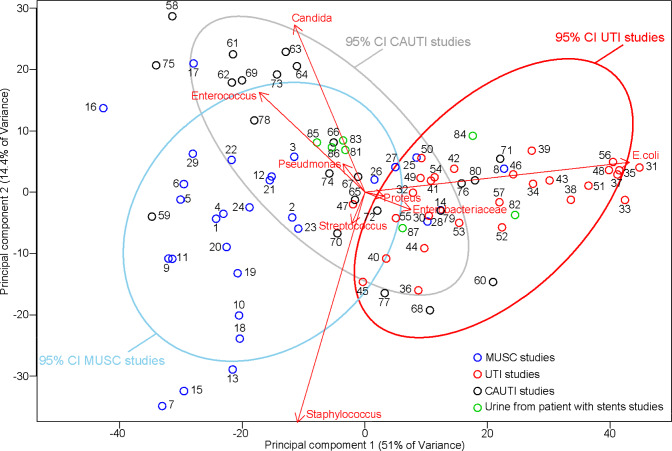
Results: We included 29 studies on MUSC, 28 studies on uncomplicated UTI and 23 CAUTI studies. The proportion of Staphylococci, Enterococci and Candida were significantly higher in MUSC and stent associated bacteriuria compared to their proportion in uncomplicated UTIs where E. coli dominates. By comparing MUSC, CAUTI and UTI with a PCA, the detected pathogen spectrum exhibited clearly distinguishable trends in the frequency of the main isolated pathogens influencing these three groups of urinary tract infections. With respect to MUSC and UTI, their 95% confidence interval ellipse only showed minimal overlap emphasizing that the spectrum of pathogens in the two groups is clearly distinct.
Conclusions: The frequency of detection of Staphylococci, Enterococci and Candida is more common in MUSC as compared to UTI. Thus, patients with indwelling ureteral stents should undergo an antimicrobial prophylaxis targeting this microbial spectrum in case of further surgery.
Keywords: Bacteriuria; Ureteral catheterization; Ureteroscopy; Urinary tract infections.
© 2024. The Author(s).
Conflict of interest statement
Declarations. Conflict of interest: The authors confirm that there are no conflicts of interest involved with the present work. Research involving human participants and/or animals: The present work is a literature review. No human participants or animals were involved in this work. Informed consent: The present work is a literature review, no informed consent was required.
Figures
References
-
- Sali GM, Joshi HB (2020) Ureteric stents: overview of current clinical applications and economic implications. Int J Urol 27(1):7–15. 10.1111/iju.14119 - PubMed
-
- Bonkat G, Bartoletti R, Bruyère F, Cai T, Geerlings SE, Köves B (2021) EAU urological infections guidelines. In: EAU annual congress Milan Italy
-
- Bonkat G et al (2012) Microbial ureteral stent colonization in renal transplant recipients: frequency and influence on the short-time functional outcome. Transpl Infect Dis 14(1):57–63. 10.1111/j.1399-3062.2011.00671.x - PubMed
-
- Scotland KB et al (2019) Ureteral stent-associated infection and sepsis: pathogenesis and prevention: a review. Biofouling 35(1):117–127. 10.1080/08927014.2018.1562549 - PubMed
Publication types
MeSH terms
LinkOut - more resources
Full Text Sources
Medical
Miscellaneous
