Review
. 2024 Dec 12;14(53):39253-39267.
doi: 10.1039/d4ra04152f. eCollection 2024 Dec 10.

Isocyanate-based multicomponent reactions

Affiliations
Review

Isocyanate-based multicomponent reactions

Clara Zavarise et al. RSC Adv. .

Abstract

Since their discovery, multicomponent reactions have attracted significant attention due to their versatility and efficiency. This review aims to explore the latest advancements in isocyanate-based multicomponent reactions and the sophisticated chemical opportunities they present for generating molecules of interest. The added value of the methodologies described, supported by mechanism schemes, as well as scopes of application, will be discussed. These developments will be organised as the main accessible chemical functions and sorted according to their type of MCR (3, 4 or 5-MCR).


Conflict of interest statement

There are no conflicts to declare.

Figures

Fig. 1
Fig. 1. General representation of possible MCRs with isocyanates.
Fig. 2
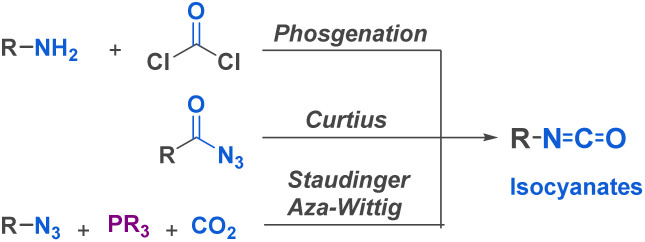
Fig. 2. Several examples of reactions producing isocyanates.
Fig. 3
Fig. 3. Reactivity of isocyanates.
Fig. 4
Fig. 4. Main classes of products resulting from nucleophilic attack on isocyanates.
Scheme 1
Scheme 1. Examples of in situ generation of isocyanates by the team of Beauchemin.
Scheme 2
Scheme 2. General scheme and a proposed mechanism of the Bucherer–Bergs reaction.
Scheme 3
Scheme 3. Synthesis of hydantoins by 3-MCR methodologies.
Scheme 4
Scheme 4. Synthesis of hydantoin derivatives by Rigby et al.
Scheme 5
Scheme 5. Synthesis of uracil and aza-uracil derivatives via pseudo-MCR methodologies.
Scheme 6
Scheme 6. Synthesis of urea derivatives by Pan et al.
Scheme 7
Scheme 7. Synthesis of cyclic semicarbazones by Mohammadi and Adib and Du et al.
Scheme 8
Scheme 8. Ugi-type synthesis of cyclic semicarbazides by Soeta et al.
Scheme 9
Scheme 9. Synthesis of triazolo-carboxamides and indazole-carboxamides by Martinez-Ariza et al.
Scheme 10
Scheme 10. Synthesis of linear ureas derivatives by SAW procedures by Babin et al. and Carnaroglio et al.
Scheme 11
Scheme 11. Synthesis of linear ureas derivatives by Yavari et al.
Scheme 12
Scheme 12. Synthesis of cyclic urea derivatives by Perrone et al., Groenendaal et al. and Vugts et al.
Scheme 13
Scheme 13. 4-MCR synthesis of a cyclic urea example by Messa et al.
Scheme 14
Scheme 14. 4-MCR for the preparation of sulfonylureas and the proposed mechanism by Zhao et al.
Scheme 15
Scheme 15. 4-MCR Synthesis of 5,6-dihydropyrrolo[2,1-a]isoquinolines by Ghosh et al.
Scheme 16
Scheme 16. Synthesis of succinimide derivatives by Esmaelli et al. and Alizadeh et al.
Scheme 17
Scheme 17. Synthesis of sulfonylamide derivatives by Alizadeh et al. and Huang et al.
Scheme 18
Scheme 18. Synthesis of imidazole derivatives by 3-MCR by Adib et al., Shen et al. and Belyaeva et al.
Scheme 19
Scheme 19. Synthesis of amide derivatives by Oberg et al. and Tanaka et al.
Scheme 20
Scheme 20. Synthesis of cyclic amide derivatives Beigi-Somar et al.
Scheme 21
Scheme 21. Synthesis of pyrimidine derivatives by Lei et al.
Scheme 22
Scheme 22. Synthesis of cyclic carbamate derivatives Liu et al.
Scheme 23
Scheme 23. Synthesis of oxazinanedione derivatives by Church et al.
Scheme 24
Scheme 24. Synthesis of cyclic carbamate derivatives by Potuganti et al.
Scheme 25
Scheme 25. Synthesis of linear carbamate derivatives by Abdou et al.
Scheme 26
Scheme 26. Synthesis of linear carbamate derivatives by 4-MCR by Yin et al.
Scheme 27
Scheme 27. Synthesis of thiocarbamates using a 3-MCR by Babin et al.
Scheme 28
Scheme 28. Synthesis of carbamimidate derivatives by Campbell et al. and Li et al.
Scheme 29
Scheme 29. MCR reactions involving isocyanates by Liang et al. and Elhefny et al.
Scheme 30
Scheme 30. MCR reactions involving isocyanates by Wang et al.

References

    1. Strecker A. Ann. Chem. Pharm. 1850;75:27–45.
    1. Strecker A. Ann. Chem. Pharm. 1854;91:349–351.
    1. Dömling A. and AlQahtani A. D., in Multicomponent Reactions in Organic Synthesis, Wiley, 1st edn, 2014, pp. 1–12
    1. Anastas P. T. and Warner J. C., Green chemistry: theory and practice, 2000
    1. Hantzsch A. Ann. Chem. Pharm. 1882;215:1–82.

LinkOut - more resources