Acoustics of rubbing feathers: the velvet of owl feathers reduces frictional noise
- PMID: 39670422
- PMCID: PMC11832125
- DOI: 10.1242/jeb.246234
Acoustics of rubbing feathers: the velvet of owl feathers reduces frictional noise
Abstract
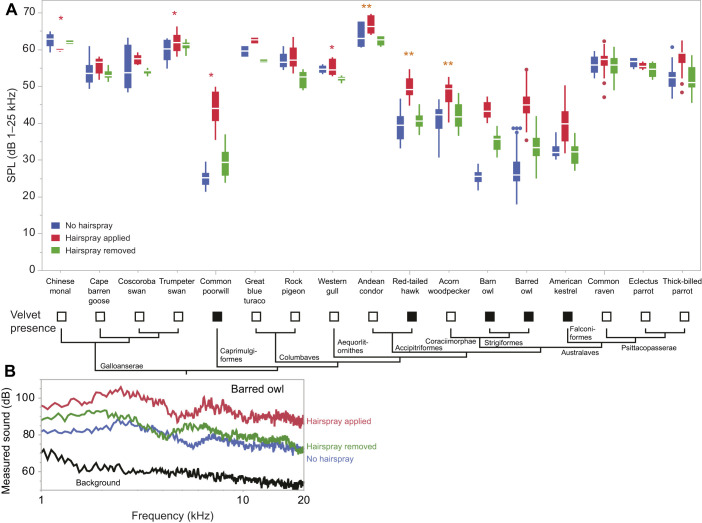
One feather structure associated with an owl's ability to fly quietly is the soft dorsal surface on their flight feathers: the velvet. This velvet is a mat of elongated filamentous pennulums that extend up from feather barbules. The aerodynamic noise hypothesis posits this velvet reduces aerodynamic noise caused by the formation of turbulence, while the structural noise hypothesis posits the velvet acts as a dry lubricant, reducing frictional noise produced by feathers sliding past one another. We investigated the structural noise hypothesis by quantifying the length of the velvet on 24 locations across the wing of the barred owl (Strix varia) and then qualitatively assessing the presence of velvet in 24 bird species. We found that velvet has evolved at least 4 times independently (convergently) in owls, nightbirds, hawks and falcons. Then, we rubbed 96 pairs of feathers together from 17 bird species (including the four clades that have independently evolved velvet) under three experimental treatments: control, hairspray applied (to impair the velvet) and hairspray removed. The sound of feathers rubbing against each other was broadband, similar to the sound of rubbing sandpaper or Velcro. Species with velvet produced rubbing sounds that were 20.9 dB quieter than species without velvet, and velvet-coated feathers became 7.4 dB louder when manipulated with hairspray, while feathers lacking velvet only increased in loudness by 1.7 dB, relative to the control treatments. These results all support the hypothesis that the velvet primarily functions to ameliorate the sounds of feathers rubbing against other feathers.
Keywords: Aeroacoustics; Locomotion-induced sound; Pennulums; Quiet flight; Sonation; Strigiformes.
© 2025. Published by The Company of Biologists.
Conflict of interest statement
Competing interests The authors declare no competing or financial interests.
Figures




References
-
- Blake, W. K. (2017). Mechanics of Flow-Induced Sound and Vibration: Complex Flow-Structure Interactions, Vol. 2. Academic Press.
Publication types
MeSH terms
Grants and funding
LinkOut - more resources
Full Text Sources
Medical
Miscellaneous