


Accuracy of type IV collagen 7S versus Enhanced Liver Fibrosis score for diagnosing fibrosis in patients with metabolic dysfunction-associated steatotic liver disease
- PMID: 39670882
- PMCID: PMC11637746
- DOI: 10.1097/HC9.0000000000000563
Accuracy of type IV collagen 7S versus Enhanced Liver Fibrosis score for diagnosing fibrosis in patients with metabolic dysfunction-associated steatotic liver disease
Abstract
Background: Various noninvasive tests can be used to identify high-risk groups of patients with metabolic dysfunction-associated steatotic liver disease/steatohepatitis (MASLD). In this study, we compared the diagnostic performance of serum type 4 collagen 7S (COL4-7S) and the Enhanced Liver Fibrosis (ELF) score for detecting fibrosis in patients with MASLD.
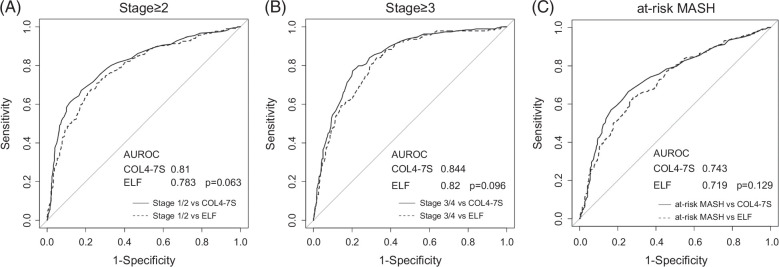
Methods: Among 1368 patients with MASLD who underwent liver biopsy, 794 with values for both serum COL4-7S and the ELF score were enrolled in this multicenter study. The diagnostic performance of COL4-7S and ELF for detecting fibrosis stage ≥2, fibrosis stage ≥3, and at-risk metabolic dysfunction-associated steatohepatitis were evaluated using ROC curve, continuous net reclassification improvement, and integrated discrimination improvement analyses.
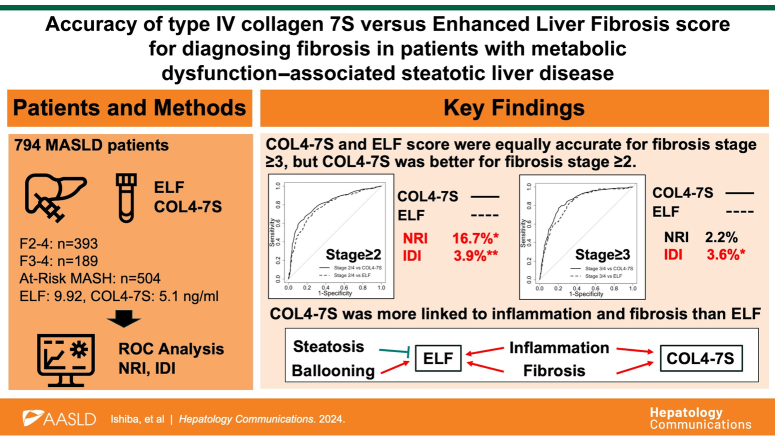
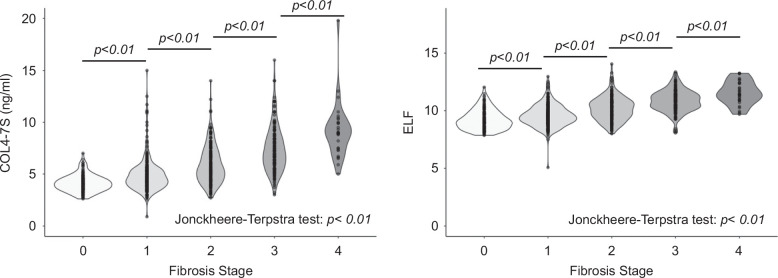
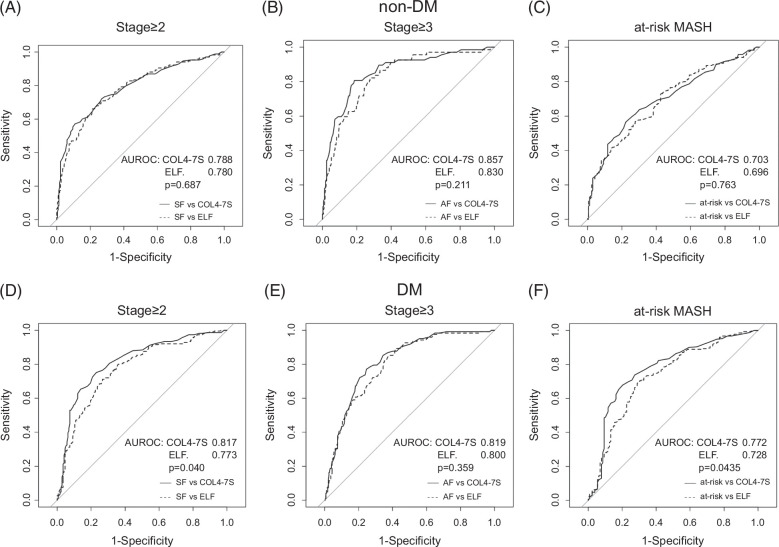
Results: Both COL4-7S and ELF scores increased significantly with increasing fibrosis. The AUROC for each outcome was higher for COL4-7S than ELF, but not significantly. The diagnostic performance for detecting fibrosis stage ≥2 was significantly better for COL4-7S than for the ELF score (s net reclassification improvement=16.7%, p=0.018; integrated discrimination improvement=3.9%, p<0.01). In patients without diabetes, the diagnostic performance for each outcome did not differ significantly between COL4-7S and ELF score, but in patients with diabetes, the diagnostic performance for fibrosis stage ≥2 was higher for COL4-7S than for the ELF score (AUROC=0.817 vs. 0.773, p=0.04; s net reclassification improvement=32.7%, p<0.01; integrated discrimination improvement=5.6%, p<0.01).
Conclusions: The diagnostic performance of serum COL4-7S (a single marker) for identifying more advanced disease in patients with MASLD was at least equivalent to that of the ELF score (a combined marker).
Copyright © 2024 The Author(s). Published by Wolters Kluwer Health, Inc. on behalf of the American Association for the Study of Liver Diseases.
Conflict of interest statement
Yoshio Sumida is on the speaker’s bureau for MSD, Novo Nordisk, Taisho, Kowa, Mochida, and Siemens Healthcare. Hirokazu Takahashi is on the speaker’s bureau for Kowa, Taisho Pharma, and Novo Nordisk. He received grants from Sysmex and Abbvie GK. Hidenoru Toyoda is on the speaker’s bureau for Gilead Sciences, Abbvie, Eisai, Fujifilm WAKO, Terumo, Takeda, Chugai, Kowa, and Bayer. Masato Yoneda received grants from Gilead Sciences Incorporated. Hideaki Fukushima is employed by Siemens Healthcare Diagnostics K.K. The remaining authors report no conflict of interest.
Figures
References
-
- Hagström H, Nasr P, Ekstedt M, Stål P, Hultcrantz R, Kechagias S. Accuracy of noninvasive scoring systems in assessing risk of death and liver-related endpoints in patients with nonalcoholic fatty liver disease. Clin Gastroenterol Hepatol. 2019;17:1148–56.e4. - PubMed
-
- Guha IN, Parkes J, Roderick P, Chattopadhyay D, Cross R, Harris S, et al. Noninvasive markers of fibrosis in nonalcoholic fatty liver disease: Validating the European Liver Fibrosis Panel and exploring simple markers. Hepatology. 2008;47:455–60. - PubMed
Publication types
MeSH terms
Substances
LinkOut - more resources
Full Text Sources
Medical
