


Giving voice to employees in low-skilled jobs works: Effect and process evaluation of a participatory sustainable employability intervention
- PMID: 39670982
- PMCID: PMC11664181
- DOI: 10.3233/WOR-230507
Giving voice to employees in low-skilled jobs works: Effect and process evaluation of a participatory sustainable employability intervention
Abstract
Background: To improve the sustainable employability (SE) of employees in low-skilled jobs, there is an urgent need to implement more effective approaches for this group.
Objective: This evaluation study aimed to get insight into the effect and implementation process of an organisational intervention called 'Healthy HR' (HHR), which promoted the job control and SE of employees in low-skilled jobs in two Dutch organisations.
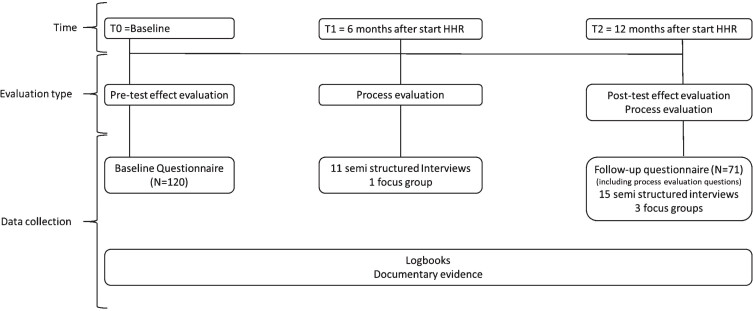
Methods: An effect evaluation with a pretest-posttest design and a mixed-methods process evaluation were conducted. Quantitative data were collected at baseline (N = 120) and at 12 months' follow-up (N = 71). Paired t-tests and dose-response analyses were performed (N = 50). Mixed-methods process data were collected on the implementation process using questionnaires, individual interviews with employees and employer representatives (N = 26), focus groups (N = 4) and logbooks.
Results: A positive effect was found for job control at 12 months' follow-up. An effect on the distal outcome SE was not significant. The dose-response analysis showed that a higher dose of HHR resulted in better job control. This positive effect was supported by the qualitative process analysis. HHR had a positive impact on the awareness level about health and healthy workplaces among all stakeholders.
Conclusions: This study showed a promising participatory approach to improve job control for employees in low-skilled jobs by actively involving them in a genuine dialogue and giving them an active voice. Effects on SE might require a longer follow-up.
Keywords: Employees in low-skilled jobs; evaluation; intervention; job control; mixed-methods; sustainable employability.
Conflict of interest statement
The authors declare that they have no conflict of interest.
Figures

References
-
- van der Klink JJ, Bultmann U, Burdorf A, Schaufeli WB, Zijlstra FR, Abma FI, et al.. Sustainable employability–definition, conceptualization, and implications: A perspective based on the capability approach. Scandinavian Journal of Work, Environment & Health. 2016;42(1):71–9. doi: 10.5271/sjweh.3531. - DOI - PubMed
-
- Manuel K. Duurzame inzetbaarheid in de industrie: Wat is nodig om de duurzame inzetbaarheid van medewerkers in deze sector te bevorderen? Tijdschrift voor HRM. 2021;24(1):1–25. doi: 10.5117/THRM2021.1.MANU. - DOI
-
- van Harten EJ. Employable ever after: Examining the antecedents and outcomes of sustainable employability in a hospital context: University Utrecht; 2016.
MeSH terms
LinkOut - more resources
Full Text Sources
