Patient-Clinician Communication Interventions Across Multiple Primary Care Sites: A Cluster Randomized Clinical Trial
- PMID: 39671203
- PMCID: PMC11645648
- DOI: 10.1001/jamahealthforum.2024.4436
Patient-Clinician Communication Interventions Across Multiple Primary Care Sites: A Cluster Randomized Clinical Trial
Abstract
Importance: Despite various attempts to improve patient-clinician communication, there has been limited head-to-head comparison of these efforts.
Objective: To assess whether clinician coaching (mobile application or in-person) is more effective than reminder posters in examination rooms and whether mobile app use is noninferior to in-person coaching.
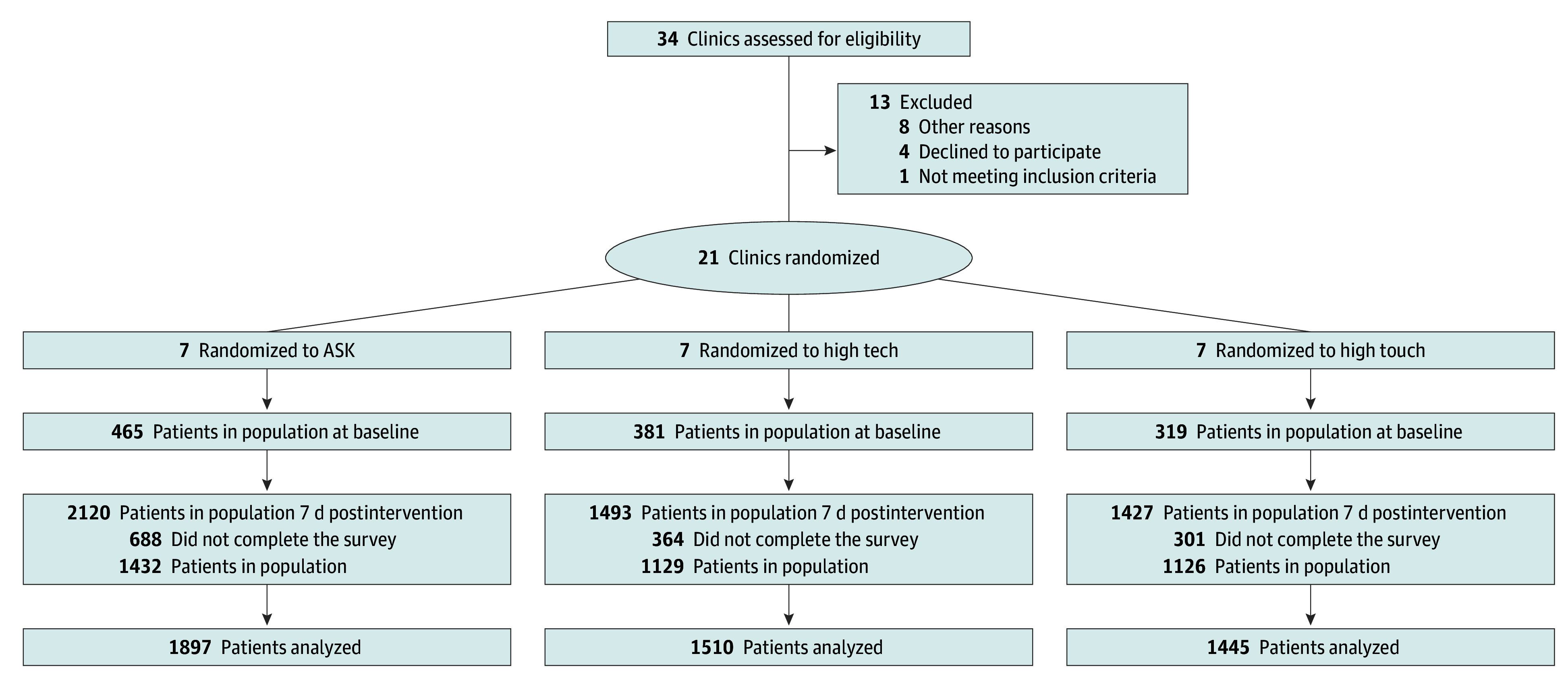
Design, setting, and participants: A cluster randomized clinical trial with 3 arms. A total of 21 primary care clinics participated in 3 health systems in the US; participants were patients and primary care clinicians with clinic visits between August 28, 2019, and December 31, 2021. Data were analyzed from August 4, 2022, to November 10, 2024. Data analysis was based on intention to treat.
Interventions: In-person coaching of clinicians with standardized patient instructor training (high-touch), mobile application-based coaching (high-tech), and posters placed in examination rooms encouraging shared decision-making (AskShareKnow [ASK]). Before visits, patients in the high-touch and high-tech groups were prompted to inform their clinicians of the most important matter for discussion using online check-in.
Main outcomes and measures: The primary outcome was a patient engagement measure (CollaboRATE) of patient perceptions of communication and shared decision-making during the visit. Difference-in-differences mixed-effect regression with random intercepts for primary care clinician were used for analyses. Secondary outcomes included the net promoter score (patient's likelihood of recommending this clinician to others) and patient's confidence in managing their health.
Results: Participants included 4852 patients with a median age of 54 years (IQR, 39-66 years); 63.6% were women. A total of 114 clinicians (median age range, 40-59 years; 48 were women [42.1%]) participated. The 3 interventions did not differ significantly in probability of CollaboRATE top score (marginal difference, high-tech vs ASK, -0.021; 95% CI, -0.073 to 0.030; high-touch vs ASK, -0.018, 95% CI, -0.069 to 0.033; high-tech vs high-touch, -0.003, 95% CI, -0.057 to 0.052; P = .14). Patients in the high-tech group were less likely to recommend their clinician to others than patients in the high-touch group (difference in marginal probability, -0.056; 95% CI, -0.118 to 0.019; P = .04). After 3 months, patients in the high-tech group had a significantly lower score than patients in the high-touch group (mean difference, -0.176; 95% CI, -0.341 to -0.011; P = .04) in confidence in managing their health.
Conclusions and relevance: This cluster randomized clinical trial found no evidence of intervention effects, although there were differences across systems. Some secondary outcomes suggested positive effect of clinicians receiving in-person coaching. Alternative outcome measures of patient engagement may be needed.
Trial registration: ClinicalTrials.gov Identifier: NCT03385512.
Conflict of interest statement
Figures
References
-
- Stewart M, Brown JB, Donner A, et al. The impact of patient-centered care on outcomes. J Fam Pract. 2000;49(9):796-804. - PubMed
Publication types
MeSH terms
Associated data
LinkOut - more resources
Full Text Sources
Medical