


Menopausal hormone therapy: assessing associations with breast and colorectal cancers by familial risk
- PMID: 39673461
- PMCID: PMC11700558
- DOI: 10.1093/jncics/pkae121
Menopausal hormone therapy: assessing associations with breast and colorectal cancers by familial risk
Abstract
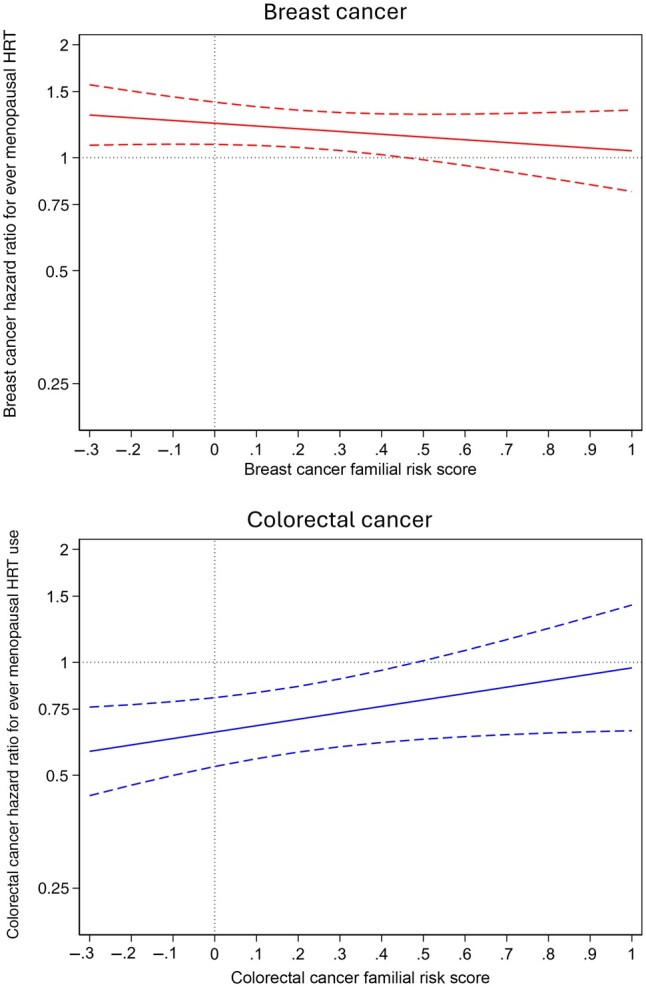
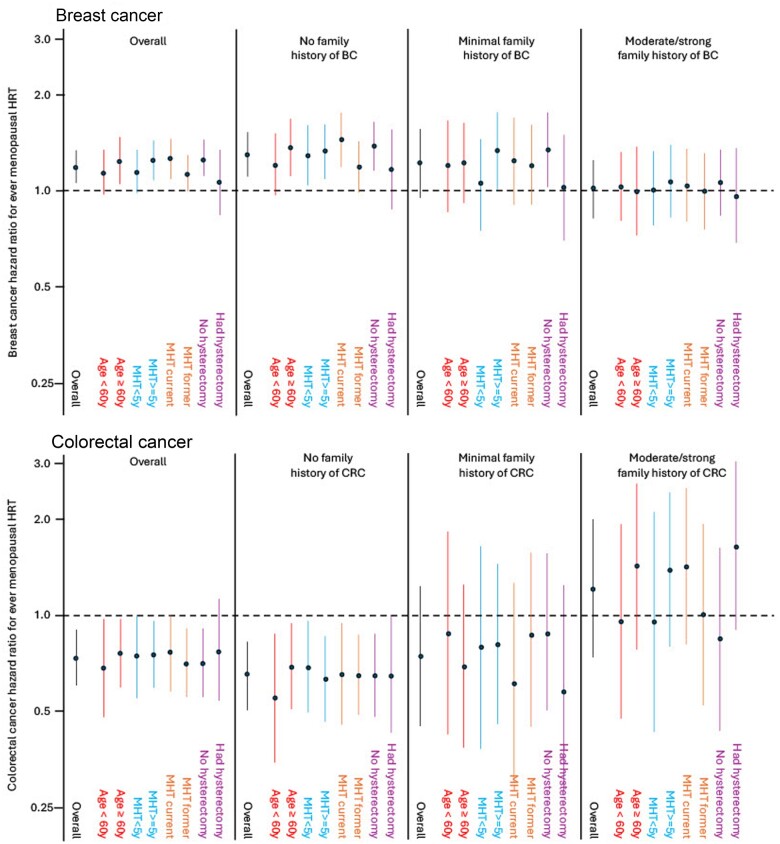
Menopausal users of hormone replacement therapy (HRT) are at increased breast cancer risk and decreased colorectal cancer (CRC) risk compared with individuals who have never used HRT, but these opposing associations may differ by familial risk of breast cancer and CRC. We harmonized data from 3 cohorts and generated separate breast cancer and CRC familial risk scores based on cancer family history. We defined moderate or strong family history as a risk score of 0.4 or higher, where 0.4 was equivalent to a 50-year-old woman with 1 parent diagnosed with either breast cancer or CRC at 55 years of age. Of 24 486 women assessed, 1243 and 405 were diagnosed with incident breast cancer and CRC, respectively. For breast cancer, menopausal HRT ever use versus never use hazard ratios were 1.27 (95% CI = 1.11 to 1.45) for a breast cancer familial risk score below 0.4 and 1.01 (95% CI = 0.82 to 1.25) for a breast cancer familial risk score of 0.4 or higher (Pdifference = .08). For CRC, menopausal HRT hazard ratios were 0.63 (95% CI = 0.50 to 0.78) for a CRC familial risk score below 0.4 and 1.21 (95% CI = 0.73 to 2.00) for a CRC familial risk score of 0.4 or higher (Pdifference = .03). Associations with menopausal HRT use that apply to the general population may not hold for women at moderate or strong familial risk of these cancers.
© The Author(s) 2024. Published by Oxford University Press.
Conflict of interest statement
Kelly-Anne Phillips has an unpaid advisory role with AstraZeneca and research funding (to Kelly-Anne Phillips’s institution) from AstraZeneca. The other authors declared no conflicts of interest during the conduct of this study outside the grant funding listed in the “Funding” section.
Figures
References
-
- Chlebowski RT, Aragaki AK. The Women's Health Initiative randomized trials of menopausal hormone therapy and breast cancer: Findings in context. Menopause. 2023;30:454-461. - PubMed
MeSH terms
Grants and funding
LinkOut - more resources
Full Text Sources
Medical