Review
. 2025 Jan;301(1):108072.
doi: 10.1016/j.jbc.2024.108072. Epub 2024 Dec 14.

Epitope mapping via in vitro deep mutational scanning methods and its applications

Affiliations
Review

Epitope mapping via in vitro deep mutational scanning methods and its applications

Meredith M Keen et al. J Biol Chem. 2025 Jan.

Abstract

Epitope mapping is a technique employed to define the region of an antigen that elicits an immune response, providing crucial insight into the structural architecture of the antigen as well as epitope-paratope interactions. With this breadth of knowledge, immunotherapies, diagnostics, and vaccines are being developed with a rational and data-supported design. Traditional epitope mapping methods are laborious, time-intensive, and often lack the ability to screen proteins in a high-throughput manner or provide high resolution. Deep mutational scanning (DMS), however, is revolutionizing the field as it can screen all possible single amino acid mutations and provide an efficient and high-throughput way to infer the structures of both linear and three-dimensional epitopes with high resolution. Currently, more than 50 publications take this approach to efficiently identify enhancing or escaping mutations, with many then employing this information to rapidly develop broadly neutralizing antibodies, T-cell immunotherapies, vaccine platforms, or diagnostics. We provide a comprehensive review of the approaches to accomplish epitope mapping while also providing a summation of the development of DMS technology and its impactful applications.

Keywords: antibody engineering; deep mutational scanning; diagnostics; epitope mapping; immunotherapies; linking genotype to phenotype; vaccine design; viral surveillance.


Conflict of interest statement

Conflict of interest The authors declare that they have no conflicts of interest with the contents of this article.

Figures
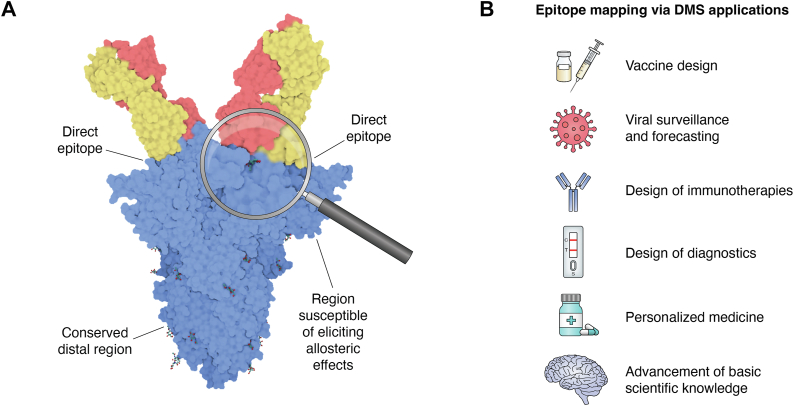
Figure 1
Figure 1
Epitope mapping via DMS applications.A, epitope mapping is a technique used to define the structural region responsible for direct protein-protein interactions. Epitope Mapping via deep mutational scanning (EM-DMS) can provide a more detailed insight on the effects that individual mutations have on these interactions. Regions that are liable to demonstrate allosteric effects and areas of high conservation are also characterized. The structure featured here can be found in the Protein Database (PDB) under accession code 7U0P (166). B, information gained from epitope mapping has broad reaching applications into the rational design of vaccines, therapeutics, diagnostics, personalized medicine, and the advancement of basic scientific knowledge in an unprecedented manner.
Figure 2
Figure 2
Workflow of epitope mapping via DMS. The standard workflow begins with the synthesis of a site-saturated mutational library followed by the integration of the library into a display platform to be surface-expressed. Selection pressure is applied to the library cells to sort out the desired population. The selected cells are then prepared for deep sequencing by extracting RNA, generating and amplifying cDNA, appending sequencing adapters and unique molecular identifier sequences. Once the sequencing data is received, algorithmic workflows are performed to link the genotype to phenotype. This information is illustrated with the generation of heatmaps, weblogo plots, and representation on protein surfaces.
Figure 3
Figure 3
Synthesis of a site-saturated mutational library.A, in the 54 studies that employed epitope mapping via DMS, five different synthesis strategies were used to generate a site-saturated mutational (SSM) library, each with its own set advantages and disadvantages which are illustrated here. B, different degenerate codons were employed in the generation of SSM libraries. These degenerate codons vary in the representation of the 20 amino acids, frequency of stop codons, and bias towards specific nucleotides.
Figure 4
Figure 4
Display platforms. All 54 studies which employed DMS for epitope mapping purposes are represented in this circular diagram. The degree to which each display platform or integration method was used is represented by the proportion of each area relative to the entire circle. The inner most circle represents the four display platforms and their respective popularity. The middle circle represents the methods of integration into the display platform of the corresponding color and their respective popularity. The outer circle represents the diversity of proteins that were surface-displayed within each platform of corresponding color.
Figure 5
Figure 5
Functional assays. The six different functional assays performed in the 54 studies that employed DMS for epitope mapping purposes are represented in this graph. The level of selective pressure that an assay is able to apply to the library cells is represented on the X-axis. The Y-axis is split by the five different display platforms. The usage of each assay is represented by the color of the circle.

References

    1. Zhou F., He S., Sun H., Wang Y., Zhang Y. Advances in epitope mapping technologies for food protein allergens: a review. Trends Food Sci. Technology. 2021;107:226–239.
    1. Davidson E., Doranz B.J. A high-throughput shotgun mutagenesis approach to mapping B-cell antibody epitopes. Immunology. 2014;143:13–20. - PMC - PubMed
    1. Hu D., Irving A.T. Massively-multiplexed epitope mapping techniques for viral antigen discovery. Front. Immunol. 2023;14 - PMC - PubMed
    1. Araya C.L., Fowler D.M. Deep mutational scanning: assessing protein function on a massive scale. Trends Biotechnol. 2011;29:435–442. - PMC - PubMed
    1. Hietpas R.T., Jensen J.D., Bolon D.N.A. Experimental illumination of a fitness landscape. PNAS. 2011;108:7896–7901. - PMC - PubMed

Publication types

LinkOut - more resources
