


Sensorless vector-controlled induction motor drives: Boosting performance with Adaptive Neuro-Fuzzy Inference System integrated augmented Model Reference Adaptive System
- PMID: 39676841
- PMCID: PMC11639364
- DOI: 10.1016/j.mex.2024.102992
Sensorless vector-controlled induction motor drives: Boosting performance with Adaptive Neuro-Fuzzy Inference System integrated augmented Model Reference Adaptive System
Abstract
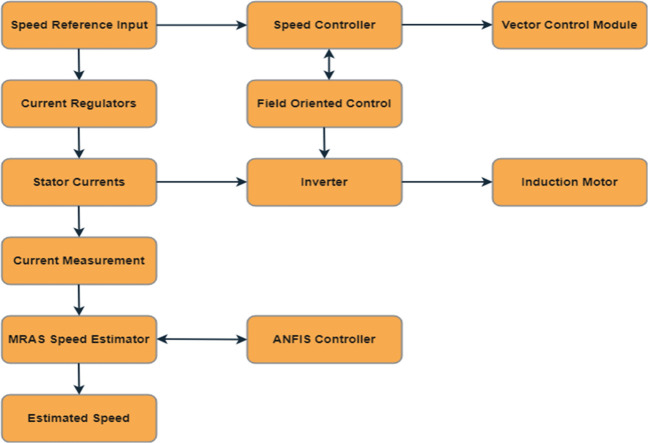
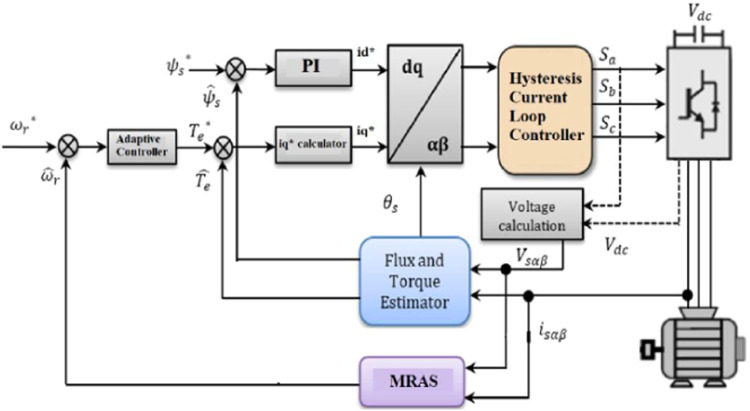
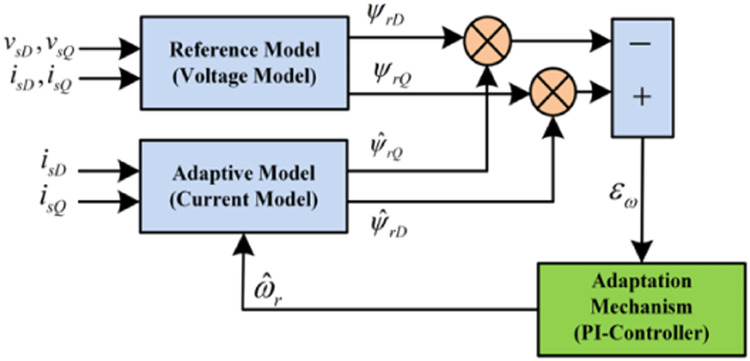
The Model Reference Adaptive System (MRAS) is effective for speed control in sensorless Induction Motor (IM) drives, particularly at zero and very low speeds. This study enhances MRAS's resilience and dynamic performance by integrating an Adaptive Neuro-Fuzzy Inference System (ANFIS) controller into sensorless vector-controlled IM drives. The research addresses challenges related to parameter uncertainties, load variations, and external disturbances through the combination of MRAS and ANFIS. The ANFIS controller enhances dynamic performance by adjusting its parameters based on the error between estimated and measured rotor speeds, which improves reference speed tracking and ensures smoother drive operation. This integration of ANFIS with MRAS reduces the sensitivity of the sensorless control system to parameter variations, such as changes in motor parameters or load torque, thereby enhancing system stability. The primary goal is to ma-intain stability and mitigate the impact of parameter variations on the sensorless control system. The proposed MRAS-ANFIS scheme was evaluated using MATLAB and compared with existing systems. Results show that the ANFIS-enhanced MRAS delivers superior dynamic performance and robustness, proving to be an effective solution for applications demanding precise speed control and high reliability. •ANFIS integration for improved control: integrating an Adaptive Neuro-Fuzzy Inference System (ANFIS) with MRAS enhances the dynamic performance and resilience of sensorless Induction Motor (IM) drives, particularly at zero and very low speeds.•Increased stability and robustness: The ANFIS controller adapts to parameter uncertainties, load variations, and disturbances, improving speed tracking and reducing sensitivity to motor parameter changes, thus enhancing system stability.•Superior performance Validated: MATLAB simulations show that the ANFIS-enhanced MRAS outperforms existing systems, offering superior dynamic performance and robustness, making it ideal for precise speed control applications.
Keywords: Adaptive Neuro-Fuzzy Inference System; Induction motor drive; Integration of Adaptive Neuro-Fuzzy Inference System (ANFIS) with Model Reference Adaptive System (MRAS); Load variations; Model reference adaptive system; Rotor speed estimation; Sensorless induction motor; Speed control.
© 2024 The Author(s).
Conflict of interest statement
The authors declare that they have no known competing financial interests or personal relationships that could have appeared to influence the work reported in this paper.
Figures
References
-
- Pei W. Lagrangian modeling and passivity based control of induction motors for electric vehicles. IFAC-PapersOnLine. 2018;51(31):499–503.
-
- Echeikh H., Trabelsi R., Iqbal A., Mimouni M.F. Real time implementation of indirect rotor flux oriented control of a five-phase induction motor with novel rotor resistance adaption using sliding mode observer. J. Franklin Inst. 2018;355(5):2112–2141.
-
- Chekroun S., Zerikat M., Benharir N. Speed-sensorless control of induction motor drive using MRAS-neural self-tuning IP obsrever. Przegląd Elektrotechniczny. 2018:94.
-
- Hamdi H., Regaya C.B., Zaafouri A. Real-time study of a photovoltaic system with boost converter using the PSO-RBF neural network algorithms in a My Rio controller. Solar Energy. 2019;183:1–6.
-
- Zahraoui Y.A., Akherraz M.O., Elbadaoui S.A. “Improvement of induction motor state observation: extended kalman filter versus adaptive luenberger observer. WSEAS Transactions on Systems and Control. 2020;15:120–130.
Publication types
LinkOut - more resources
Full Text Sources
