Awareness and monitoring of infection control practices among healthcare workers in three primary health centers in India
- PMID: 39677009
- PMCID: PMC11638719
- DOI: 10.3205/dgkh000514
Awareness and monitoring of infection control practices among healthcare workers in three primary health centers in India
Abstract
Objective: This study aimed to assess the awareness of and adherence to infection control practices among healthcare workers (HCWs) in three primary healthcare centers (PHCs) near Aurangabad City, Maharashtra, India.
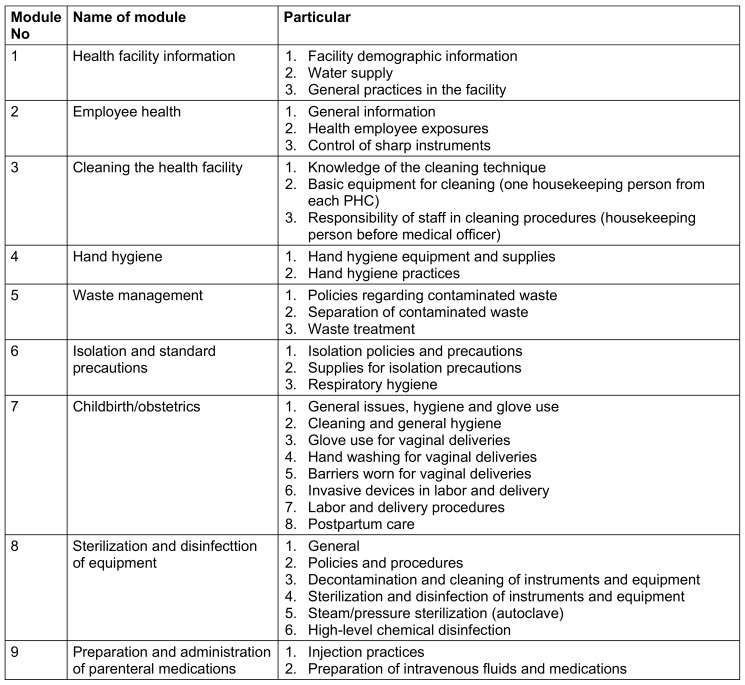
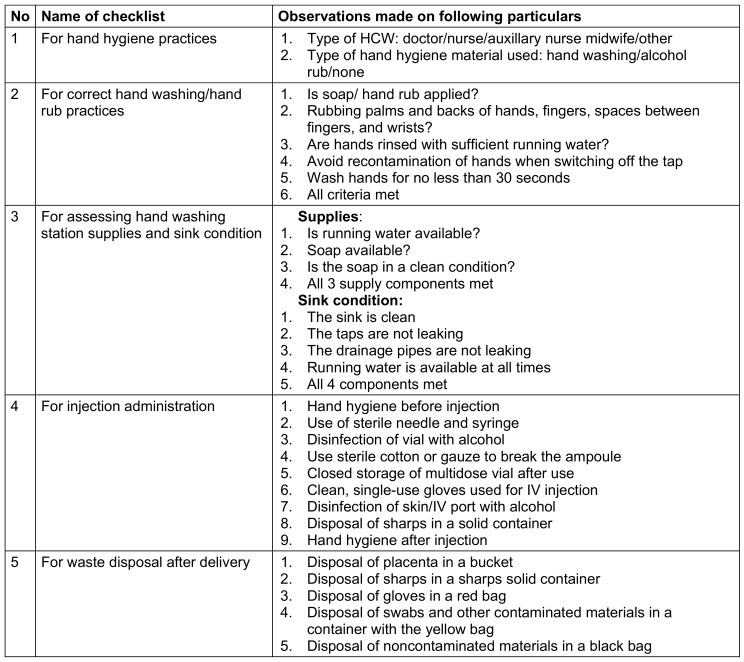
Method: A prospective observational study over six months involved 64 HCWs from three PHCs (A, B, and C). Questionnaires and observation checklists based on guidelines from the WHO and the Systems for Improved Access to Pharmaceuticals and Services (SIAPS) were used to evaluate infection control practices across nine modules. These modules encompass health facility information, employee health, cleaning practices, hand hygiene, waste management, isolation and standard precautions, childbirth/obstetrics, sterilization, and preparation/administration of parenteral medications.
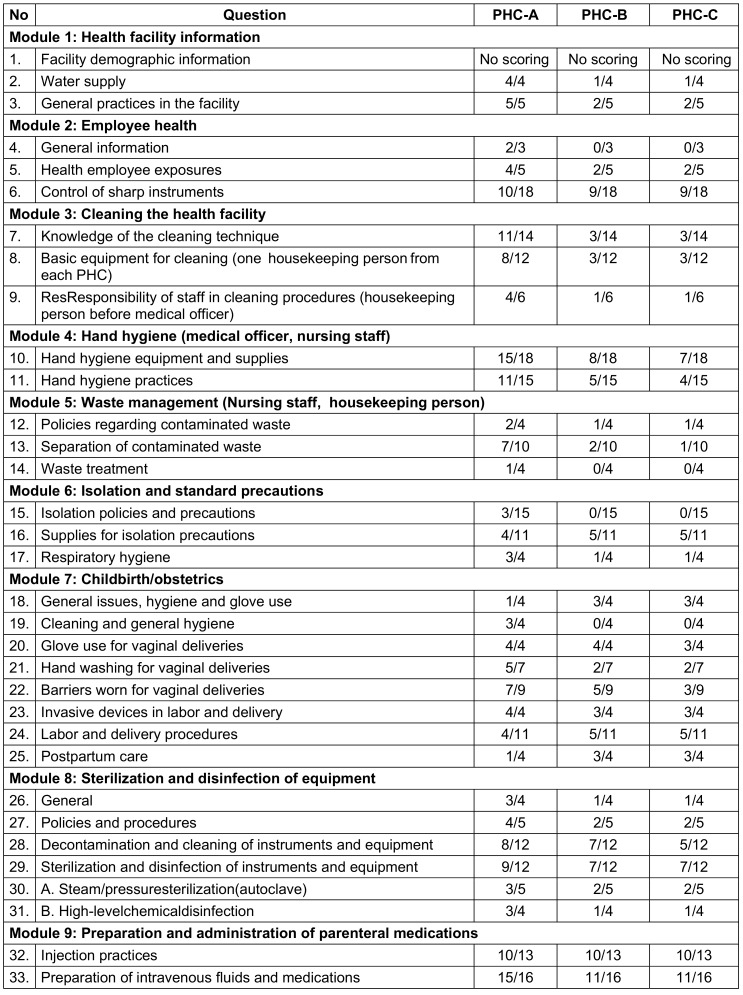
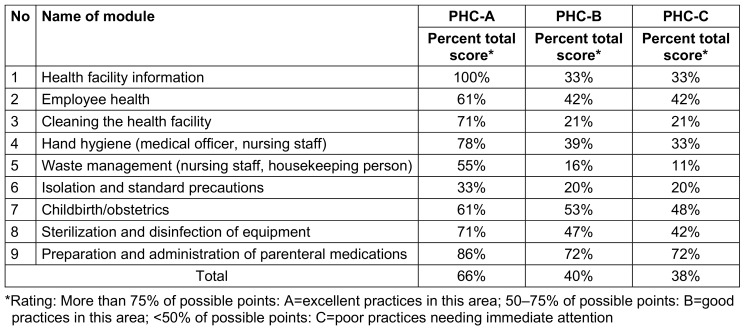
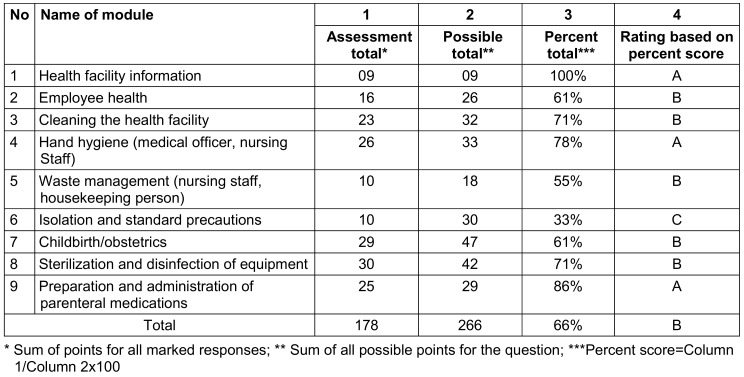
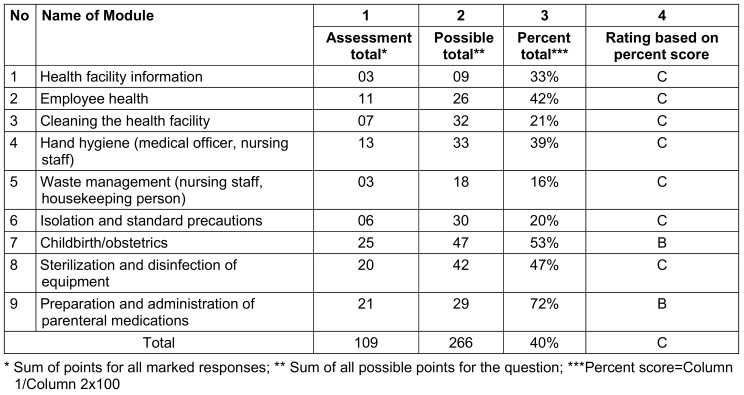
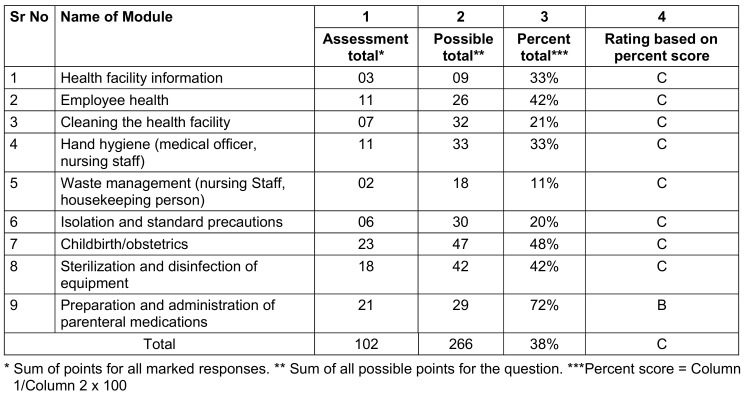
Results: The study revealed varying levels of adherence to infection control practices among the three PHCs. PHC-A demonstrated strong practices with an overall score of 66%, while PHC-B and PHC-C exhibited weaker practices with 40% and 38%, respectively. Hand hygiene practices showed higher compliance at PHC-A (78%), contrasting with lower compliance observed at PHC-B (39%) and PHC-C (33%). The study also noted deficiencies in hand hygiene facilities and inconsistencies in injection administration and waste disposal practices.
Conclusion: This study underscores the importance of ongoing training and targeted interventions to enhance infection control practices among HCWs in PHCs. The findings provide valuable insights for policymakers and administrators seeking to improve infection prevention measures in primary healthcare settings, contributing to better healthcare outcomes and enhanced patient safety.
Zielsetzung: Es sollten das Bewusstsein und die Einhaltung von Infektionskontrollpraktiken bei Beschäftigten im Gesundheitswesen in drei lokalen Gesundheitszentren (PHCs) in der Nähe der Stadt Aurangabad, Maharashtra, Indien, bewertet werden.
Methode: An der prospektiven Beobachtungsstudie über sechs Monate nahmen 64 Angestellte des Gesundheitswesens aus drei PHC teil. Anhand von Fragebögen und Beobachtungschecklisten, die auf den Richtlinien der WHO und dem System for Improved Access to Pharmaceuticals and Service (SIAPS) basieren, wurden die Praktiken der Infektionskontrolle in folgenden neun Modulen bewertet: Informationen über die Gesundheitseinrichtung, Gesundheit der Mitarbeiter, Reinigungspraktiken, Händehygiene, Abfallmanagement, Basishygiene und Isolierung, Entbindung, Sterilisation und Vorbereitung/Verabreichung von Parenteralia.
Ergebnisse: Die Studie ergab, dass sich die drei PHCs in unterschiedlichem Maß an Infektionskontrollpraktiken hielten. PHC-A wies mit einem Gesamtergebnis von 66% eine vergleichsweise gute Praxis auf, während PHC-B und PHC-C mit 40% bzw. 38% eine schwächere Praxis aufwiesen. Die Händehygiene wurde in PHC-A (78%) besser eingehalten, in PHC-B (39%) und PHC-C (33%) dagegen weniger. Außerdem wurden Mängel bei den Möglichkeiten zur Wahrnehmung der Händehygiene sowie Unstimmigkeiten bei der Verabreichung von Injektionen und bei der Abfallentsorgung festgestellt.
Schlussfolgerung: Die Studie unterstreicht die Bedeutung kontinuierlicher Schulungen und gezielter Maßnahmen zur Verbesserung der Infektionskontrollpraktiken des Gesundheitspersonals in Gesundheitszentren. Die Ergebnisse liefern wertvolle Erkenntnisse für politische Entscheidungsträger und Verwaltungsmitarbeiter, die Maßnahmen zur Infektionsprävention in der primären Gesundheitsversorgung verbessern wollen, um zu besseren Ergebnissen in der Gesundheitsversorgung und zu mehr Patientensicherheit beizutragen.
Keywords: awarness; healthcare workers; infection control practices; primary health centers.
Copyright © 2024 Mulay et al.
Conflict of interest statement
The authors declare that they have no competing interests.
Figures

References
-
- Al Kerity SHF, Naji AB. Evaluation of health care workers’ practices concerning infection control measures at primary health care centers. Sci J Med Res. 2017;1(1):63–68. doi: 10.37623/SJMR.2017.1207. - DOI
-
- Alabbadi AA, Alharthi BH, Qammash RA, Gammash AA, Abdulmjeed EA, Alhawsawi SY, et al. Assessment of the knowledge and practices of infection control standards among health care workers at the primary healthcare level in Makkah City at Saudi Arabia. Migr Letter. 2023;20(1):2048–2062.
-
- Systems for Improved Access to Pharmaceuticals and Services (SIAPS) Program. Infection Control Self-Assessment Tool for Primary Health Care Facilities. Arlington, VA: Management Sciences for Health; 2013. [Accessed 2024 Oc 4]. (Ger). Available from: https://siapsprogram.org/wp-content/uploads/2013/01/12-137-ICAT-PCH.FINA....
LinkOut - more resources
Full Text Sources