


Coupling-enabled chirality in terahertz metasurfaces
- PMID: 39677586
- PMCID: PMC11636346
- DOI: 10.1515/nanoph-2023-0019
Coupling-enabled chirality in terahertz metasurfaces
Abstract
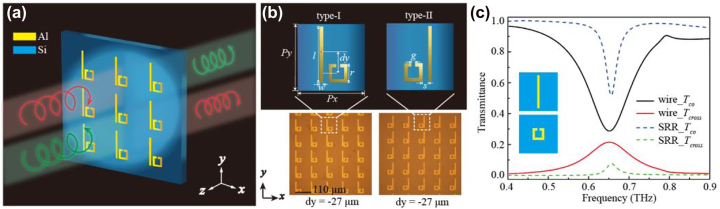
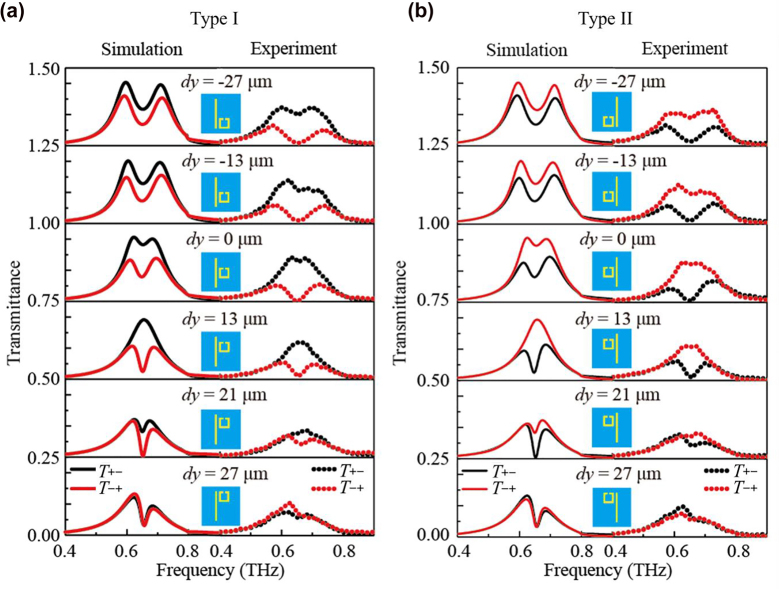
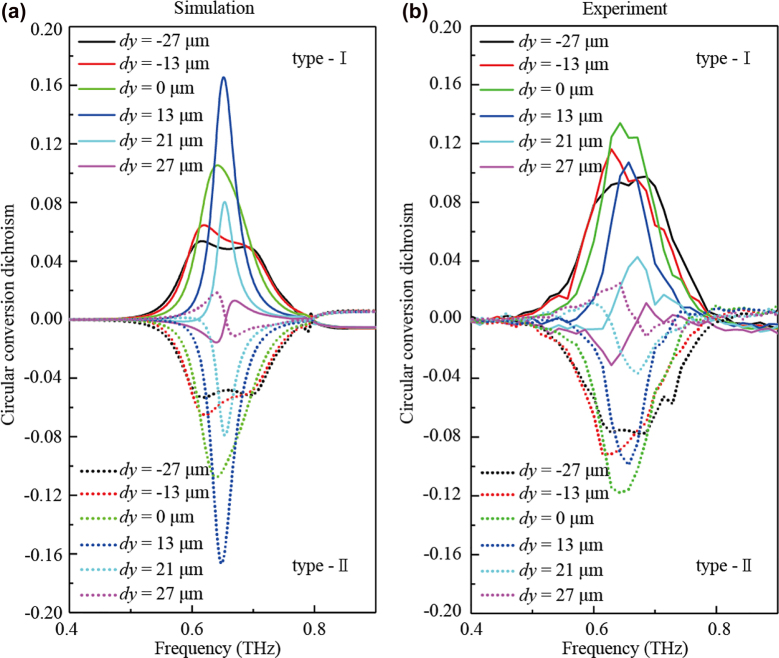
Chirality prevails in nature and is of great value for molecular biology, medicine, and bioscience. Due to the enhancement of chiroptical responses, chiral metasurfaces has attracted enormous attentions. In this paper, some novel polarization-sensitive transmission effects in terahertz chiral metasurfaces are exhibited. In the chiral metasurfaces whose unit cell consists of two basic resonators - a wire and a split ring resonator (SRR), we observe the asymmetrical transmission for circularly polarized state from the circular cross-polarization conversion spectra and the circular conversion dichroism (CCD). More importantly, we verify that the chiroptical activities can be affected by the coupling between the two resonators by simply moving their relative position in the terahertz metasurfaces. From the experimental and simulated results, we observe the distinguished variation in the circular cross-polarization conversion spectra and CCD, and combining with the theoretical analysis using coupled mode theory, we reveal that the chirality of the metasurfaces is strongly correlated to the coupling between the two modes determined by the wire and SRR. Finally, we demonstrate the coupling-enabled chirality by investigating the dependence of CCD on the coupling discrepancy with different relative positions of the two resonators. These findings offer the insights into the relationship between chirality and mode coupling and provide a theoretical method to design chiral metasurfaces and enhance the circular conversion dichroism, which have potential applications in the fields such as optical sensing, polarization imaging, and biological/chemical detection.
Keywords: chirality; coupled-mode theory; coupling; metasurface.
© 2023 the author(s), published by De Gruyter, Berlin/Boston.
Figures
References
-
- Luo Y., Chi C., Jiang M., et al. Plasmonic chiral nanostructures: chiroptical effects and applications. Adv. Opt. Mater. 2017;5:1700040. doi: 10.1002/adom.201700040. - DOI
LinkOut - more resources
Full Text Sources