


Poor sleep quality among bedtime smartphone user medical students in Ethiopia, 2024
- PMID: 39677974
- PMCID: PMC11638613
- DOI: 10.1016/j.sleepx.2024.100134
Poor sleep quality among bedtime smartphone user medical students in Ethiopia, 2024
Abstract
Background: Smartphone use has become widespread and continues to grow rapidly. Medical students, already highly susceptible to sleep deprivation, may experience exacerbated issues due to smartphone usage, particularly at bedtime. Therefore, understanding the potential negative impacts of this behavior is crucial. This study aims to assess the prevalence and risk factors of sleep quality among medical students bed time smart phone users in Ethiopia.
Subject and methods: An institutional-based cross-sectional study design was employed, involving 354 undergraduate medical students selected through simple random sampling from Debre Marko's University, the University of Gondar, and Debre Berhan University. Data were collected using the Pittsburgh Sleep Quality Index and structured interviews. Variables with a p-value of ≤0.2 in bivariable regression were included in multivariable logistic regression. Crude odds ratios and adjusted odds ratios were calculated, while chi-square tests were used to assess assumptions. In multivariable regression, variables with a p-value of ≤0.05 were deemed significant predictors at the 95 % confidence interval.
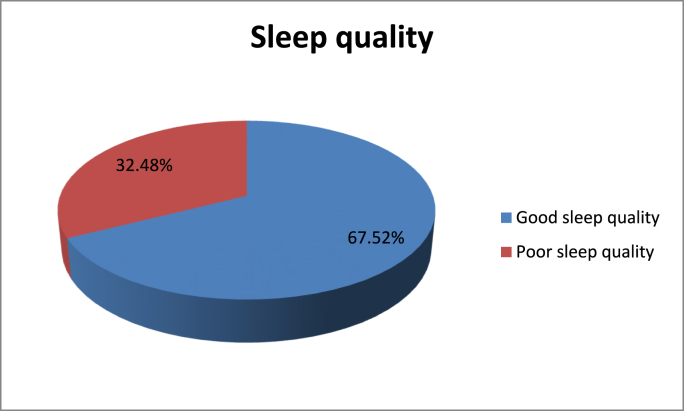
Result: The results showed that among bedtime smartphone users, 67.52 % had a poor sleep quality index greater than 5. Poor sleep quality was significantly linked to factors such as sex, regular coffee consumption, the purpose of smartphone use, phone position during use, the duration of smartphone use, and a history of disease. Social media usage was the most common activity, accounting for 41.60 % of smartphone use, followed by watching videos (21.65 %).
Conclusion: This study highlights the detrimental effects of bedtime smartphone use on sleep quality, which subsequently impacts mental. Given these findings, it is strongly recommended that medical students reduce their smartphone use before bedtime to improve their sleep quality.
Keywords: Ethiopia; Medicine; PSQI; Poor sleep quality; Smart phone.
© 2024 The Authors.
Conflict of interest statement
The authors declare that they have no known competing financial interests or personal relationships that could have appeared to influence the work reported in this paper.
Figures
References
-
- Buysse D. The Pittsburgh Sleep Quality Index: a new instrument for psychiatric practice and research. Psychiatry. 2003;18:498. - PubMed
-
- Abdallah A.A., Mahfouz E.M., Mohammed E.S., Emam S.A., Abd-El Rahman T.A. Sleep quality and its association with body weight among adults: an epidemiological study. Malaysian Journal of Public Health Medicine. 2021;21(1):327–335.
-
- Al Shammari M.A., Al Amer N.A., Al Mulhim SN., Al Mohammedsaleh H.N., AlOmar R.S. The quality of sleep and daytime sleepiness and their association with academic achievement of medical students in the eastern province of Saudi Arabia. Journal of Family and Community Medicine. 2020;27(2):97–102. - PMC - PubMed
-
- Exelmans L., Van den Bulck J. Bedtime mobile phone use and sleep in adults. Soc Sci Med. 2016;148:93–101. - PubMed
LinkOut - more resources
Full Text Sources
