. 2024 Nov 18;4(1):vbae166.
doi: 10.1093/bioadv/vbae166. eCollection 2024.

The ISCB competency framework v. 3: a revised and extended standard for bioinformatics education and training

Affiliations

The ISCB competency framework v. 3: a revised and extended standard for bioinformatics education and training

Cath Brooksbank et al. Bioinform Adv. .

Abstract

Motivation: Developing competency in the broad area of bioinformatics is challenging globally, owing to the breadth of the field and the diversity of its audiences for education and training. Course design can be facilitated by the use of a competency framework-a set of competency requirements that define the knowledge, skills and attitudes needed by individuals in (or aspiring to be in) a particular profession or role. These competency requirements can help to define curricula as they can inform both the content and level to which competency needs to be developed. The International Society for Computational Biology (ISCB) developed a list of bioinformatics competencies in 2014, and these have undergone several rounds of improvement. In consultation with a broad bioinformatics training community, these have now been further refined and extended to include knowledge skills and attitudes, and mappings to previous and other existing competency frameworks.

Results: Here, we present version 3 of the ISCB competency framework. We describe how it was developed and how to access it, as well as providing some examples of how it has been used.

Availability and implementation: The framework is openly accessible at https://competency.ebi.ac.uk/framework/iscb/3.0/competencies.


Conflict of interest statement

None declared.

Figures
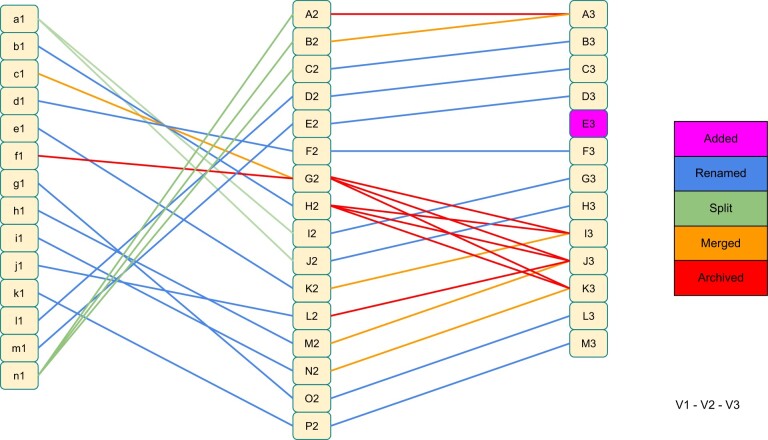
Figure 1.
Figure 1.
Mapping to previous versions. Summary diagram showing the relationship of each competency to its predecessors across versions 1.0, 2.0, and 3.0 of the ISCB Competency Framework. The dataset from which this mapping is derived is provided in the Supplementary Material, together with mappings to other frameworks. This information was also used to populate the interactive version of the framework at https://competency.ebi.ac.uk/framework/iscb/3.0/competencies.
Figure 2.
Figure 2.
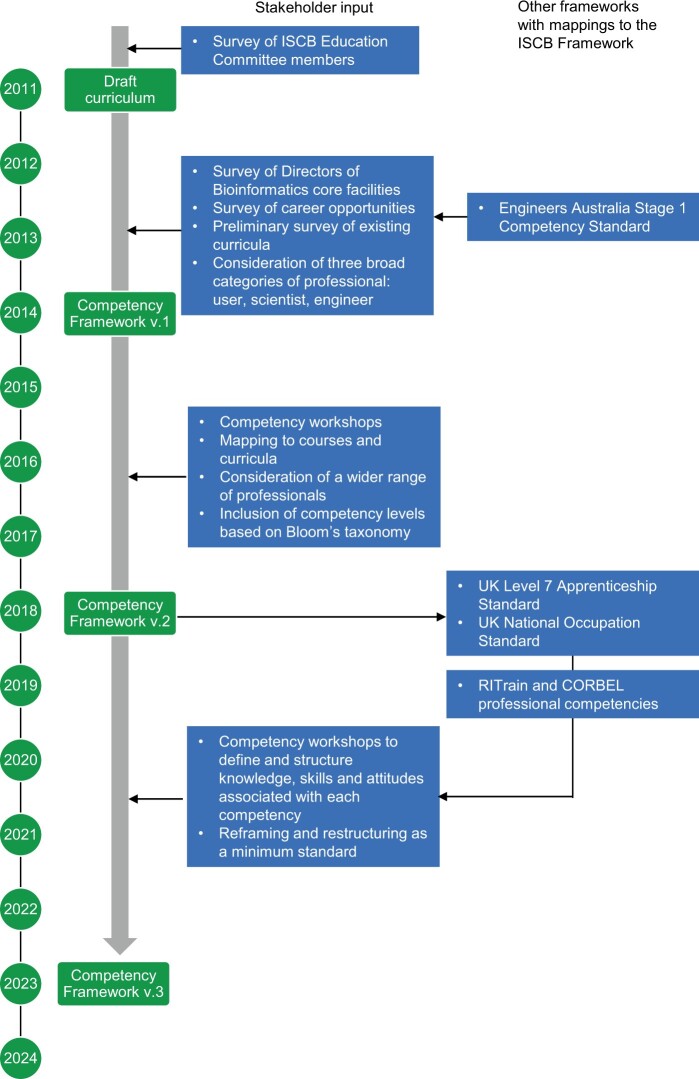
Evolution of the ISCB competency framework. This timeline summarizes the key inputs to the ISCB competency framework at different stages of its development (boxes with arrows). In the case of the UK level 7 apprenticeship standard and National Occupation Standard, the relationship is cyclical: version 2 of the ISCB Competency framework informed development of the UK standards; the knowledge, skills and attitudes developed by standards task forces were then used to inform version 3 of the ISCB framework. Mappings to all the frameworks listed here are detailed in the Supplementary Material.
Figure 3.
Figure 3.
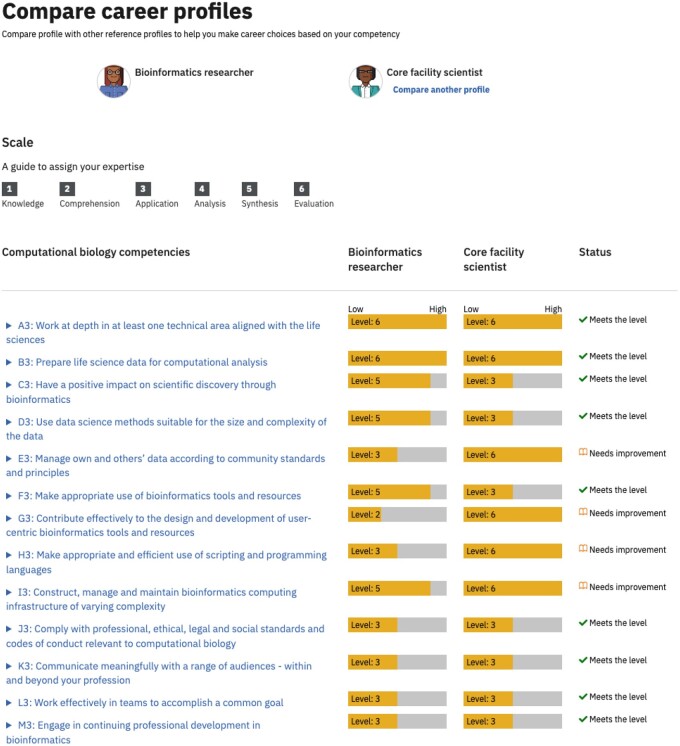
Comparison of two ISCB career profiles in the competency hub. A user can select two pre-published career profiles (here Bioinformatics researcher and core facility scientist) and compare the minimum Bloom’s level at which competency is required. A “status” column clarifies which competency areas the user needs to work on. Each competency in the hub is linked to courses that support users to develop their competency in that particular area (not shown).

References

    1. Anderson LW, Krathwohl DR.. A Taxonomy for Learning, Teaching, and Assessing: A Revision of Bloom's Taxonomy of Educational Objectives. Boston: Allyn and Bacon, 2001.
    1. Anon. Bioinformatics scientist degree apprenticeship (ST0649) level 7 end-point assessment plan (non-integrated). 2018. https://www.instituteforapprenticeships.org/media/2520/st0649_bioinforma... (23 October 2024, date last accessed).
    1. Attwood TK, Bongcam-Rudloff E, Brazas ME. et al.; GOBLET Consortium. GOBLET: the global organisation for bioinformatics learning, education and training. PLoS Comput Biol 2015;11:e1004143. - PMC - PubMed
    1. Cantelli G, Bateman A, Brooksbank C. et al. The european bioinformatics institute (EMBL-EBI) in 2021. Nucleic Acids Res 2022;50:D11–9. 10.1093/nar/gkab1127 - DOI - PMC - PubMed
    1. De Las Rivas J, Bonavides-Martínez C, Campos-Laborie FJ. et al. Bioinformatics in Latin America and SoIBio impact, a tale of spin-off and expansion around genomes and protein structures. Brief Bioinform 2019;20:390–7. 10.1093/bib/bbx064 - DOI - PMC - PubMed

LinkOut - more resources