Construction, validation, and visualization of a web-based nomogram to predict survival in male breast cancer patients with second primary prostate cancer
- PMID: 39678429
- PMCID: PMC11635572
- DOI: 10.21037/gs-24-287
Construction, validation, and visualization of a web-based nomogram to predict survival in male breast cancer patients with second primary prostate cancer
Abstract
Background: The advancement of early detection and treatment has brought about a significant concern for male breast cancer (MBC) survivors-the emergence of a second primary malignancy (SPM) poses a grave threat to their lives. Among them, second primary prostate cancer (spPCa) holds particular significance. This study aimed to investigate the impact of spPCa on the prognosis of MBC patients.
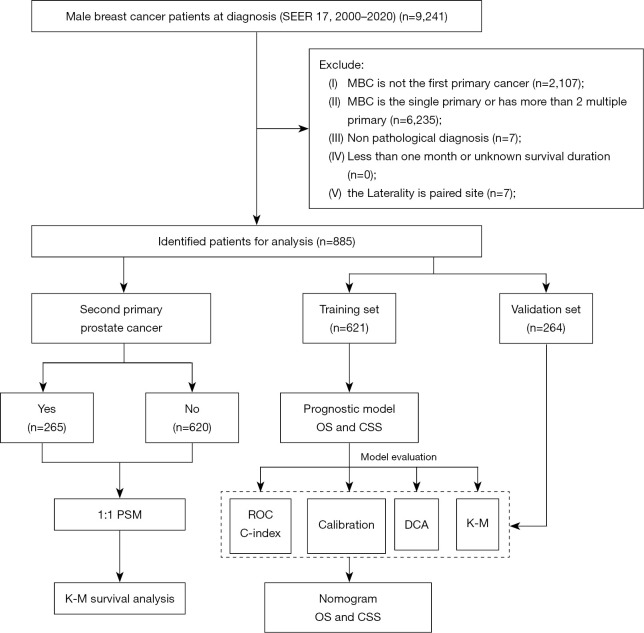
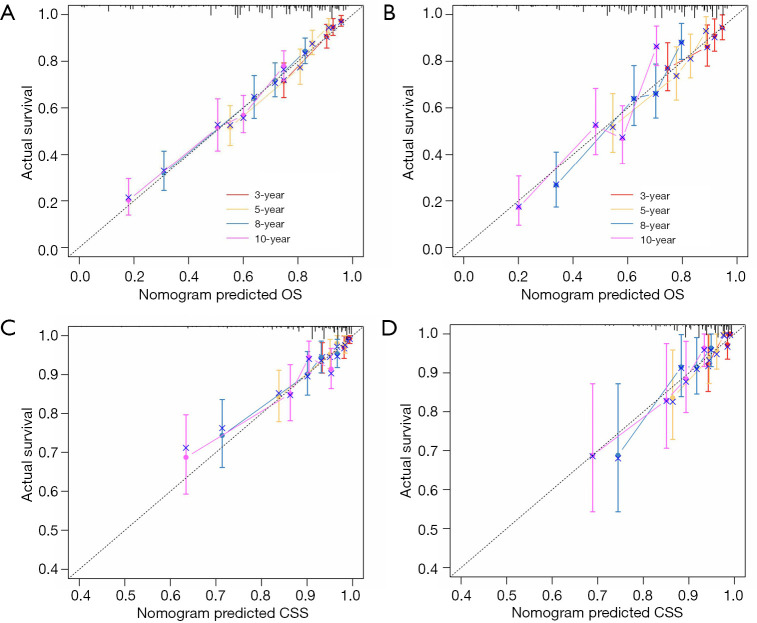
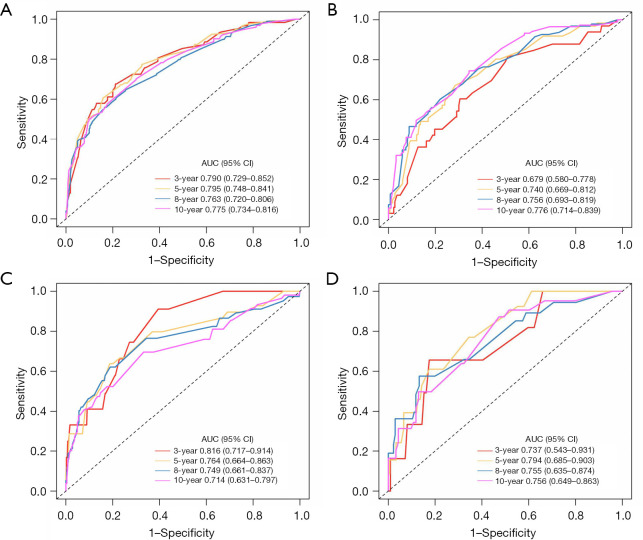
Methods: We performed a retrospective analysis using information from the Surveillance, Epidemiology, and End Results (SEER) database to investigate individuals diagnosed with MBC who also experienced an SPM between 2000 and 2020. Propensity score matching (PSM) was employed to balance the baseline characteristics of individuals with spPCa and those with second primary non-prostate cancer (non-PCa). The impact of spPCa on participant survival was assessed using the Kaplan-Meier method. Furthermore, two nomograms were developed, based on univariate and multifactor Cox regression analyses, to predict overall survival (OS) and cancer-specific survival (CSS). The capacity of the nomograms was evaluated using the concordance index (C-index), calibration curve, receiver operating characteristic (ROC) analysis, and decision curve analysis (DCA). Additionally, a risk stratification system was devised, taking into account the cumulative score of each patient in the nomogram.
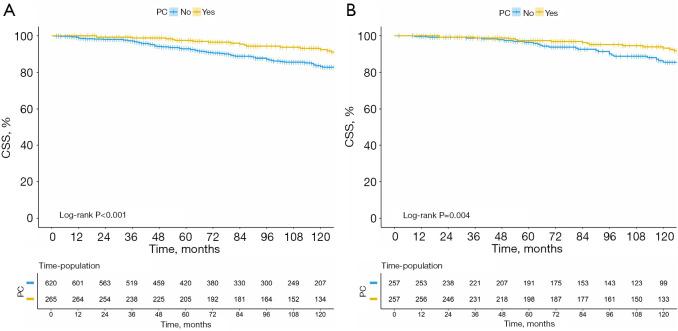
Results: This study enrolled a total of 885 MBC patients who experienced an SPM, of which 265 (29.9%) were diagnosed with spPCa. Through PSM, 257 pairs of eligible participants were selected. Survival analysis revealed that patients with prostate cancer (PCa) as an SPM have longer OS and CSS compared to those with other types of cancer as an SPM. The participants were randomly divided into a training set and a validation set in a ratio of 7:3. The Cox proportional hazards model was utilized to assess the risk factors associated with survival outcomes. Two nomograms were developed to forecast the 3-, 5-, 8-, and 10-year OS and CSS of male patients who had breast cancer and SPM. The two nomograms exhibited excellent performance in terms of the C-index, ROC curves, calibration plots, and DCA curves, demonstrating their exceptional clinical discriminative ability and predictive utility. In the risk stratification system predicated on the total score of the nomogram, patients deemed high-risk exhibited diminished OS and CSS. Additionally, we created user-friendly web applications to enhance the accessibility of the nomogram in clinical practices, which can be accessed at https://mbcpre.shinyapps.io/DynNomapp_OS/ for OS and https://mbcpre.shinyapps.io/DynNomapp_CSS/ for CSS.
Conclusions: MBC patients with spPCa exhibit a more favorable prognosis than those with other SPMs. The two nomograms we constructed could accurately forecast the OS and CSS for MBC patients with spPCa. Patients whose nomograms are stratified as high-risk should gain additional attention. Our nomograms may aid clinicians in personalizing treatment strategies and supporting clinical decisions.
Keywords: Male breast cancer (MBC); Surveillance, Epidemiology, and End Results (SEER); nomogram; second primary prostate cancer (spPCa); survival probability.
2024 AME Publishing Company. All rights reserved.
Conflict of interest statement
Conflicts of Interest: All authors have completed the ICMJE uniform disclosure form (available at https://gs.amegroups.com/article/view/10.21037/gs-24-287/coif). The authors have no conflicts of interest to declare.
Figures




References
LinkOut - more resources
Full Text Sources
Miscellaneous