The influence between plaque rupture and non-plaque rupture on clinical outcomes in patients with ST-segment elevation myocardial infarction after primary percutaneous coronary intervention: a prospective cohort study
- PMID: 39678843
- PMCID: PMC11635223
- DOI: 10.21037/jtd-24-1482
The influence between plaque rupture and non-plaque rupture on clinical outcomes in patients with ST-segment elevation myocardial infarction after primary percutaneous coronary intervention: a prospective cohort study
Abstract
Background: Coronary atherosclerosis can lead to acute clinical events upon atherosclerotic plaque rupture (PR) or erosion and arterial thrombus formation. Identifying the effect of distinct plaque characteristics on clinical outcomes in patients with ST-segment elevation myocardial infarction (STEMI) is critical for clinical therapy. Our goal was to ascertain the correlation between clinical outcome, long-term prognosis, and morphological plaque characteristics in STEMI.
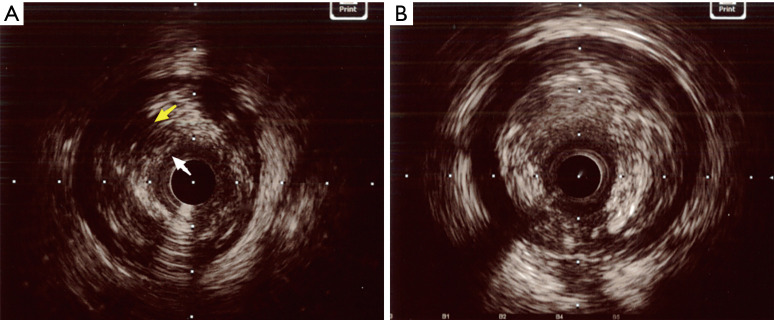
Methods: The data used in this prospective cohort research came from a prior multicenter prospective cohort study (ChiCTR1800019923). One hundred and thirteen consecutive STEMI patients were involved in our cohort study. Patients with STEMI who received primary percutaneous coronary intervention (pPCI) within 24 hours of symptom onset were included in the study and divided into two groups according to plaque characteristics derived from intravascular ultrasound (IVUS): a PR group and a non-PR group. The primary outcome was the incidence of no reflow or slow flow, the secondary outcome was major adverse cardiac events (MACEs) at 1-year follow-up.
Results: This study enrolled 113 consecutive patients with STEMI [mean age 56 (range, 49-65.5) years; males 90.27%]. Of the 113 patients, PR was found in 93 (82.3%), while non-PR was found in 20 (17.7%). The PR group had a higher rates of plaque eccentricity index (64.28%±22.69% vs. 60.08%±15.54%; P=0.045), higher rates of lipid pool-like images (62.37% vs. 30.00%; P=0.008), and higher rates of tissue prolapse (22.95% vs. 13.33%; P=0.01). Compared with that in the non-PR group, the incidence of no reflow or slow flow was higher in the PR group after pPCI (26.88% vs. 5.00%; P=0.04). Multivariable logistic regression showed that PR [odds ratio (OR) =8.188; 95% confidence interval (CI): 1.020-65.734; P=0.048] was an independent predictor of no reflow or slow flow. Survival analysis revealed no significant differences in MACE incidence between the two groups at 1-year follow-up (7.61% vs. 10.00%; P=0.66). Furthermore, 29 patients with PR were treated without stenting, most of them were free of MACEs (27/29). MACE between subgroups of stenting and non-stenting had no significant differences (7.94% vs. 6.90%; P=0.86) in the PR group.
Conclusions: In comparison to patients with non-PR, PR were not associated with the risk of recurrent myocardial infarction (MI), revascularization, heart failure, or cardiac death at 1-year follow-up, while associated with an increased incidence of no reflow or slow flow during pPCI. This observation would be considered while risk stratification and dealing with patients who have STEMI. Most patients with PR who were treated without stenting were MACE free. Further research should be conducted to determine whether interventional treatment without stenting is feasible for patients with STEMI and PR.
Keywords: Plaque rupture (PR); ST-segment elevation myocardial infarction (STEMI); intravascular ultrasound (IVUS).
2024 AME Publishing Company. All rights reserved.
Conflict of interest statement
Conflicts of Interest: All authors have completed the ICMJE uniform disclosure form (available at https://jtd.amegroups.com/article/view/10.21037/jtd-24-1482/coif). S.T. reports research grants and consultancy from Pulse Medical. The other authors have no conflicts of interest to declare.
Figures


References
-
- Morishima I, Sone T, Okumura K, et al. Angiographic no-reflow phenomenon as a predictor of adverse long-term outcome in patients treated with percutaneous transluminal coronary angioplasty for first acute myocardial infarction. J Am Coll Cardiol 2000;36:1202-9. 10.1016/s0735-1097(00)00865-2 - DOI - PubMed
LinkOut - more resources
Full Text Sources
Research Materials