


Influence of cochlear coverage on speech perception in single sided deafness, bimodal, and bilateral implanted cochlear implant patients
- PMID: 39681657
- PMCID: PMC11950124
- DOI: 10.1007/s00405-024-09086-x
Influence of cochlear coverage on speech perception in single sided deafness, bimodal, and bilateral implanted cochlear implant patients
Abstract
Purpose: Individualized cochlear implantation (CI) is essential to facilitate optimal hearing results for patients. Influence of cochlear coverage (CC) has been studied, however without consideration of different CI-categories, like single sided deafness (SSD), bimodal, and bilateral separately.
Methods: Retrospective analysis of preoperative CT scans was performed at a tertiary center. For each patient their individual CC with the selected electrode array was calculated off the complete CDL. Patients were categorized into SSD (n = 30), bimodal (n = 72), and bilateral CI patients (n = 29). Speech perception within the first 12 months post-implantation was compared between patient groups with shorter and longer CC. For subgroup analysis the cutoff between a shorter or longer CC was identified by the median.
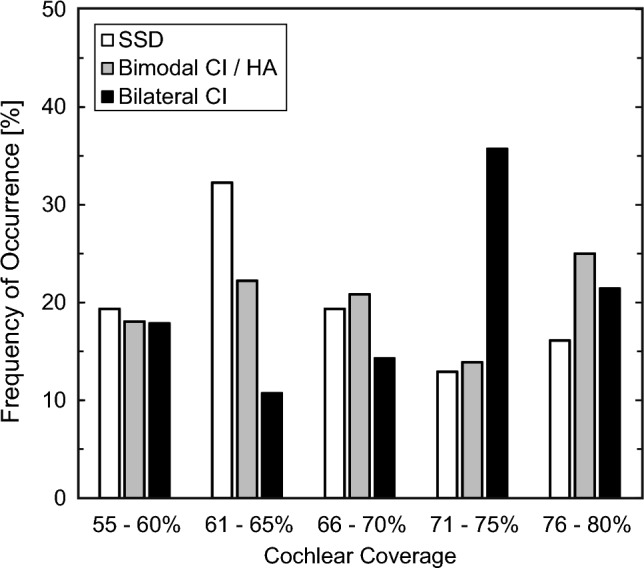
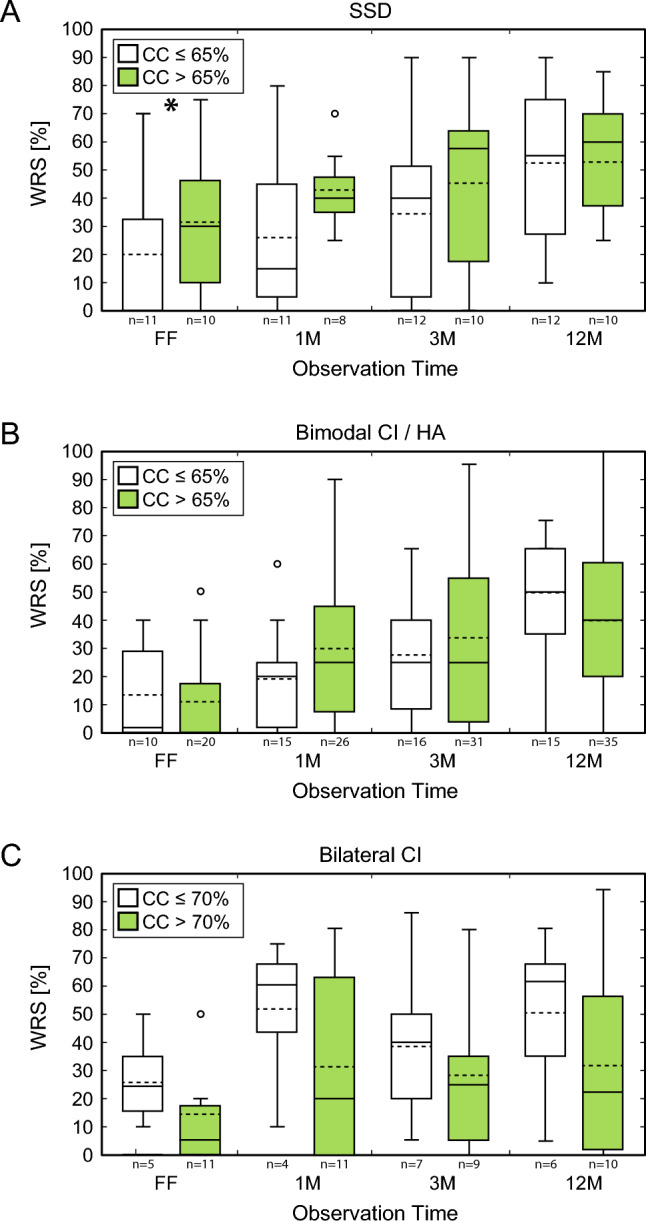
Results: Cutoff between a shorter or longer CC was identified at 65% off the complete CDL for SSD and bimodal patients, and at 70% for bilateral patients. In SSD-patients longer CC was associated with better performance at activation (CCshorter 20.0 ± 28.9% vs. CClonger 31.5 ± 24.7%; p = 0.04) and no benefit was found with deeper insertion at 12 months. No significant benefit was found for deeper insertion in bimodal and bilateral patients.
Conclusions: Capacities of hearing performance seem to differ between SSD, bimodal and bilateral patients within the first year after implantation with regards to cochlear coverage. SSD-patients appear to benefit from deeper insertion than 65% up to 12 months after implantation. However, these results should be interpreted with caution, hence development of speech perception with CI is influenced by a whole range of factors, and bimodal and bilateral treated patients are extremely heterogenous patient groups.
Keywords: Bimodal; Cochlear coverage; SSD; Single sided deafness; Speech perception.
© 2024. The Author(s).
Conflict of interest statement
Declarations. Conflict of interest: TR and JLS received travel expenses from MED EL GmbH, Innsbruck, Austria and Cochlear Deutschland GmbH & Co. KG. Ethical approval: Study protocol was performed according to ethical guidelines of the 2002 Declaration of Helsinki, and carried out after approval by the Institutional Review Board and Ethics Committee of the Ludwig-Maximilians-Universität München, Munich, Germany (Ethikkommission der LMU München) (reference number 19-562). Consent to participate: Not applicable. Consent for publication (include appropriate statements): Not applicable. Consolidated standard of reporting trial statement: Patient flow diagram see Fig. 1.
Figures

References
-
- WHO (2022) Deafness and hearing loss World Health Organization. https://www.who.int/health-topics/hearing-loss. Accessed 6 Aug 2023
-
- Arndt S, Laszig R, Aschendorff A, Hassepass F, Beck R, Wesarg T (2017) Cochlear implant treatment of patients with single-sided deafness or asymmetric hearing loss. HNO 65(Suppl 2):98–108. 10.1007/s00106-016-0297-5 - PubMed
-
- Rader T, Fastl H, Baumann U (2013) Speech perception with combined electric-acoustic stimulation and bilateral cochlear implants in a multisource noise field. Ear Hear 34(3):324–332. 10.1097/AUD.0b013e318272f189 - PubMed
-
- von Ilberg CA, Baumann U, Kiefer J, Tillein J, Adunka OF (2011) Electric-acoustic stimulation of the auditory system: a review of the first decade. Audiol Neurootol 16(Suppl 2):1–30. 10.1159/000327765 - PubMed
MeSH terms
LinkOut - more resources
Full Text Sources
Medical
