. 2024 Oct 18;2(1):70.
doi: 10.1186/s44263-024-00101-1.

Systems modelling and simulation to guide targeted investments to reduce youth suicide and mental health problems in a low-middle-income country

Affiliations

Systems modelling and simulation to guide targeted investments to reduce youth suicide and mental health problems in a low-middle-income country

Laura Ospina-Pinillos et al. BMC Glob Public Health. .

Abstract

Background: Despite suicide's public health significance and global mental health awareness, current suicide prevention efforts show limited impact, posing a challenge for low- and middle-income countries. This study aimed to develop a dynamic simulation model that could be used to examine the potential effectiveness of alternative interventions for reducing youth mental health problems and suicidal behavior in Bogotá, Colombia.

Methods: A system dynamics model was designed using a participatory approach involving three workshops conducted in 2021 and 2022. These workshops engaged 78 stakeholders from various health and social sectors to map key mental health outcomes and influential factors affecting them. A model was subsequently developed, tested, and presented to the participants for interactive feedback, guided by a moderator. Simulation analyses were conducted to compare projected mental health outcomes for a range of intervention scenarios with projections for a reference scenario corresponding to business-as-usual.

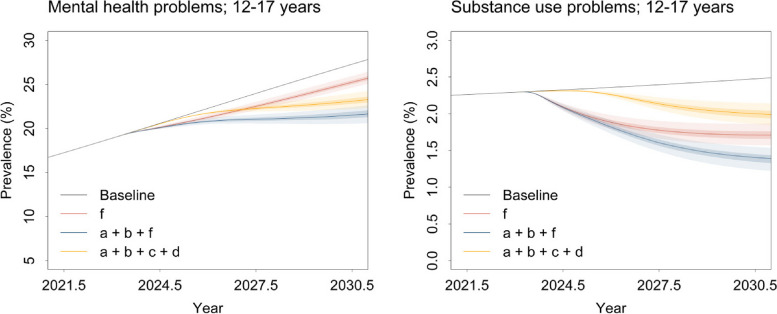
Results: A total of 6670 suicide attempts and 347 suicides are projected among 7 - 17-year-olds from January 1, 2023, to early 2031 under the business-as-usual scenario. Mental health issues among 12 - 17-year-olds are projected to increase from 18.9% (2023) to 27.8% (2031), and substance use issues from 2.29 to 2.49% over the same period. School-based suicide prevention and gatekeeper training are the most effective strategies, reducing total numbers of suicide attempts and suicides by more than 20% (i.e., compared to business-as-usual). However, discontinuous funding significantly hinders these effective suicide prevention efforts.

Conclusions: Systems modelling is an important tool for understanding where the best strategic financial and political investments lie for improving youth mental health in resource-constrained settings.

Keywords: Colombia; Decision analysis; Low- and middle-income countries; Mental health; Participatory research; Simulation; Strategic planning; Suicide prevention; Systems modelling; Young people.


Conflict of interest statement

Declarations. Ethics approval and consent to participate: The study was approved by the Human Research Ethics Committee of the Pontificia Universidad Javeriana (Bogotá, Colombia) and the Hospital Universitario San Ignacio (protocol number FM-CIE-0103–21). All participants signed an informed consent. The study conformed to the principles of the Helsinki Declaration. Consent for publication: Not applicable. Competing interests: IBH is the Co-Director, Health and Policy at the Brain and Mind Centre (BMC) University of Sydney. He is the Chief Scientific Advisor to, and a 3.2% equity shareholder in InnoWell Pty Ltd. JO is both Head of Systems Modelling, Simulation & Data Science, and Co-Director of the Mental Wealth Initiative at the University of Sydney's Brain and Mind Centre. She is also Managing Director of Computer Simulation & Advanced Research Technologies (CSART) and acts as Advisor to the OECD Neuroscience-inspired Policy Initiative and the Brain Capital Alliance. The remaining authors declare no competing interests.

Figures
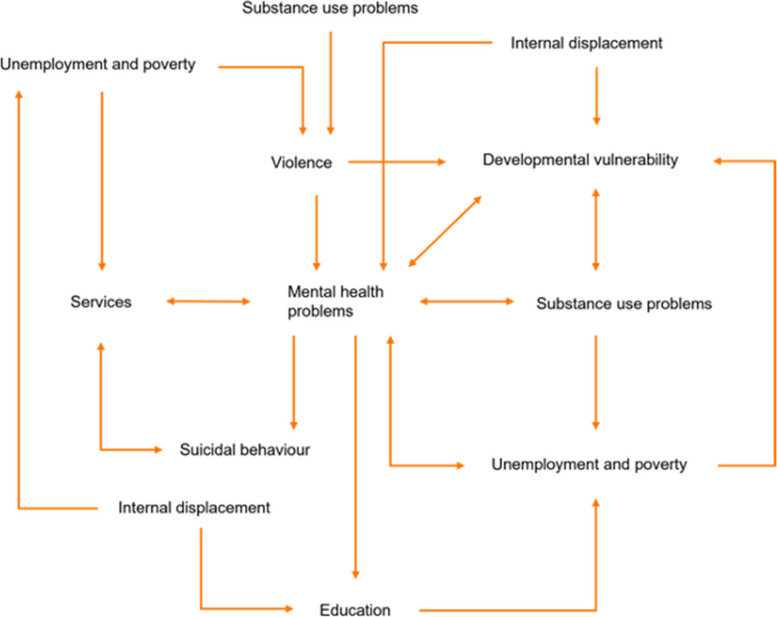
Fig. 1
Fig. 1
High-level map of the core system dynamics model showing the causal connections among model sectors. Single-headed arrows indicate unidirectional causal connections; bidirectional causal connections are shown as double-headed arrows
Fig. 2
Fig. 2
Projected numbers of suicide attempts and suicides per year for children and adolescents (7 − 17 years) in Bogotá, Colombia under the baseline scenario. Data for suicide attempts and suicides are from the Suicidal Behaviour Epidemiological Surveillance Subsystem (SISVECOS) and the National Institute of Legal Medicine and Forensic Sciences (INMLCF), respectively
Fig. 3
Fig. 3
Differences in total (cumulative) numbers of suicide attempts and suicide mortality between the baseline and intervention scenarios for children and adolescents (7 − 17 years) in Bogotá, Colombia over the period 2023 − 2031. Mean numbers of prevented suicide attempts and suicides (reported in the second column from the left) and mean percentage reductions and 95% intervals (in the rightmost column) were derived from the distributions of projected outcomes calculated in the sensitivity analyses. Note that the 95% intervals provide a measure of the impact of uncertainty in the assumed intervention effects but should not be interpreted as confidence intervals. The plot on the right shows the mean percentage reductions (closed circles) and 95% and 50% intervals (light and heavy lines, respectively)
Fig. 4
Fig. 4
Prevalence of child and adolescent MH problems and substance use problems (12 − 17 years) in Bogotá, Colombia under the baseline scenario and for selected intervention scenarios: f (red), community connectedness programs; a + b + f (blue), school-based suicide prevention programs + anti-bullying programs + community connectedness programs; a + b + c + d (yellow), school-based suicide prevention programs + anti-bullying programs + gatekeeper suicide prevention training + suicide helplines. Solid lines correspond to median values derived from the sensitivity analyses. Pointwise 95% and 50% intervals are indicated with light and dark shading, respectively
Fig. 5
Fig. 5
Effect of cyclical program funding on reductions in suicidal behavior among children and adolescents (7 − 17 years) in Bogotá, Colombia. Continuous funding (blue): school-based suicide prevention programs + anti-bullying programs + gatekeeper suicide prevention training + suicide helplines (intervention scenario g in Fig. 3), continuously funded from 1 January 2023 until the end of the simulation. Cyclical funding (red): school-based suicide prevention programs + anti-bullying programs + gatekeeper suicide prevention training + suicide helplines, commencing in 2023 (as in the continuous funding simulation), but with discontinuous funding, so that all four interventions end and restart midway through 2026 and 2030 (we assumed a 4-year funding cycle aligned with, although not necessarily attributable to, presidential elections). Median values derived from the sensitivity analyses are plotted as solid lines. Pointwise 95% and 50% intervals are indicated with light and dark shading, respectively

References

    1. World Health Organization. Suicide. 2023. Available from: https://www.who.int/news-room/fact-sheets/detail/suicide. Cited 2023 Sept 12.
    1. Kendler KS. From many to one to many—the search for causes of psychiatric illness. JAMA Psychiat. 2019;76(10):1085–91. - DOI - PubMed
    1. Alegría M, Nemoyer A, Falgàs Bagué I, Wang Y, Alvarez K. Social determinants of mental health: where we are and where we need to go. Curr Psychiatry Rep. 2018;20(11):1. - DOI - PMC - PubMed
    1. Occhipinti JA, Skinner A, Iorfino F, Lawson K, Sturgess J, Burgess W, et al. Reducing youth suicide: systems modelling and simulation to guide targeted investments across the determinants. BMC Med. 2021;19(1):1–3. - DOI - PMC - PubMed
    1. Skinner A, Occhipinti JA, Song YJC, Hickie IB. Population mental health improves with increasing access to treatment: evidence from a dynamic modelling analysis. BMC Psychiatry. 2022;22:692. - PMC - PubMed

LinkOut - more resources