


Laser-Induced Graphene Decorated with MOF-Derived NiCo-LDH for Highly Sensitive Non-Enzymatic Glucose Sensor
- PMID: 39683820
- PMCID: PMC11643804
- DOI: 10.3390/molecules29235662
Laser-Induced Graphene Decorated with MOF-Derived NiCo-LDH for Highly Sensitive Non-Enzymatic Glucose Sensor
Abstract
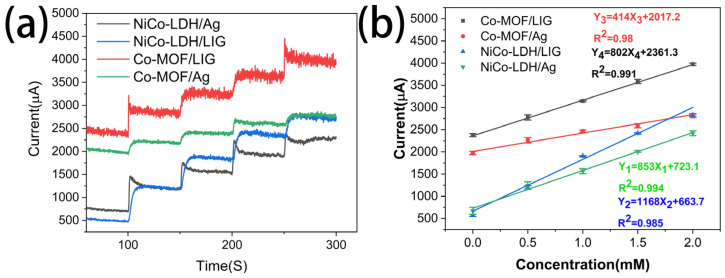
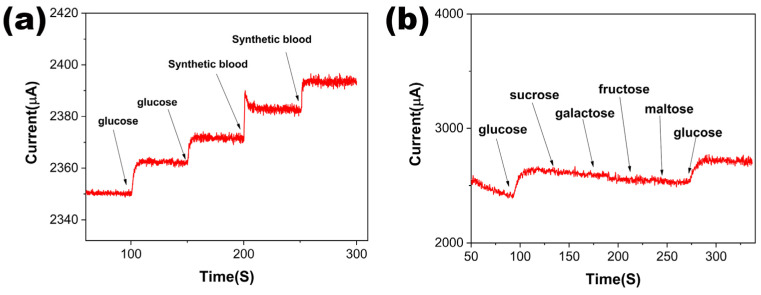
Designing and fabricating a highly sensitive non-enzymatic glucose sensor is crucial for the early detection and management of diabetes. Meanwhile, the development of innovative electrode substrates has become a key focus for addressing the growing demand for constructing flexible sensors. Here, a simple one-step laser engraving method is applied for preparing laser-induced graphene (LIG) on polyimide (PI) film, which serves as the sensor substrate. NiCo-layered double hydroxides (NiCo-LDH) are synthesized on LIG as a precursor, utilizing the zeolitic imidazolate framework (ZIF-67), and then reacted with Ni(NO3)2 via solvent-thermal methods. The sensitivity of the non-enzymatic electrochemical glucose sensor is significantly improved by employing NiCo-LDH/LIG as the sensing material. The porous and interconnected structure of NiCo-LDH, derived from ZIF-67, enhances the accessibility of electrochemically active sites, while the incorporation of LIG ensures exceptional conductivity. The combination of NiCo-LDH with LIG enables efficient electron transport, leading to an increased electrochemically active surface area and enhanced catalytic efficiency. The fabricated electrode achieves a low glucose detection limit of 0.437 μM and demonstrates a high sensitivity of 1141.2 and 631.1 μA mM-2 cm-2 within the linear ranges of 0-770 μM and 770-1970 μM, respectively. Furthermore, the NiCo-LDH/LIG glucose sensor demonstrates superior reliability and little impact from other substances. A flexible integrated LIG-based non-enzymatic glucose sensor has been developed, demonstrating high sensitivity and suggesting a promising application for LIG-based chemical sensors.
Keywords: NiCo-LDH; ZIF-67; flexible; glucose sensor; laser-induced graphene.
Conflict of interest statement
The authors declare no conflicts of interest.
Figures




References
-
- Xiong L.-Y., Kim Y.-J., Seo W.-C., Lee H.-K., Yang W.-C., Xie W.-F. High-performance non-enzymatic glucose sensor based on Co3O4/rGO nanohybrid. Rare Met. 2023;42:3046–3053. doi: 10.1007/s12598-023-02318-9. - DOI
-
- Zhang H., Hua S.F., Zhang L. Co-immobilization of cellulase and glucose oxidase on graphene oxide by covalent bonds: A biocatalytic system for one-pot conversion of gluconic acid from carboxymethyl cellulose. J. Chem. Technol. Biotechnol. 2020;95:1116–1125. doi: 10.1002/jctb.6296. - DOI
-
- Kim K.M., Nguyen P.T., Kim J., Song S.H., Park J.W., Kim M.I. Chemiluminescence Immunoassay for Sensitive Detection of C-reactive Protein Using Graphene Oxide–Gold Nanoparticle–Luminol Hybrids as Enhanced Luminogenic Molecules. Chemosensors. 2024;12:193. doi: 10.3390/chemosensors12090193. - DOI
-
- Rabchinskii M.K., Besedina N.A., Brzhezinskaya M., Stolyarova D.Y., Ryzhkov S.A., Saveliev S.D., Antonov G.A., Baidakova M.V., Pavlov S.I., Kirilenko D.A., et al. Graphene Amination towards Its Grafting by Antibodies for Biosensing Applications. Nanomaterials. 2023;13:1730. doi: 10.3390/nano13111730. - DOI - PMC - PubMed
MeSH terms
Substances
Grants and funding
LinkOut - more resources
Full Text Sources
Research Materials
Miscellaneous
