


Mechanocaloric Effects Characterization of Low-Crystalline Thermoplastic Polyurethanes Fiber
- PMID: 39684104
- PMCID: PMC11644121
- DOI: 10.3390/polym16233360
Mechanocaloric Effects Characterization of Low-Crystalline Thermoplastic Polyurethanes Fiber
Abstract
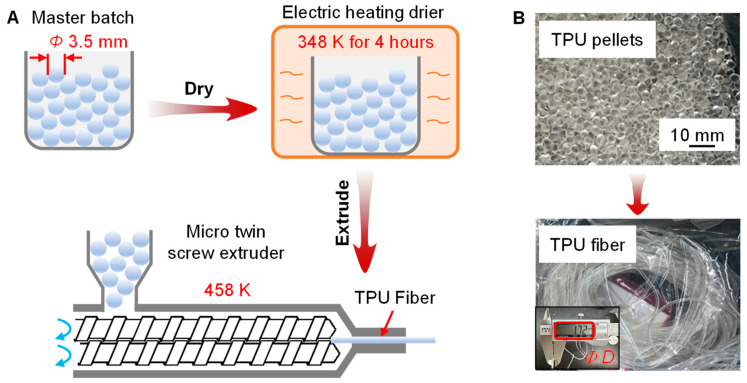
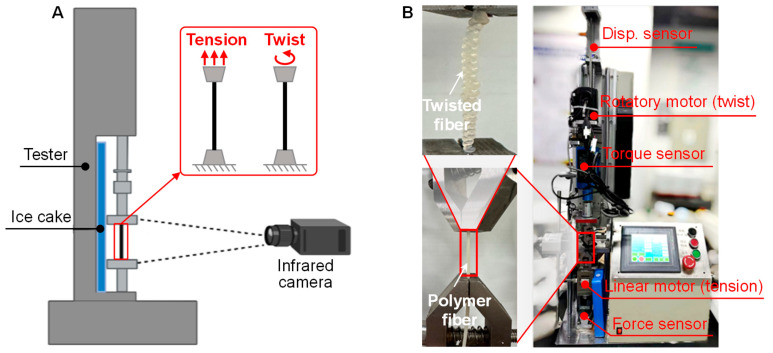
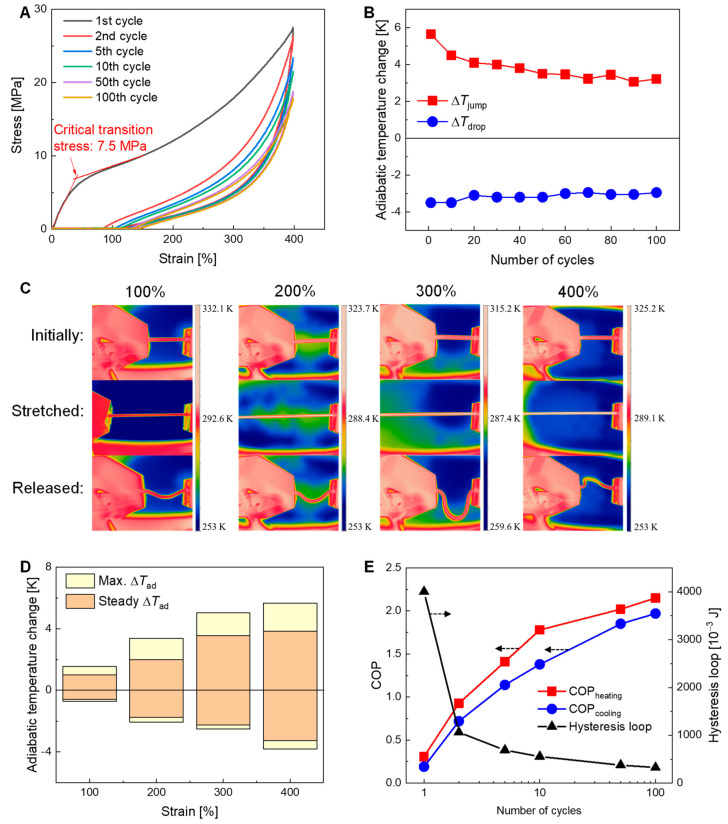
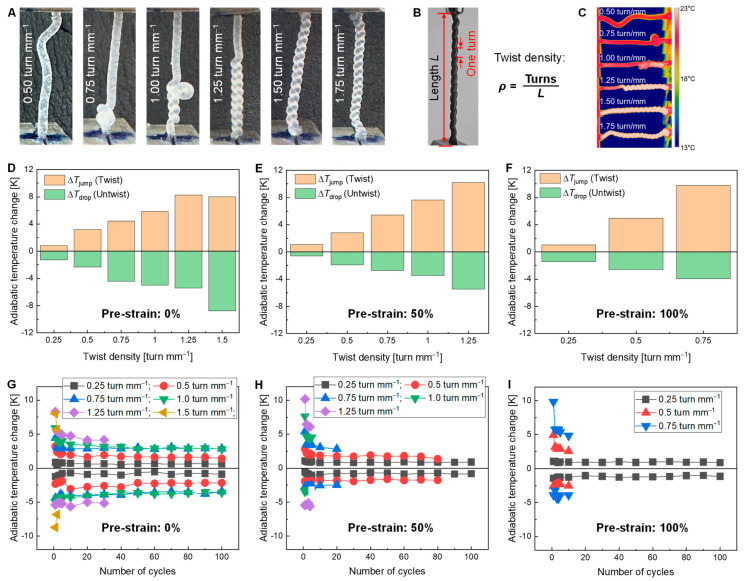
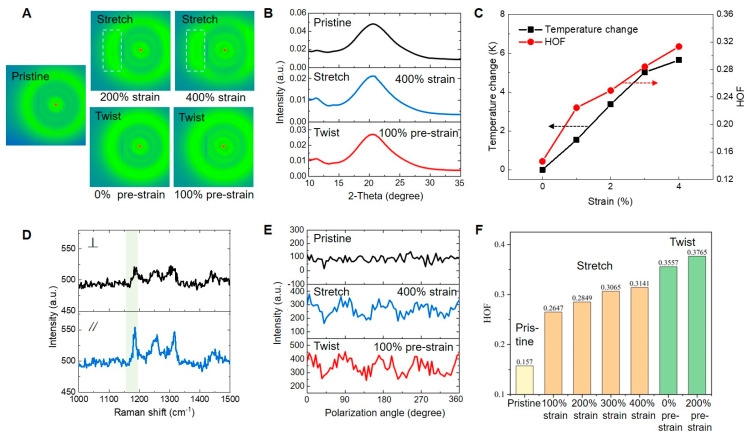
Mechanocaloric cooling/heat pumping with zero carbon emission and high efficiency shows great potential for replacing traditional refrigeration with vapor compression. Mechanocaloric prototypes that are developed using shape memory alloys (SMAs) face the problems of a large driving force and high cost. In this work, we report a low-crystalline thermoplastic polyetherurethane (TPU) elastomer fiber with a low actuation force and good mechanocaloric performance. We fabricate the TPU fiber and develop a multifunctional mechanical tester to measure both the elastocaloric and twistocaloric effects. In the experiments, the applied stress required to induce mechanocaloric effects of the TPU fiber is only 10~30 MPa, which is much lower than that of widely used NiTi elastocaloric SMAs (600~1200 MPa). The TPU fiber produces a maximum twistocaloric adiabatic temperature change of 10.2 K, which is 78.9% larger than its elastocaloric effect of 5.7 K. The wide-angle X-ray scattering (WAXS) results show that the strain-induced amorphous chain alignment and associated configurational entropy change are the main causes of the good mechanocaloric effects of the TPU fiber, rather than the strain-induced crystallization. This work demonstrates the potential of achieving low-force heat-efficient mechanocaloric cooling using thermoplastic elastomer fibers.
Keywords: elastocaloric; mechanocaloric; solid-state cooling; thermoplastic elastomer; twistocaloric.
Conflict of interest statement
All the authors declare that there are no conflicts of interest.
Figures
References
-
- IEA The Future of Cooling. 2018. [(accessed on 15 May 2018)]. Available online: https://www.iea.org/reports/the-future-of-cooling.
-
- Abas N., Kalair A.R., Khan N., Haider A., Saleem Z., Saleem M.S. Natural and synthetic refrigerants, global warming: A review. Renew. Sustain. Energy Rev. 2018;90:557–569. doi: 10.1016/j.rser.2018.03.099. - DOI
-
- Ciconkov R. Refrigerants: There is still no vision for sustainable solutions. Int. J. Refrig. 2018;86:441–448. doi: 10.1016/j.ijrefrig.2017.12.006. - DOI
-
- Mañosa L., Planes A., Acet M. Advanced materials for solid-state refrigeration. J. Mater. Chem. A. 2013;1:4925–4936. doi: 10.1039/c3ta01289a. - DOI
LinkOut - more resources
Full Text Sources
