


Comparison of Fluid Flow Rates by Fluid Height and Catheter Size in Normal and Hypertensive Blood-Pressure Scenarios
- PMID: 39685067
- PMCID: PMC11641750
- DOI: 10.3390/healthcare12232445
Comparison of Fluid Flow Rates by Fluid Height and Catheter Size in Normal and Hypertensive Blood-Pressure Scenarios
Abstract
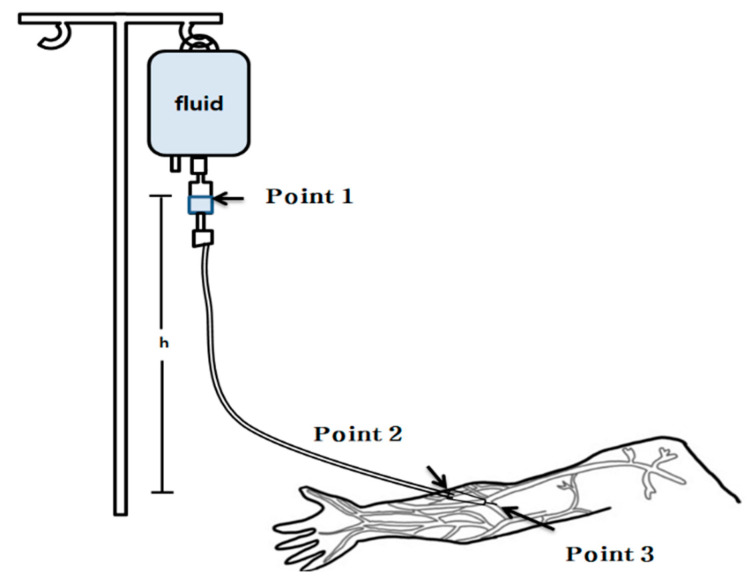
Objectives: This study is performed to determine the effects of fluid height, inner catheter diameter, and peripheral venous pressure on room-temperature intravenous fluid administration.
Methods: We employed the Bernoulli equation, with frictional forces considered for volumetric analysis.
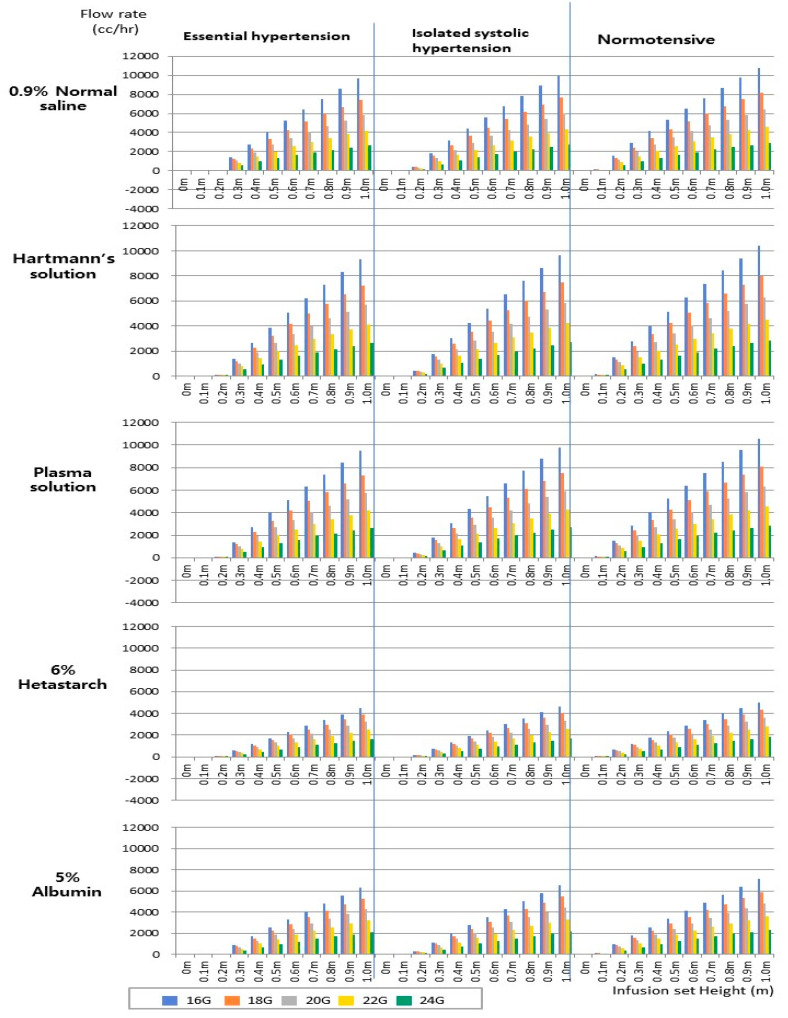
Results: The results of this study demonstrate that infusion-set height, catheter size, fluid type, and blood pressure significantly affect flow rates. Under normotensive conditions, flow rates ranged from 58.2 to 10,743.18 cc/h, with the highest rates observed at a 1 m infusion-set height and larger catheters. Additionally, 6% hetastarch exhibited the lowest flow rates, while 0.9% normal saline showed the highest. Under hypertensive conditions, slightly higher infusion-set elevations were required for measurable flow rates, but they remained lower than those under normotensive conditions.
Conclusion: This study investigates the mechanics of peripheral venous fluid therapy and provides foundational data for future nursing research on fluid management.
Keywords: flow rate; fluid dynamics; fluid therapy; infusion system; peripheral intravenous catheter.
Conflict of interest statement
The authors declare no conflicts of interest.
Figures
References
-
- Westbrook J.I., Duffield C., Li L., Creswick N.J. How much time do nurses have for patients? A longitudinal study quantifying hospital nurses’ patterns of task time distribution and interactions with health professionals. BMC Health Serv. Res. 2011;11:319. doi: 10.1186/1472-6963-11-319. - DOI - PMC - PubMed
-
- Kim J.I., Lee J., Chang O. Perceived importance and performance of intravenous fluid therapy by nurses in small-medium general hospitals. J. Korean Acad. Fundam. Nurs. 2013;20:372–380. doi: 10.7739/jkafn.2013.20.4.372. - DOI
LinkOut - more resources
Full Text Sources
