


Virtual Reality to Improve Sleep Quality in Patients Suffering from Painful Diabetic Polyneuropathy: A Proof of Concept Study
- PMID: 39685622
- PMCID: PMC11642838
- DOI: 10.3390/jcm13237163
Virtual Reality to Improve Sleep Quality in Patients Suffering from Painful Diabetic Polyneuropathy: A Proof of Concept Study
Abstract
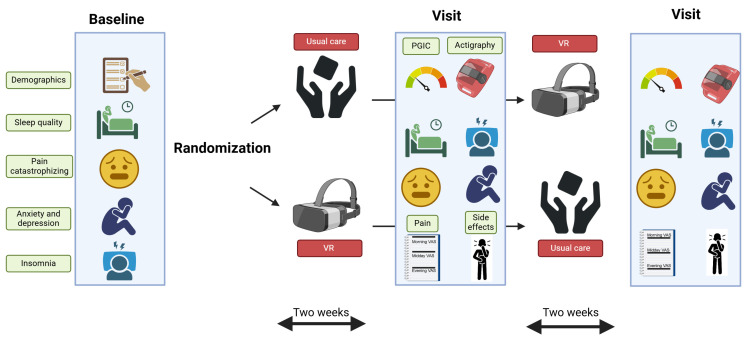
Background/Objectives: Sleep disturbance is often observed in the context of chronic pain. We hypothesize that, by providing an immersive Virtual Reality (VR) experience with a serious game to chronic pain patients an hour before bedtime, attention can be diverted from the pain condition, consequently leading to improved sleep quality. The aim is to evaluate the efficacy of VR compared to usual care in reducing the number of awakenings during the night and increasing sleep efficiency in patients suffering from painful diabetic polyneuropathy (PDPN). Methods: Eight patients with PDPN were randomized to either two weeks of VR or two weeks of usual care, followed by a cross-over. The primary outcome measurements were sleep efficiency and number of awakenings during the night. As secondary outcomes, self-reported sleep quality, insomnia, pain catastrophizing, anxiety, depression, pain intensity, side effects and impression of change were evaluated. Results: Data of seven patients were analysed. Actigraphy data, self-reported sleep quality, insomnia, pain catastrophizing, anxiety, depression and pain intensity scores did not differ between usual care and VR. As for impression of change, more patients improved after VR compared to usual care (V = 21, p = 0.03). Conclusions: A 2-week period of pain neuroscience education through VR did not result in increased sleep efficiency or fewer awakenings compared to usual care in patients with PDPN. These pilot results indicate that patients subjectively experience an improvement, yet this is not substantiated by either self-reported or objective measurements.
Keywords: behavioral therapy; biopsychosocial treatment; chronic pain; diabetes; immersive technologies; patient education.
Conflict of interest statement
Lisa Goudman is a postdoctoral research fellow funded by the Research Foundation Flanders (FWO), Belgium (project number 1211425N). Maarten Moens is funded by the Research Foundation Flanders (FWO), Belgium (project number 1801125N). Philippe Rigoard reports grants and consultant fees from Medtronic, Abbott and Boston Scientific, outside of the submitted work. Maarten Moens has received speaker fees from Medtronic. STIMULUS received independent research grants from Medtronic. There are no other conflicts of interest to declare.
Figures
References
-
- Tesfaye S., Boulton A.J.M., Dyck P.J., Freeman R., Horowitz M., Kempler P., Lauria G., Malik R.A., Spallone V., Vinik A., et al. Diabetic neuropathies: Update on definitions, diagnostic criteria, estimation of severity, and treatments. Diabetes Care. 2010;33:2285–2293. doi: 10.2337/dc10-1303. - DOI - PMC - PubMed
-
- Purdy K., Zochodne D.W. Chapter 19—Diabetes and the Nervous System. In: Aminoff M.J., Josephson S.A., editors. Aminoff’s Neurology and General Medicine. 6th ed. Academic Press; Boston, MA, USA: 2021. pp. 303–316. - DOI
-
- Truini A., Spallone V., Morganti R., Tamburin S., Zanette G., Schenone A., De Michelis C., Tugnoli V., Simioni V., Manganelli F., et al. A cross-sectional study investigating frequency and features of definitely diagnosed diabetic painful polyneuropathy. Pain. 2018;159:2658–2666. doi: 10.1097/j.pain.0000000000001378. - DOI - PubMed
-
- Gylfadottir S.S., Christensen D.H., Nicolaisen S.K., Andersen H., Callaghan B.C., Itani M., Khan K.S., Kristensen A.G., Nielsen J.S., Sindrup S.H., et al. Diabetic polyneuropathy and pain, prevalence, and patient characteristics: A cross-sectional questionnaire study of 5,514 patients with recently diagnosed type 2 diabetes. Pain. 2020;161:574–583. doi: 10.1097/j.pain.0000000000001744. - DOI - PMC - PubMed
Grants and funding
LinkOut - more resources
Full Text Sources
Research Materials
