


Palliative radiotherapy of soft tissue tumoral masses based on diagnostic instead of planning computed tomography scans
- PMID: 39687465
- PMCID: PMC11647240
- DOI: 10.1016/j.phro.2024.100682
Palliative radiotherapy of soft tissue tumoral masses based on diagnostic instead of planning computed tomography scans
Abstract
Background and purpose: Radiotherapy (RT) treatment planning is based on a planning computed tomography scan (pCT), while the decision to treat is often already established on a diagnostic CT scan (dCT). The objective of this study was to evaluate the usage of dCT for palliative radiation planning of soft tissue tumoral masses (STTMs), removing the need for a pCT scan and associated attendances.
Materials and methods: RT planning was performed retrospectively to 38 STTMs of 7 anatomical sites using volumetric modulated arc therapy techniques in dCT and transferred to pCT. The dose of clinical target volumes (CTV), D(95 %,50 %), were compared between the plans. The patient setup was assessed in cone-beam CT scans.
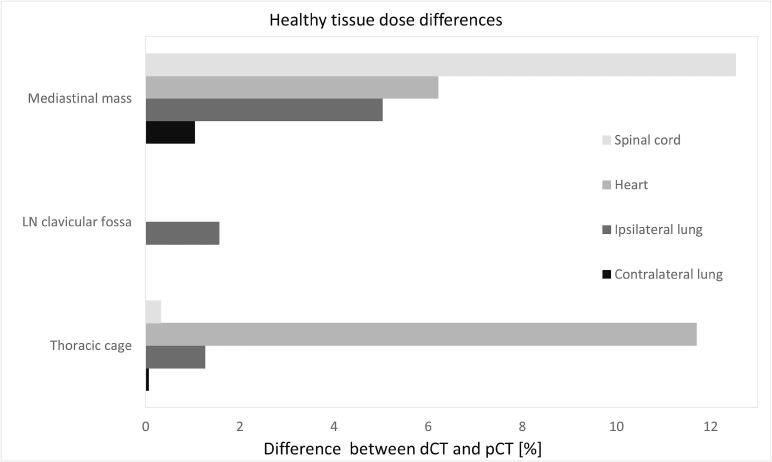
Results: The differences of D(95 %,50 %) between dCT and pCT plans were the lowest in the STTMs of the thoracic cage (0.9 %,0.9 %), STTMs in the inguinal area (0.8 %,1.3 %) and in mediastinal masses associated with superior vena cava syndrome (SVCS) (1.1 %,1.3 %), while the differences increased for other sites. The patient setup was acceptable for 88 % of mediastinal masses associated with SVCS and ≤ 60 % of cases in other sites comparing pCT and CBCT images with a strict margin of 6 mm, but all cases fitted to increased 2 cm margin.
Conclusions: This study demonstrated the possibility of using dCT scans for palliative RT planning of STTMs for mediastinal masses associated with SVCS and for STTMs in the thoracic cage and in the inguinal area, indicating the potential feasibility of this procedure for clinical use.
Keywords: Computer-assisted; Neoplasm metastasis; Palliative treatment; Radiotherapy planning; Radiotherapy setup errors.
© 2024 The Authors.
Conflict of interest statement
The authors declare that they have no known competing financial interests or personal relationships that could have appeared to influence the work reported in this paper.
Figures


References
-
- IAEA, International Atomic Energy Agency. Radiotherapy in Palliative Cancer Care: Development and Implementation. IAEA Human Health Reports No. 2, 2012. IAEA, Vienna.
-
- Wong S., Roderick S., Kejda A., Atyeo J., Grimberg K., Porter B., et al. Diagnostic Computed Tomography Enabled Planning for Palliative Radiation Therapy: Removing the Need for a Planning Computed Tomography Scan. Pract Radiat Oncol. 2021;11(2):e146–e153. doi: 10.1016/j.prro.2020.10.010. - DOI - PubMed
-
- Schuler T., Back M., Hruby G., Carroll S., Jayamanne D., Kneebone A., et al. Introducing Computed Tomography Simulation-Free and Electronic Patient-Reported Outcomes-Monitored Palliative Radiation Therapy into Routine Care: Clinical Outcomes and Implementation Experience. Adv Radiat Oncol. 2020;6(2) doi: 10.1016/j.adro.2020.100632. - DOI - PMC - PubMed
-
- Glober G., Kubli A., Kielbasa J., Chauhan B., Burch D., Holmes T., et al. Technical Report: Diagnostic Scan-Based Planning (DSBP), A Method to Improve the Speed and Safety of Radiation Therapy for the Treatment of Critically Ill Patients. Pract Radiat Oncol. 2020;10(5):e425–e431. doi: 10.1016/j.prro.2020.01.009. - DOI - PubMed
LinkOut - more resources
Full Text Sources
