


Phosphorus dynamics and sustainable agriculture: The role of microbial solubilization and innovations in nutrient management
- PMID: 39687549
- PMCID: PMC11647644
- DOI: 10.1016/j.crmicr.2024.100326
Phosphorus dynamics and sustainable agriculture: The role of microbial solubilization and innovations in nutrient management
Abstract
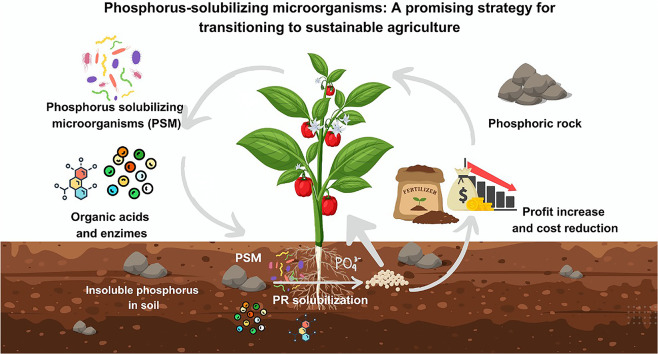
Phosphorus (P) is an essential element for plant growth, playing a crucial role in various metabolic processes. Despite its importance, phosphorus availability in soils is often restricted due to its tendency to form insoluble complexes, limiting plant uptake. The increasing demand for phosphorus in agriculture, combined with limited global reserves of phosphate rock, has created challenges for sustainable plant production. Additionally, the overuse of chemical phosphorus fertilizers has resulted in environmental degradation, such as eutrophication of water bodies. Increasing agronomic phosphorus (P) efficiency is crucial because of population growth and increased food demand. Hence, microorganisms involved in the P cycle are a promising biotechnological strategy that has gained global interest in recent decades. Microorganisms' solubilization of phosphate rock (PR) is an environmentally sustainable alternative to chemical processing for producing phosphate fertilizers. Phosphorus-solubilizing microorganisms (PSMs), including bacteria and fungi, and their enzymatic processes offer an eco-friendly and sustainable alternative to chemical inputs by converting insoluble phosphorus into forms readily available for plant uptake. Integrating PSMs into agricultural systems presents a promising strategy to reduce dependence on chemical fertilizers, enhance soil health, and contribute to the transition toward more sustainable and resilient agricultural practices. It can be an alternative that reduces the loss of phosphorus in the environment, especially the eutrophication of aquatic systems. This paper explores the challenges of phosphorus availability in agriculture and the potential of microbial phosphorus solubilization as a sustainable alternative to conventional practices.
Keywords: Phosphate rock; Phosphorus; Phosphorus-solubilizing microorganisms; Sustainable agriculture.
© 2024 The Author(s).
Conflict of interest statement
The authors declare that they have no known competing financial interests or personal relationships that could have appeared to influence the work reported in this paper.
Figures
References
-
- Asimov I. Doubleday; New York: 1974. Asimov On Chemistry.
-
- Barrera Galicia G.C. Supresión de la pudrición de la raíz del maíz (Fusarium spp.) mediada por las actividades metabólicas de Burkholderia sensu lato. (Tesis doctoral) CINVESTAV Unidad Irapuato. 2023
-
- Barrera-Galicia G.C., Peniche-Pavía H.A., Peña-Cabriales J.J., Covarrubias S.A., Vera-Núñez J.A., Délano-Frier J.P. Metabolic footprints of Burkholderia sensu lato rhizosphere bacteria active against maize Fusarium pathogens. Microorganisms. 2021;9(10):2061. doi: 10.3390/microorganisms9102061. - DOI - PMC - PubMed
-
- Bieleski R.L. Phosphate pools, phosphate transport, and phosphate availability. Annu. Rev. Plant Physiol. 1973;24:225–252.
LinkOut - more resources
Full Text Sources
Research Materials
