Review
. 2025 Jan:351:199514.
doi: 10.1016/j.virusres.2024.199514. Epub 2024 Dec 19.

Foot-and-mouth disease in Asia

Affiliations
Review

Foot-and-mouth disease in Asia

Md Abdur Rahman et al. Virus Res. 2025 Jan.

Abstract

Foot-and-mouth disease (FMD) is a highly contagious transboundary disease prevalent across the Asian continent, affecting both wild and domestic artiodactyls. The disease is caused by a virus belonging to the Aphthovirus genus of the Picornaviridae family which is categorized into seven serotypes: C, O, A, SAT1, SAT2, SAT3, and Asia1. The virus spreads through direct and indirect contact, including semen, meat, fomites, ingestion, and aerosols. FMD has a severe economic impact due to the high morbidity and mortality, especially in young animals. Prevention of the disease relies on vaccination with the prevalent serotype(s) or the slaughter and destruction of affected animals. This review discusses the prevalence of various FMD virus (FMDV) serotypes across Asia, along with the transmission modes, pathogenesis, immune response, and immune suppression by FMDV. Additionally, the review explores FMD diagnosis, prevention, and control strategies, and highlights future opportunities for research aimed at developing strain-specific viral and bacterial combined vaccines.

Keywords: Combined vaccine; Concurrent infections; Diagnosis; FMD; Immune suppression; Serotypes.


Conflict of interest statement

Declaration of competing interest We affirm that we have no financial or other conflicts of interest.

Figures

Fig. 1:
Fig. 1
Structure of FMDV and genomic organization. The complete virion of FMDV is 146S that consists of 12 pentamers (12S) and each pentamer is made up with 5 propolymers (5S). The genome is organized with 5UTR (consisting S-fragment, poly C, Pseudoknots, CRE, IRES), ORF (consisting of structural protein VP1, VP2, VP3, VP4 and non-structural protein Lpro, 2A, 2B, 2C, 3A, 3B, 3Cpro and 3Dpol) and 3UTR. Empty capsid is 75S which confers defensive immunity to vaccinated animals.
Fig. 2:
Fig. 2
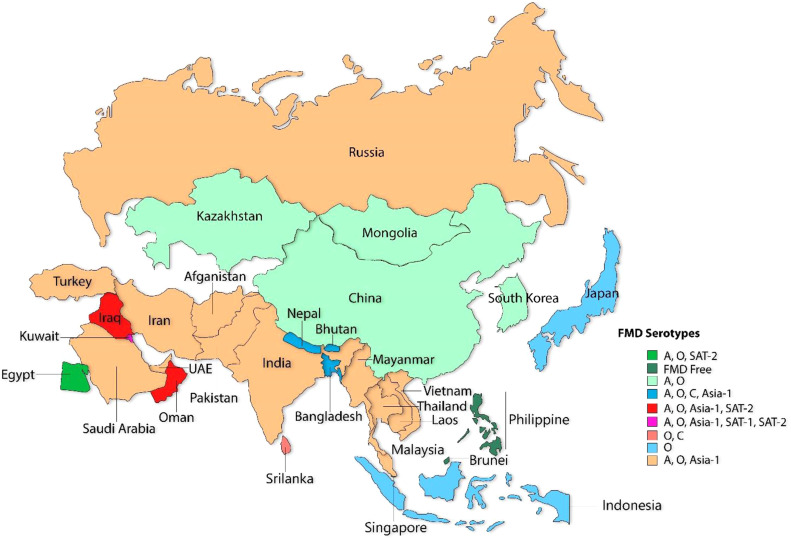
Geographical distribution of FMDV serotypes throughout ASIA. Brunei, Philippine and Singapore are FMD free. In other countries, the main serotypes are as shown in the key.
Fig. 3:
Fig. 3
Mode of FMDV transmission. Direct transmission via breath, indirect transmission through products of animal, Direct and indirect both transmission may occur by people, bird, vehicle, feed and equipment and semen.
Fig. 4:
Fig. 4
Replication of FMDV. The FMD virus binds to membrane receptors, entries via endocytosis and releases viral RNA genome into the cytoplasm of host cell. Through translation, positive sense genomic RNAs are converted to negative sense RNAs as mature viral proteins. Then encapsulation, cell lysis occurs and releases from that cell and infects neighboring cell.
Fig. 5:
Fig. 5
After infection, initiation of FMDV replication at pharyngeal epithelium and vastly in pneumocytes of the lung, travels to blood causing viremia, and then to different organs/tissues developing vesicles on tongue, feet, nasal cavities and udder with secondary bacterial complications; also myocarditis.

References

    1. Hirsh C.D., MacLauchlan N.J., Walner R.L. Vol. 2. Blackwell Science; Oxford UK: 2004. p. 341. (Veterinary Microbiology).
    1. Blacksell S.D., Siengsanan-Lamont J., Kamolsiripichaiporn S., Gleeson L.J., Windsor P.A. A history of FMD research and control programmes in Southeast Asia: lessons from the past informing the future. Epidemiology and Infection. 2019;147:e171. - PMC - PubMed
    1. Li P., Huang S., Zha J., Sun P., Li D., Bao H., et al. Evaluation of immunogenicity and cross-reactive responses of vaccines prepared from two chimeric serotype O foot-and-mouth disease viruses in pigs and cattle. Vet. Res. 2022;53:56. doi: 10.1186/s13567-022-01072-7. - DOI - PMC - PubMed
    1. Nampanya S., Khounsy S., Abila R., Young J.R., Bush R.D., Windsor P.A. (2016). Financial impacts of foot-and-mouth disease at village and national levels in Lao PDR Transboundary and Emerging Diseases. 63, e403–411. - PubMed
    1. Tuthill T.J., Groppelli E., Hogle J.M., Rowlands D.J. Springer; 2010. Picornaviruses. In: Cell entry By Non-Enveloped Viruses; pp. 43–89.

Publication types

MeSH terms

LinkOut - more resources